
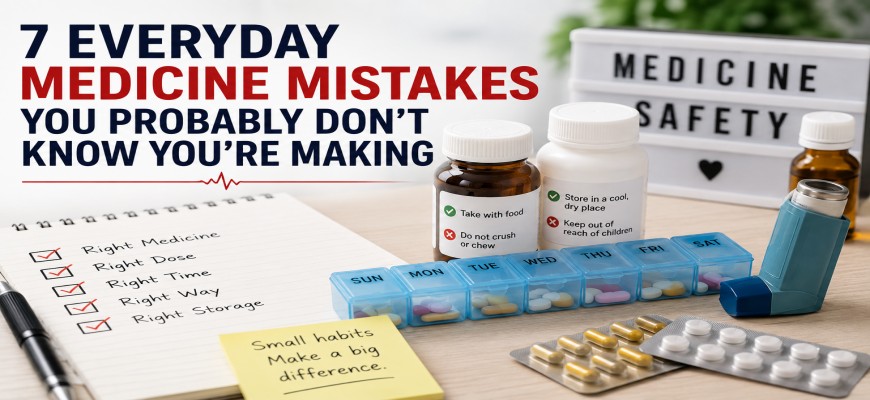
Picture a fairly ordinary Tuesday. You swallow your morning tablet with a glass of orange juice because that's what's in the fridge. Later, you split a leftover pill in half because the full one feels too strong. That evening, you take a cold and flu capsule on top of the pain reliever you took earlier, without really checking what's in either one. None of this feels careless. It feels like an average day.
That's exactly the point. Most medicine mistakes are not dramatic, and they rarely involve someone doing something obviously reckless. They happen quietly, inside routines that feel completely normal, because a habit seems harmless until you actually look at why the instructions exist in the first place.
This article walks through seven everyday medicine mistakes that are easy to overlook. Some may affect how well a medicine works. Others may matter more for certain medicines than others, or may not matter much at all depending on what you're taking. The goal here isn't to alarm you — it's to help you recognize a habit you might already have, and know when it's worth double-checking the label or asking a pharmacist.
Each one is explained in detail below, including why people tend to do it, what can happen, and what to do instead.
Why people do it: Water isn't always what's within reach. Coffee, juice, or milk are often just sitting on the table already, and swallowing a pill with whatever's nearby feels like a minor detail.
What can happen: Depending on the medicine, certain drinks can change how much of it your body actually absorbs, or how it's broken down.
Why it matters: Grapefruit and grapefruit juice are a well-documented example. The FDA notes that grapefruit juice can affect an enzyme the body uses to process certain medications, which can raise the amount of that medication in the bloodstream. This has been specifically documented with some statins, such as simvastatin and atorvastatin, some blood pressure medicines, and a few other drug classes — though not all statins are affected the same way. Separately, dairy products and calcium-fortified drinks can reduce the absorption of some antibiotics and thyroid medicine if taken too close together.
What to do instead: Unless your pharmacist tells you otherwise, plain water is the safest default for most oral medicines. If you regularly drink grapefruit juice, coffee, or milk around the time you take medicine, mention it to your pharmacist — they can tell you whether it matters for what you're taking.
When to ask a pharmacist or doctor: If you take a statin, a blood pressure medicine, an antibiotic, or thyroid medicine and regularly consume grapefruit products, dairy, or calcium-fortified drinks around dosing time, it's worth asking specifically whether that combination applies to your prescription.
Why people do it: A spoon is already in the drawer, and a "teaspoon" sounds like a simple, standard amount.
What can happen: Household spoons vary widely in actual volume, so a "teaspoon" from one drawer can hold a noticeably different amount than a real 5 mL dose.
Why it matters: Research funded by the National Institutes of Health found that parents who thought of a child's dose in teaspoons or tablespoons were about twice as likely to make a dosing error compared to parents who measured in milliliters, and were far more likely to reach for a kitchen spoon instead of a proper measuring tool. Both the American Academy of Pediatrics and the FDA specifically advise against using household spoons for this reason, recommending an oral syringe, dosing cup, or calibrated dropper instead.
What to do instead: Always use the dosing device that comes with a liquid medicine. If it's lost, ask the pharmacy for a replacement rather than substituting a kitchen spoon. If a label only lists teaspoon or tablespoon amounts, ask the pharmacist to confirm the equivalent in milliliters.
When to ask a pharmacist or doctor: If you've lost the dosing device, if the label's units are unclear, or if you're ever unsure how much you actually gave, particularly for a child's medicine.
Why people do it: A tablet might feel hard to swallow, or splitting it in half seems like a simple way to get a smaller dose or stretch a prescription further.
What can happen: Some tablets and capsules are specifically designed to release their medicine slowly over several hours, or to resist breaking down until they reach a certain part of the digestive system. Altering them can release the medicine faster or in a different amount than intended.
Why it matters: Extended-release formulations (often labeled "ER," "XR," "CR," "SR," or "LA") and enteric-coated tablets are built around a specific release pattern. Crushing or splitting them can undo that design, which may change how much medicine reaches the bloodstream at once. Not every tablet has this issue — some are scored and genuinely meant to be split — but the appearance of a tablet doesn't tell you which category it's in.
What to do instead: Don't crush, split, or open a tablet or capsule unless you've confirmed it's designed to be taken that way. If swallowing pills is difficult, or cost is a concern, ask the pharmacist whether an alternative form exists, rather than altering the medicine yourself.
When to ask a pharmacist or doctor: Before splitting or crushing any medicine for the first time, especially if the name includes letters like ER, XR, CR, SR, or LA, or if the medicine is being given through a feeding tube.
Why people do it: Brand names don't always make it obvious what's actually inside a product. A cold and flu capsule and a separate pain reliever can both quietly contain the same ingredient without it being obvious at a glance.
What can happen: Taking two products with the same active ingredient can add up to more than the recommended daily amount, even if neither product alone seemed like "too much."
Why it matters: This is a widely recognized concern with acetaminophen in particular, since it appears in many combination cold, flu, and pain products under different brand names. The FDA and poison control organizations have long flagged unintentional acetaminophen overdose from combination products as a preventable risk. The same logic applies more broadly — any time two products are combined, checking the active ingredients list (not just the brand name) is what actually tells you whether there's overlap.
What to do instead: Before combining any two over-the-counter products, or an OTC product with a prescription medicine, check the "active ingredients" section on both labels. If you're not sure, ask a pharmacist to check for you before you combine them.
When to ask a pharmacist or doctor: Any time you're planning to take more than one product at once, especially cold, flu, sleep, or pain products, or if you're already taking a prescription medicine and considering adding an OTC product.
Why people do it: "Once a day" can feel flexible — morning one day, afternoon the next, depending on how the day goes.
What can happen: For some medicines, taking doses at very different times from day to day can lead to bigger gaps between doses on some days and shorter gaps on others, which may affect how steady the medicine's effect is.
Why it matters: This matters more for some medicines than others. Medicines that need a steady level in the body — such as certain treatments for seizures, some antibiotics, or thyroid medicine — tend to be more sensitive to inconsistent timing than medicines used occasionally for symptoms. Thyroid medicine in particular is also commonly instructed to be taken at a consistent time relative to food and other medicines, since that timing affects absorption.
What to do instead: Check whether your medicine's instructions specify a particular time of day or spacing from meals or other medicines. If they do, try to stay within a consistent window rather than treating the time as flexible. Pairing a dose with an existing daily habit can help keep the timing steady.
When to ask a pharmacist or doctor: If you're unsure whether your specific medicine's timing is flexible or strict, or if your daily schedule makes consistent timing genuinely difficult.
Why people do it: The bathroom cabinet is the traditional "medicine cabinet," and a car's glovebox or a sunny windowsill can simply be the most convenient spot.
What can happen: Heat, humidity, and direct light can cause some medicines to break down faster than their printed expiration date assumes, which may reduce how well they work.
Why it matters: Bathrooms tend to run warmer and more humid than most other rooms because of showers and baths, which is exactly the kind of environment that can degrade tablets, capsules, and especially temperature-sensitive medicines like insulin. Medicines left in a hot car can be exposed to temperatures well beyond what manufacturers test for stability.
What to do instead: Store most medicines in a cool, dry place away from direct light — a bedroom drawer or a kitchen cabinet away from the stove usually works better than a bathroom. Check the label for any specific storage instructions, such as refrigeration, and never leave medicine in a parked car for an extended period.
When to ask a pharmacist or doctor: If a temperature-sensitive medicine, such as insulin, has been exposed to extreme heat or cold, ask before using it — don't assume it's still effective just because it looks normal.
Why people do it: Herbal supplements are often marketed and perceived as gentler than prescription medicine, so it's easy to assume they're simply harmless additions to a daily routine.
What can happen: Herbal supplements can be biologically active in ways that affect how the body processes other medicines, even though they aren't required to carry the same interaction warnings as prescription drugs.
Why it matters: St. John's Wort is a commonly cited example — it can speed up how the body breaks down a number of medicines, including certain antidepressants and some hormonal birth control, which may reduce their effectiveness. Other supplements, such as high-dose fish oil or ginkgo biloba, are often discussed in relation to blood-thinning medicines because of their potential effect on bleeding risk. The details vary by supplement and by medicine, which is exactly why checking rather than assuming matters.
What to do instead: Treat herbal and dietary supplements as part of your medicine list, not separate from it. Mention every supplement you take to your pharmacist and prescriber, the same way you would a prescription medicine.
When to ask a pharmacist or doctor: Before starting any new herbal supplement while on a prescription medicine, particularly blood thinners, antidepressants, or hormonal medicines, and any time a medicine seems less effective after adding a supplement.
Looking at the list above, a pattern emerges: none of these mistakes involve doing something unusual. They involve doing something completely ordinary — reaching for the nearest drink, using the spoon already in the drawer, storing medicine where it's always been stored — without realizing that the specific medicine involved might care about that detail.
A few things tend to make these mistakes easy to miss in real life:
None of this means people are careless. It simply means medicine safety often comes down to noticing small, specific details rather than relying on general assumptions.
Use this quick checklist any time you start a new medicine, combine products, or aren't sure about a habit you already have:
It's worth reaching out to a pharmacist, doctor, or other qualified healthcare professional in situations such as:
Pharmacists in particular are a fast, accessible resource for exactly these kinds of everyday questions, and asking is a normal part of using medicine safely, not an overreaction.
It depends on the medicine. Some medicines have documented interactions with specific drinks, such as grapefruit juice or dairy, while others aren't affected either way. Checking the label or asking a pharmacist is the most reliable way to know for your specific medicine.
It can, depending on the type of tablet. Standard, scored tablets are often fine to split, but extended-release and enteric-coated formulations are specifically designed not to be altered. The safest approach is to check before splitting rather than assume.
Check the "active ingredients" panel on both product labels, not just the brand name on the front. If you're combining an OTC product with a prescription, or two OTC products, a pharmacist can quickly check for overlap.
For some medicines, yes, particularly those that rely on a steady level in the body or that have specific timing instructions relative to food. For others, some flexibility may be fine. Your medicine's specific instructions are the best guide.
Bathrooms tend to be warmer and more humid than other rooms because of showers and baths, and that environment can cause some medicines to degrade faster than they would in a cool, dry location.
Not automatically. Herbal supplements can be biologically active and may interact with certain prescription medicines. Treating supplements as part of your overall medicine list, and mentioning them to your pharmacist or prescriber, is the safest approach.
For most people, it's using the proper dosing device for liquid medicine instead of a kitchen spoon. It's a simple swap with a clear, well-documented benefit for dosing accuracy.
Medicine safety usually isn't about one dramatic decision — it's about a handful of small, everyday habits that quietly add up. Grabbing the nearest drink, reaching for a kitchen spoon, or assuming a supplement is harmless are all understandable choices in the moment. The goal isn't to second-guess every routine you have, but to know which details are actually worth checking, and to make checking the label or asking a pharmacist a normal part of how you use medicine, not a last resort.
If anything in this article made you think, "wait, I actually do that" — that's a completely normal reaction, and it's exactly the kind of small awareness that helps reduce avoidable medicine mistakes over time.
This article provides general educational information about common medicine-use habits. It is not personalized medical advice and does not replace the official patient information leaflet, prescription label, or guidance from a qualified healthcare professional for any specific medicine. Individual instructions can vary, and some of the examples in this article may not apply to every medicine or every person. Always refer to your medicine's official instructions and consult a pharmacist, prescriber, or other qualified healthcare professional with questions about your specific medicines.

 Fetroja (Cefiderocol) for Complicated UTIs: First Siderophore Cephalosporin and the Mortality Warning Every Patient Should Know (FDA Approved 2019)
Exblifep for Complicated UTIs: FDA Approval, Efficacy, & Usage Guide
Fetroja (Cefiderocol) for Complicated UTIs: First Siderophore Cephalosporin and the Mortality Warning Every Patient Should Know (FDA Approved 2019)
Exblifep for Complicated UTIs: FDA Approval, Efficacy, & Usage Guide
 Nuzyra (Omadacycline) for Pneumonia and Skin Infections: Modernized Tetracycline with IV-to-Oral Options (FDA Approved 2018)
 Zemdri (Plazomicin) for Complicated UTIs: Newer IV Aminoglycoside for Resistant Infections (FDA Approved 2018)