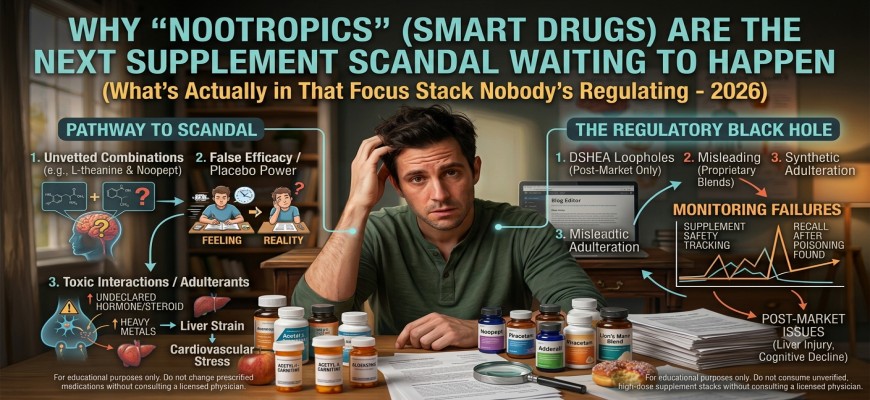
Why "Nootropics" (Smart Drugs) Are the Next Supplement Scandal Waiting to Happen — What's Actually in That Focus Stack Nobody's Regulating
A pharmacist's guide to the booming cognitive-enhancement industry, the unregulated compounds hiding inside "focus stacks," and why the next major supplement safety scandal is almost certainly brewing in this exact category.
The nootropics market — pills, powders, and drinks promising sharper focus, better memory, and a competitive edge at work or school — is projected to grow past eleven billion dollars by the end of the decade. It's marketed with the same clean, clinical aesthetic as any other wellness category: minimalist packaging, biohacker testimonials, phrases like "cognitive optimization" and "peak performance." It looks, in other words, exactly like the supplement categories that have already produced serious, documented harm.
That's not a coincidence, and it's not an accident of marketing. Nootropics sit in almost precisely the same regulatory blind spot as the weight-loss blends, pre-workouts, and "natural" enhancement products that have repeatedly ended up at the center of FDA warning letters and hospitalizations. The difference is that nootropics are newer, growing faster, and aimed at an audience — students, founders, remote workers chasing productivity — who are less likely to think of themselves as "supplement users" at all, and therefore less likely to ask the questions that might catch a problem before it reaches them. This guide breaks down exactly why this category is positioned to become the next major supplement scandal, what's actually inside many popular "stacks," and how to evaluate any nootropic before you take it.
The term "nootropic" was coined decades ago to describe substances that enhance memory and cognitive function without significant side effects or toxicity. In practice, the word has been stretched far beyond that original definition and now gets applied to an enormous range of substances with wildly different risk profiles — from a cup of green tea to compounds that are, in effect, unregulated stimulant drugs.
This definitional sprawl is exactly what makes the category so easy to market and so hard to evaluate as a consumer. A product can call itself a "nootropic" whether it contains a well-studied amino acid or an obscure synthetic compound with almost no long-term human safety data, and the label will look equally polished either way.
Nootropics inherit the same basic regulatory framework as every other dietary supplement in the United States — no pre-market approval, no mandatory safety testing, and enforcement that happens only after harm has already been documented. But several features specific to this category make it even more exposed than most:
Understanding nootropic risk starts with recognizing that the category actually contains three very different tiers of substance, all sold under the same friendly branding.
| Tier | Examples | Regulatory Status | General Risk Level |
|---|---|---|---|
| Tier 1: Everyday compounds | Caffeine, L-theanine, creatine | Widely available, reasonably well studied | Low at sensible doses |
| Tier 2: Herbal/botanical "cognitive" extracts | Bacopa monnieri, ginkgo biloba, rhodiola, lion's mane | Sold as supplements; limited but growing evidence base | Low-Moderate; interaction risk with certain medications |
| Tier 3: Synthetic/novel compounds and gray-market drugs | Racetams, phenibut, unlisted stimulants, tianeptine, unregulated peptide-like nootropics | Largely unregulated, some sold as "research chemicals," some are unapproved drugs | Moderate-Very High |
The problem is that marketing rarely distinguishes between these tiers. A "focus stack" product page will often list a Tier 1 ingredient like caffeine right next to a Tier 3 synthetic compound in the same friendly, lowercase ingredient list, with identical framing and identical reassurance — even though the actual risk profiles are worlds apart.
A number of specific ingredients show up repeatedly in nootropic products and deserve individual attention because their risk is disproportionate to how casually they're marketed.
Originally developed in the Soviet Union as an anti-anxiety medication, phenibut is sold in the U.S. as an unregulated "nootropic" for calm focus. It has a genuine and well-documented physical dependency risk with repeated use, and abrupt discontinuation after regular use can produce a severe withdrawal syndrome. It is not approved as a drug in the U.S. and carries essentially none of the dosing or monitoring safeguards a comparable prescription medication would.
Marketed in some unregulated products under nootropic or mood-support framing, tianeptine has drawn increasing public health attention — including FDA warnings — due to its potential for abuse, dependency, and dangerous overdose, particularly in high-dose gas-station and online "supplement" formulations that bear little resemblance to its original pharmaceutical use abroad.
This drug class has a long history of use in some countries as a prescription medication but is not FDA-approved as either a drug or a legally marketable dietary supplement in the U.S. Products containing racetams sold as "supplements" domestically exist in a genuine legal and regulatory gray zone, with inconsistent purity and dosing across sellers.
Some "focus" and "energy" nootropic blends have been found, through independent testing, to contain stimulant compounds beyond what's disclosed on the label — echoing the same adulteration pattern seen repeatedly in the weight-loss supplement category.
A newer wave of injectable or nasal-spray products marketed for cognitive enhancement sit even further outside any regulatory framework than oral supplements, frequently sold through the same loosely regulated channels associated with other unapproved peptide products.
Beyond the ingredients above, the nootropics world overlaps significantly with the off-label and non-prescribed use of actual prescription medications, obtained outside a legitimate doctor-patient relationship.
| Drug | Legitimate Medical Use | Nootropic-Culture Use | Key Risk |
|---|---|---|---|
| Modafinil / Armodafinil | Narcolepsy, shift-work sleep disorder | "Wakefulness" and focus enhancement, often sourced from overseas pharmacies without a prescription | Cardiovascular effects, serious skin reactions in rare cases, no medical supervision when self-sourced |
| Prescription stimulants (e.g., ADHD medications) | ADHD, narcolepsy | Off-label use for studying or work performance by people without ADHD, often obtained from peers | Cardiovascular strain, dependency potential, dangerous when combined with other stimulants in a stack |
| Low-dose naltrexone and other repurposed prescription drugs | Various approved medical uses | Marketed in some biohacker circles for cognitive or longevity benefits outside approved indications | Unsupervised use of a real pharmaceutical without proper monitoring |
Sourcing any of these outside a legitimate prescription removes every safeguard that normally exists around them — no dosing tailored to your health history, no interaction screening against your other medications, and no monitoring for side effects.
One of the least-discussed risks in nootropic marketing is dependency. Wellness branding implies these products are simply "supporting" your brain, but several popular compounds function pharmacologically as drugs the body can adapt to and come to depend on with regular use.
Weight-loss and detox supplements are typically used in short cycles. Nootropics, by contrast, are frequently marketed and used as a daily regimen — "take every morning before work" — which is exactly the usage pattern most likely to produce tolerance and physical dependency with compounds like phenibut or unregulated stimulant blends. Users often don't connect a rough patch of anxiety, insomnia, or irritability days after stopping a "harmless supplement" back to the product itself, because nothing on the label warned them dependency was even possible.
The word "stack" is central to nootropic culture — the idea of combining several compounds for a synergistic effect. This mirrors the same stacking pattern seen in dangerous weight-loss and pre-workout products, and it carries the same compounding math problem.
Each additional compound in a stack doesn't just add its own individual risk — it multiplies the number of possible interactions with everything else already in the stack, and with any prescription medications or caffeine intake layered on top. A five-ingredient stack already creates a meaningful number of two-way interaction possibilities; a ten-ingredient stack, common in some commercial "advanced" nootropic products, creates dramatically more — almost none of which has been formally studied in combination.
Nootropics have grown explosively for reasons that have less to do with the substances themselves and more to do with the culture surrounding them.
In competitive academic and professional environments, cognitive performance has increasingly become tied to personal identity and worth. A pill promising a mental edge taps directly into that anxiety, in a way that feels less like "self-medicating" and more like "optimizing" — a reframing that makes people far less cautious than they'd be with an equivalent-risk substance marketed honestly as a drug.
Influential tech and biohacking figures publicly discussing elaborate daily supplement stacks lend an air of rigor and self-experimentation to the category, even when the underlying evidence for many individual compounds is thin. Followers reasonably assume that someone successful and detail-oriented has already done the safety homework — often, they haven't.
Because these products are legally supplements rather than drugs, users apply a completely different mental risk category to them, even when the pharmacology inside the capsule is functionally similar to a controlled substance. This is the exact same psychological gap that has fueled harm in the weight-loss and sexual-enhancement supplement categories for years.
Consistent sleep, regular exercise, and stable blood sugar have a larger, better-evidenced impact on sustained cognitive performance than almost any supplement on the market — and carry essentially none of the risk.
If you want to experiment with a nootropic, well-studied basics like caffeine paired with L-theanine represent a reasonable, low-risk starting point rather than a stepping stone toward more exotic compounds.
Before taking anything with a name you don't recognize, look it up specifically for human safety data, dependency potential, and regulatory status — not just anecdotal forum reviews.
If you can't explain, in one sentence, exactly why each individual ingredient in a stack is in there and what evidence supports it, that's a sign to simplify rather than add more.
Pharmacists can flag interaction risks with prescription medications, including ADHD medications, antidepressants, and blood pressure medications, that nootropic marketing will never mention.
If a product has become something you feel you can't skip without discomfort, that's worth discussing with a healthcare provider rather than simply reordering the bottle.
No. Well-studied, everyday compounds like caffeine paired with L-theanine, or reasonably evidenced botanical extracts like bacopa monnieri, carry a fairly low risk profile for most healthy adults at sensible doses. The concern in this article is concentrated in the newer, synthetic, and gray-market corner of the category — compounds with real dependency, withdrawal, or overdose potential sold under the same reassuring branding as the low-risk options.
Regulatory attention tends to follow documented harm, and nootropics are a newer, faster-growing category than weight-loss supplements, meaning the adverse-event data trail is still accumulating. Enforcement action on specific high-risk nootropic ingredients has already begun in some cases, but broad category-wide oversight typically lags well behind consumer adoption — which is exactly the dynamic that has produced past supplement scandals in other categories.
That disclaimer is a significant red flag, not a technicality. It typically signals a seller attempting to sidestep supplement and drug regulation entirely for a product that is, in practice, being marketed and used for human ingestion — meaning there is essentially no regulatory oversight of its purity, dosing accuracy, or safety at all.
Yes, and this is one of the most commonly overlooked risks in the category. Nootropics containing stimulant-like compounds can interact with prescribed ADHD medications, certain antidepressants, and blood pressure medications, among others. Always disclose any nootropic use to your prescriber or pharmacist the same way you would disclose any other supplement.
It's one of the more reasonably evidenced combinations in the category, with research suggesting L-theanine may smooth out some of caffeine's jittery edge while supporting focused attention. It's a good example of a low-risk starting point precisely because both ingredients are well-studied and widely consumed outside the nootropic marketing context entirely.
Don't stop abruptly without guidance, particularly with compounds like phenibut that carry a documented withdrawal risk — abrupt discontinuation of dependency-forming substances can sometimes be more dangerous than continued use in the short term. Talk to a doctor about a supervised approach to tapering or stopping safely.
Format doesn't determine safety — the ingredients and their dosing do. A gummy or beverage can contain exactly the same higher-risk compounds as a capsule, sometimes with less precise dosing control, and the more approachable format can actually make people less cautious about checking the ingredient list.
The highest-risk pattern is reaching for an unfamiliar synthetic compound or a non-prescribed stimulant during an already high-stress period, which is exactly when the body is least able to absorb an unpredictable new variable. Prioritizing sleep, hydration, and consistent nutrition in the days before a big exam has a stronger evidence base than most novel nootropic products, and carries essentially no risk.
This article is for educational purposes only and does not constitute medical advice. It is not a complete list of every nootropic ingredient, risk, or interaction, and should not be used to diagnose or rule out any health condition. Do not start, stop, or change any supplement or medication regimen based on this article alone. Consult a licensed healthcare provider — ideally a pharmacist or physician familiar with your full medication list — before adding any new nootropic product, especially if you take prescription medications or have an existing health condition. If you experience any of the serious symptoms listed above, seek immediate medical attention. This content reflects general pharmacological understanding current as of September 2026; individual product risks change as new information and enforcement actions emerge.
 Xerava (Eravacycline) for Complicated Intra-Abdominal Infections: Fluorocycline Antibiotic Explained (FDA 2018)
Dalvance (Dalbavancin) for Skin Infections: Single-Dose and Two-Dose Options Explained (FDA 2014)
Xerava (Eravacycline) for Complicated Intra-Abdominal Infections: Fluorocycline Antibiotic Explained (FDA 2018)
Dalvance (Dalbavancin) for Skin Infections: Single-Dose and Two-Dose Options Explained (FDA 2014)
 Fetroja (Cefiderocol) for Complicated UTIs: First Siderophore Cephalosporin and the Mortality Warning Every Patient Should Know (FDA Approved 2019)
 Exblifep for Complicated UTIs: FDA Approval, Efficacy, & Usage Guide