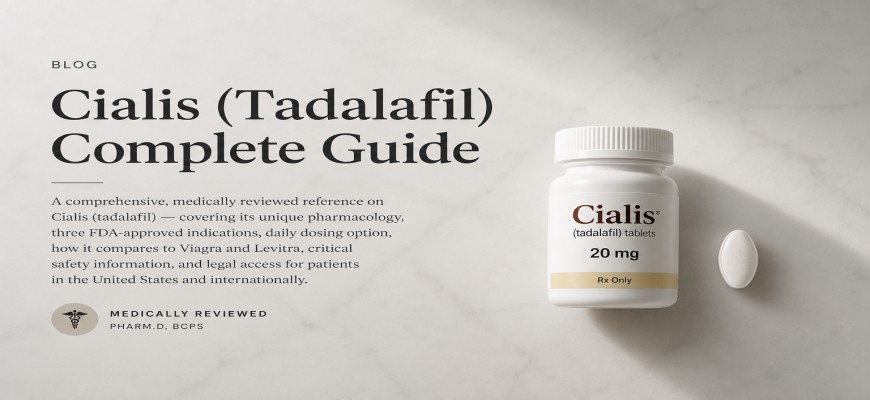
A comprehensive, medically reviewed reference on Cialis (tadalafil) — covering its unique pharmacology, three FDA-approved indications, daily dosing option, how it compares to Viagra and Levitra, critical safety information, and legal access for patients in the United States and internationally.
Medically reviewed by a Licensed Clinical Pharmacist | Last updated: June 2026 | References listed at end of article
| Generic Name | Tadalafil |
| Brand Names | Cialis (ED & BPH) · Adcirca (pulmonary arterial hypertension) · Alyq (PAH) |
| Drug Class | Phosphodiesterase type 5 (PDE5) inhibitor |
| FDA Approvals | 2003 (erectile dysfunction) · 2009 (benign prostatic hyperplasia) · 2011 (ED + BPH) · Adcirca: 2009 (PAH) |
| DEA Schedule | Not a controlled substance |
| Available Doses | 2.5 mg · 5 mg · 10 mg · 20 mg |
| On-Demand Dose (ED) | 10 mg taken 30 min–2 hr before sexual activity (range: 5–20 mg) |
| Daily Dose (ED / BPH) | 2.5–5 mg once daily, same time each day |
| Onset of Action | 30 minutes to 2 hours |
| Duration of Effect | Up to 36 hours — longest of all PDE5 inhibitors |
| Half-Life | ~17.5 hours — approximately 3× longer than sildenafil or vardenafil |
| Food Interaction | None significant — can be taken with or without food, including high-fat meals |
| Alcohol Interaction | Moderate caution — additive blood pressure lowering with heavy use |
| Critical Interaction | Nitrates — absolute contraindication. Fatal hypotension risk. |
| Generic Available | Yes — widely available in USA since 2018 |
Cialis is the brand name for tadalafil — a prescription oral medication and the most versatile of the four FDA-approved phosphodiesterase type 5 (PDE5) inhibitors. Developed by Eli Lilly and ICOS Corporation and approved by the U.S. Food and Drug Administration in November 2003, Cialis is prescribed for three distinct clinical indications: erectile dysfunction (ED), benign prostatic hyperplasia (BPH), and both conditions simultaneously — a dual indication that no other PDE5 inhibitor holds. Under the brand name Adcirca, tadalafil at a higher dose of 40 mg is also FDA-approved for the treatment of pulmonary arterial hypertension (PAH).
Within the ED treatment landscape, Cialis occupies a singular position: its half-life of approximately 17.5 hours is roughly three times longer than sildenafil (Viagra) or vardenafil (Levitra), producing a duration of effect of up to 36 hours — the longest of any PDE5 inhibitor and the clinical basis for its widely used descriptor, "the weekend pill." This extended therapeutic window fundamentally changes how patients relate to the medication, removing the rigid timing requirement that characterizes shorter-acting PDE5 inhibitors and allowing substantially more spontaneous sexual activity.
Cialis is also the only PDE5 inhibitor available in a once-daily low-dose formulation — 2.5 mg or 5 mg taken at the same time each day — which produces continuous background PDE5 inhibition and eliminates the need to plan sexual activity around a dosing window entirely. This once-daily option has transformed the pharmacological management of ED and BPH for patients who prefer treatment that integrates seamlessly into daily life rather than requiring conscious timing before intimacy.
Generic tadalafil entered the U.S. market in 2018, making this previously expensive branded medication significantly more accessible. Today, generic tadalafil is widely dispensed at a fraction of the original Cialis cost, and it is bioequivalent to the branded product in all pharmacokinetic parameters. Erectile dysfunction affects an estimated 30 million men in the United States and over 150 million globally — with prevalence rising sharply with age and with conditions including diabetes, hypertension, and cardiovascular disease. Cialis and its generic represent one of the most impactful pharmacological tools available for addressing this significant and undertreated burden of male health.
Tadalafil works through the same fundamental mechanism as all PDE5 inhibitors — selective inhibition of the phosphodiesterase type 5 enzyme — but its molecular structure, receptor binding kinetics, and pharmacokinetic profile are sufficiently distinct from sildenafil and vardenafil to produce meaningfully different clinical characteristics.
The physiology of erection begins with sexual stimulation triggering the release of nitric oxide (NO) in the corpus cavernosum — the paired erectile bodies of the penis. Nitric oxide activates guanylate cyclase, which catalyzes the conversion of guanosine triphosphate (GTP) to cyclic guanosine monophosphate (cGMP). Elevated cGMP causes relaxation of smooth muscle in penile arteries and the corpus cavernosum itself, allowing increased blood inflow and producing the vascular engorgement that constitutes an erection. PDE5 is the enzyme responsible for metabolizing and inactivating cGMP — terminating the erection. Tadalafil selectively inhibits PDE5, preventing cGMP degradation, sustaining smooth muscle relaxation and maintaining the conditions for erectile response in the presence of ongoing sexual stimulation.
The same PDE5-mediated cGMP pathway is present in prostatic and urethral smooth muscle — which explains tadalafil's efficacy in benign prostatic hyperplasia. By relaxing smooth muscle in the prostate, bladder neck, and proximal urethra, tadalafil reduces the urinary obstruction symptoms associated with BPH, including urinary urgency, frequency, weak stream, and incomplete bladder emptying. The dual ED-BPH indication reflects this shared mechanism operating across anatomically related structures.
Tadalafil's receptor binding demonstrates a degree of selectivity: it has approximately 10,000 times greater affinity for PDE5 than for PDE1, PDE2, PDE4, or PDE7. Its activity at PDE6 — the retinal photoreceptor enzyme implicated in sildenafil's visual disturbances — is lower than sildenafil's, contributing to the very low incidence of visual side effects with tadalafil. Uniquely, tadalafil does inhibit PDE11 — an enzyme found in skeletal muscle and the testes — which is believed to underlie the back pain and myalgia that are more characteristic of tadalafil than other PDE5 inhibitors.
After oral administration, tadalafil is absorbed and reaches peak plasma concentrations within 2 hours — somewhat slower than sildenafil or vardenafil, but with a half-life of approximately 17.5 hours that sustains clinically relevant plasma concentrations for up to 36 hours. Food, including high-fat meals, does not meaningfully affect tadalafil's absorption — a significant practical advantage for patients, removing the dietary restriction that complicates the use of sildenafil and vardenafil.
No other FDA-approved oral ED treatment approaches the 36-hour therapeutic window that tadalafil's extended half-life provides. In practical clinical terms, this means a single on-demand dose taken on a Friday evening remains pharmacologically effective through the weekend, allowing multiple opportunities for sexual activity without re-dosing. This is not a claim that an erection is maintained for 36 hours — it describes the period during which sexual stimulation is most likely to produce a reliable erectile response. The medication requires stimulation for each episode of sexual activity within the window, exactly as with shorter-acting agents.
Cialis is the only PDE5 inhibitor with an FDA-approved once-daily dosing regimen — 2.5 mg or 5 mg taken at the same time each day, regardless of planned sexual activity. Daily dosing produces steady-state tadalafil plasma concentrations within five days of initiation, providing continuous background PDE5 inhibition that allows sexual activity at any time without advance planning. For men in committed relationships who have regular sexual activity, this regimen is often preferred over on-demand dosing as it eliminates the clinical and psychological dimension of timing medication to intimacy — medication use becomes invisible in day-to-day life.
Unlike sildenafil and vardenafil, whose absorption is significantly delayed by high-fat meals — reducing peak concentrations and extending the time to onset unpredictably — tadalafil's absorption is essentially unaffected by food or alcohol intake. A patient can take tadalafil with a full meal, including a high-fat dinner, without meaningfully altering the medication's pharmacokinetics. This removes a common source of inconsistent response that affects shorter-acting PDE5 inhibitors.
Cialis is the only PDE5 inhibitor FDA-approved for three distinct clinical indications: erectile dysfunction alone, benign prostatic hyperplasia alone, and both conditions simultaneously. For the substantial proportion of men — estimated at 30–50% of men over 50 — who have concurrent ED and BPH, a single daily tadalafil dose addresses both conditions simultaneously. This simplifies treatment, reduces the medication burden, and may improve adherence compared to managing the two conditions with separate drug classes.
| Feature | Cialis (Tadalafil) | Viagra (Sildenafil) | Levitra (Vardenafil) | Stendra (Avanafil) |
|---|---|---|---|---|
| FDA Approval | 2003 | 1998 | 2003 | 2012 |
| Standard On-Demand Dose | 10 mg | 50 mg | 10 mg | 100 mg |
| Dose Range | 2.5–20 mg | 25–100 mg | 2.5–20 mg | 50–200 mg |
| Daily Dosing Option | Yes — 2.5 or 5 mg/day | No | No | No |
| Onset of Action | 30 min–2 hr | 30–60 min | 25–60 min | 15–30 min |
| Duration of Effect | Up to 36 hours | 4–6 hours | 4–5 hours | Up to 6 hours |
| Half-Life | ~17.5 hours | 3–5 hours | 4–5 hours | 3–5 hours |
| High-Fat Meal Effect | None — can take anytime | Delays absorption | Delays absorption | Minimal effect |
| Visual Side Effects | Very low | Moderate (PDE6 activity) | Low | Very low |
| Back Pain / Myalgia | More common (PDE11) | Uncommon | Uncommon | Uncommon |
| BPH Indication | Yes — unique to tadalafil | No | No | No |
| PAH Indication | Yes (as Adcirca/Alyq) | Yes (as Revatio) | No | No |
| Generic Available | Yes (since 2018) | Yes (since 2017) | Yes (since 2018) | No (brand only) |
| Nitrate Contraindication | Absolute | Absolute | Absolute | Absolute |
The most clinically significant differentiators that favor tadalafil over other PDE5 inhibitors are its 36-hour duration, its daily dosing option, its lack of food interaction, and its triple-indication approval covering both ED and BPH. For patients who value spontaneity, prefer not to time medication, or have concurrent BPH requiring treatment, tadalafil has a compelling clinical advantage. For patients who prioritize the fastest possible onset — particularly those who have found the tadalafil 30-minute-to-2-hour onset window too variable — avanafil (Stendra), which can produce meaningful response in 15 minutes, may be preferable. The choice between agents remains individual and physician-guided.
Cialis is FDA-approved for the treatment of erectile dysfunction in adult men, defined as the consistent or recurrent inability to achieve or maintain an erection sufficient for satisfactory sexual performance. Clinical trial data supporting approval demonstrated significant improvements in the International Index of Erectile Function (IIEF) across the full spectrum of ED severity — mild, moderate, and severe — and across diverse patient populations including those with diabetes, hypertension, and post-radical prostatectomy status. In pivotal phase III trials, 81% of intercourse attempts were successful with tadalafil 20 mg compared to 35% with placebo — a clinically substantial and statistically significant difference that supported approval across all severity subgroups.
Benign prostatic hyperplasia (BPH) — the non-malignant enlargement of the prostate gland that occurs in most men as they age — produces a constellation of lower urinary tract symptoms (LUTS) including urinary urgency, increased frequency (particularly nocturia), weak or intermittent stream, difficulty initiating urination, and a sensation of incomplete bladder emptying. These symptoms affect an estimated 50% of men by age 60 and 90% by age 85, and represent a significant quality-of-life burden. Tadalafil 5 mg once daily is FDA-approved for BPH symptom management — the only PDE5 inhibitor with this approval. Clinical trials demonstrated significant improvements on the International Prostate Symptom Score (IPSS) and quality-of-life subscales compared to placebo, with a magnitude of effect comparable to alpha-blockers in mild-to-moderate BPH presentations.
The co-occurrence of ED and BPH in the same patient is exceedingly common — estimates suggest 30–50% of men over 50 with BPH have concurrent erectile dysfunction. Tadalafil 5 mg once daily is FDA-approved to treat both conditions simultaneously, providing symptomatic relief for BPH lower urinary tract symptoms while also maintaining erectile function. This dual benefit from a single daily tablet simplifies therapy, reduces medication burden, and may improve adherence relative to managing the two conditions with separate drug classes. Alpha-blockers — the conventional first-line BPH treatment — can be combined with tadalafil, though this requires careful physician management of the additive blood pressure-lowering effect.
At a substantially higher dose of 40 mg once daily, tadalafil is FDA-approved under the brand names Adcirca and Alyq for the treatment of pulmonary arterial hypertension (PAH) — a rare, progressive, and life-threatening condition characterized by elevated blood pressure in the pulmonary arteries supplying the lungs. In PAH, PDE5 inhibition dilates pulmonary vasculature, reducing the right ventricular pressure load and improving exercise capacity. The PHIRST trial — the pivotal phase III study — demonstrated significant improvements in 6-minute walk distance and time to clinical worsening with tadalafil 40 mg compared to placebo. This indication is managed exclusively by pulmonologist and cardiology specialists; it is not relevant to the standard ED and BPH prescribing context and is mentioned here for completeness.
Cialis is available in four tablet strengths — 2.5 mg, 5 mg, 10 mg, and 20 mg — and is the only PDE5 inhibitor offering two fundamentally different dosing strategies: on-demand dosing before anticipated sexual activity, and once-daily continuous dosing. Selecting the appropriate strategy is a physician-guided decision based on frequency of sexual activity, patient preference, concurrent BPH status, and other clinical variables.
| ED — On-Demand, Standard Adult | 10 mg taken at least 30 minutes before anticipated sexual activity. May be increased to 20 mg or decreased to 5 mg based on individual efficacy and tolerability. Maximum: one 20 mg dose per 24-hour period. Effect lasts up to 36 hours from a single dose. |
| ED — Once-Daily Continuous Dosing | 2.5 mg once daily, taken at the same time each day without regard to timing of sexual activity. May be increased to 5 mg based on response and tolerability. Steady-state plasma concentration reached within 5 days. Allows spontaneous sexual activity at any point once steady state is established. |
| BPH — Once Daily | 5 mg once daily, taken at the same time each day. Not for on-demand use. Symptom improvement typically becomes evident within 1–4 weeks of daily use. |
| ED + BPH — Once Daily | 5 mg once daily. Addresses both conditions simultaneously. Maximum 5 mg/day for this combined indication. |
| Elderly Patients (65+) | No automatic dose adjustment required based on age alone. However, elderly patients have approximately 25% higher tadalafil plasma exposure. Begin on-demand use at 5 mg; consider 2.5 mg daily for the daily regimen. Titrate based on response and tolerability. |
| Mild–Moderate Hepatic Impairment | On-demand: start at 10 mg; do not exceed 10 mg per dose. Daily dosing: exercise caution; not recommended in moderate hepatic impairment (Child-Pugh B). Not recommended at all in severe hepatic impairment (Child-Pugh C). |
| Renal Impairment (CrCl 30–50 mL/min) | On-demand: start at 5 mg; maximum 10 mg per dose, no more frequently than once every 48 hours. Daily dosing: start at 2.5 mg; maximum 5 mg once daily. |
| Severe Renal Impairment (CrCl <30 mL/min) | On-demand: maximum 5 mg per dose. Daily dosing: not recommended. Close monitoring required. |
| Patients on Alpha-Blockers | On-demand: start at 5 mg. Daily dosing: initiate at 2.5 mg. Allow adequate blood pressure stabilization before dose escalation. Additive hypotensive effect requires cautious initiation. |
| Patients on Strong CYP3A4 Inhibitors | Maximum 10 mg per 72 hours for on-demand use. Daily dosing not recommended with strong inhibitors. Includes ritonavir, atazanavir, ketoconazole 400 mg, itraconazole 400 mg. |
| PAH (Adcirca / Alyq) | 40 mg once daily. Not used for ED at this dose. Specialist management only. |
The choice between on-demand and daily Cialis is not purely pharmacological — it reflects lifestyle, frequency of sexual activity, partner dynamics, and the psychological preference for or against timing medication. Patients who have sexual activity two or more times per week often prefer the daily regimen for its spontaneity and elimination of the dosing-to-activity window. Patients who have sexual activity less frequently typically find on-demand dosing more practical and cost-effective. Both strategies are clinically equivalent in efficacy at their respective doses. Discuss both options with your prescribing physician.
For on-demand use, Cialis should be taken at least 30 minutes before anticipated sexual activity, though the medication may require up to 2 hours to reach peak plasma concentrations in some patients. Unlike Viagra and Levitra, Cialis can be taken with or without food — including a full high-fat meal — without meaningful impact on absorption rate or peak concentration. This removes the dietary planning requirement that complicates timing with shorter-acting PDE5 inhibitors.
For daily use, Cialis should be taken at the same time each day, irrespective of planned sexual activity. Consistency of timing is important for maintaining stable steady-state plasma concentrations. If a daily dose is missed, it should be taken as soon as remembered — unless it is nearly time for the next scheduled dose, in which case the missed dose should be skipped and the regular schedule resumed. Two doses should never be taken within 24 hours.
Tablets should be swallowed whole with water. They may be cut in half for dose adjustment if the tablet is scored, but should not be crushed or chewed. Grapefruit and grapefruit juice should be avoided, as grapefruit inhibits intestinal CYP3A4 and can significantly increase tadalafil plasma concentrations, amplifying both effects and adverse effects unpredictably.
Sexual stimulation is required for tadalafil to produce an erection. The medication enhances the physiological response to stimulation; it does not generate desire, arousal, or spontaneous erections independently. Patients who expect the medication to function without sexual stimulation will experience apparent treatment failure that does not represent true pharmacological non-response.
Cialis's side effect profile reflects its PDE5 inhibitory mechanism — vasodilatory effects at sites beyond the corpus cavernosum — as well as its unique PDE11 inhibition in skeletal muscle. At standard doses, adverse effects are generally mild to moderate and resolve without intervention. The most relevant difference between tadalafil's profile and those of sildenafil and vardenafil is the higher incidence of back pain and myalgia, and the virtually absent incidence of visual disturbances.
Headache is the most commonly reported adverse effect, occurring in approximately 11–15% of patients on on-demand doses and slightly less frequently on the daily low dose. It reflects cerebral vasodilation secondary to PDE5 inhibition and typically responds to standard analgesics. Dyspepsia (indigestion, heartburn, or upper abdominal discomfort) is reported in approximately 10% of patients and may be managed by ensuring the medication is not taken on an empty stomach, though this is not a pharmacokinetic requirement for tadalafil as it is for sildenafil.
Back pain and myalgia are characteristic features of tadalafil that distinguish it from other PDE5 inhibitors — reported in approximately 6% of patients on the 10 mg dose and up to 9% at 20 mg. These effects typically begin 12–24 hours after dosing, consistent with tadalafil's longer half-life, and resolve within 48 hours without treatment. They are believed to arise from tadalafil's activity at PDE11, which is present in skeletal muscle and cardiac tissue. In the majority of patients, back pain and myalgia are mild and do not lead to discontinuation, but they should be discussed with the prescribing physician if they are persistent or severe.
Nasal congestion affects approximately 4% of patients, and facial flushing — less prominent than with sildenafil — is reported in approximately 3–4%. Dizziness reflects mild systemic blood pressure lowering and is reported in approximately 2% of patients on standard doses. Visual disturbances — including the blue-green color tinge, photosensitivity, and blurred vision that characterize sildenafil — are exceedingly rare with tadalafil due to its lower activity at PDE6, the retinal phosphodiesterase subtype.
With daily low-dose tadalafil (2.5–5 mg), adverse effects are generally less frequent and less severe than with on-demand higher doses, and the side effect profile tends to diminish further after the initial weeks of treatment as tolerance to the vasodilatory effects develops.
The combination of Cialis with any nitrate medication in any form is absolutely contraindicated and potentially fatal. Nitrates and PDE5 inhibitors both lower blood pressure through nitric oxide pathways; their combination produces catastrophic, unpredictable, and potentially irreversible hypotension. This applies to all nitrate forms without exception: nitroglycerin tablets, sublingual spray, transdermal patches, long-acting oral nitrates (isosorbide mononitrate, isosorbide dinitrate), and recreational amyl or butyl nitrite ("poppers"). There is no dose or timing adjustment that makes this combination safe. If you use nitrates for any reason — including emergency nitroglycerin for chest pain — you cannot take Cialis. Inform every physician and emergency provider that you take tadalafil.
Rare cases of sudden, painless loss of vision in one or both eyes — a condition called non-arteritic anterior ischemic optic neuropathy (NAION) — have been reported in patients taking PDE5 inhibitors, including tadalafil. NAION results from reduced blood flow to the optic nerve and can result in permanent vision impairment. A direct causal relationship between tadalafil and NAION has not been definitively established; many affected patients had pre-existing risk factors including small optic disc anatomy, diabetes, hypertension, and cardiovascular disease. Nevertheless, the FDA requires this risk to be disclosed in labeling. Any sudden decrease or loss of vision in one or both eyes during or after taking Cialis requires immediate cessation of the medication and same-day emergency ophthalmological evaluation.
Cases of sudden decrease or loss of hearing, sometimes with accompanying tinnitus and dizziness, have been reported with all PDE5 inhibitors including tadalafil. The mechanism is not fully understood and a definitive causal link has not been established, but the FDA has required label updates to reflect this potential risk. Any sudden hearing change during or after Cialis use warrants immediate discontinuation of the medication and urgent medical evaluation.
Priapism — a prolonged, painful erection lasting more than four hours, unrelated to sexual stimulation — is a urological emergency. While rare with tadalafil at approved doses, cases have been documented. If untreated, priapism leads to ischemic damage to erectile tissue, fibrosis, and permanent erectile dysfunction. Risk is elevated in men with predisposing conditions including sickle cell disease, multiple myeloma, and leukemia. Any erection persisting beyond four hours requires emergency medical treatment regardless of the presence or absence of pain — delays in seeking care directly worsen outcomes.
Sexual activity imposes a cardiovascular demand comparable to moderate physical exercise. In patients with significant underlying cardiovascular disease, this physical stress — independent of tadalafil — can precipitate cardiac events. Tadalafil is contraindicated in men for whom sexual activity is medically inadvisable based on cardiovascular status. The Princeton Consensus Guidelines provide a structured framework for cardiovascular risk stratification before PDE5 inhibitor prescribing that represents standard clinical practice; all physicians prescribing tadalafil should apply this framework, particularly for men over 50 with multiple cardiovascular risk factors.
| Interaction | Mechanism | Clinical Consequence | Management |
|---|---|---|---|
| Nitrates (all forms) | Additive nitric oxide–cGMP pathway vasodilation | Severe, potentially fatal hypotension — the most dangerous PDE5 inhibitor interaction | Absolute contraindication without exception. Includes GTN tablets/spray, transdermal nitrates, isosorbide preparations, and recreational nitrites ("poppers"). |
| Alpha-blockers | Additive smooth muscle relaxation and blood pressure lowering | Symptomatic hypotension, dizziness, syncope. Risk highest within 4 hours of alpha-blocker dose. | Start tadalafil at 5 mg (on-demand) or 2.5 mg (daily). Allow hemodynamic stabilization on stable alpha-blocker dose before initiating. Tamsulosin 0.4 mg once daily generally tolerated with caution. |
| Strong CYP3A4 inhibitors | Reduced tadalafil first-pass metabolism ? markedly elevated plasma levels | Substantially elevated tadalafil exposure; risk of severe adverse effects and hypotension | On-demand: maximum 10 mg per 72 hours. Daily dosing: not recommended. Includes ritonavir, atazanavir, indinavir, ketoconazole 400 mg, itraconazole 400 mg. |
| Moderate CYP3A4 inhibitors | Partial CYP3A4 inhibition ? elevated tadalafil exposure | Approximately 2-fold increase in tadalafil AUC with erythromycin | Use with caution. Consider maximum 10 mg per dose with erythromycin, clarithromycin, fluconazole. Disclose to prescriber. |
| CYP3A4 inducers | Accelerated tadalafil metabolism ? reduced plasma concentrations | Reduced or absent therapeutic effect — apparent treatment failure | Rifampicin reduces tadalafil AUC by approximately 88%. Carbamazepine, phenytoin, St John's Wort similarly reduce exposure. Consider alternative treatment during induction therapy. |
| Other PDE5 inhibitors | Additive PDE5 inhibition and vasodilation | Amplified blood pressure lowering and adverse cardiovascular effects | Contraindicated. Do not combine tadalafil with sildenafil, vardenafil, or avanafil at any dose. |
| Antihypertensive agents | Additive blood pressure lowering | Enhanced hypotensive effect — dizziness, lightheadedness, syncope on standing | Disclose all antihypertensive medications before starting Cialis. Monitor blood pressure on initiation. Most stable, well-controlled hypertensive patients tolerate the combination with careful initiation. |
| Alcohol (heavy consumption) | Additive vasodilation and blood pressure lowering; alcohol also independently impairs erectile function | Enhanced flushing, orthostatic hypotension, dizziness; potential neutralization of erectile benefit | Moderate consumption (1–2 standard drinks) is generally acceptable. Heavy drinking on dosing days should be avoided. Cialis's 36-hour half-life means alcohol taken many hours after dosing may still interact. |
| Grapefruit / grapefruit juice | Intestinal CYP3A4 inhibition ? increased tadalafil absorption | Unpredictably elevated tadalafil plasma concentrations | Avoid grapefruit and grapefruit juice on days tadalafil is taken. Given tadalafil's 17.5-hour half-life, avoidance for the 24 hours following dosing is advisable. |
| Antacids (magnesium hydroxide/aluminum hydroxide) | Reduced rate of tadalafil absorption | Reduced peak concentration and delayed onset when taken simultaneously | Separate antacid and tadalafil administration by at least 2 hours where possible. |
If you experience chest pain, chest tightness, or any symptom that may indicate a cardiac event after taking Cialis, inform emergency medical personnel immediately and before accepting any medication that the nitrate contraindication applies to you. Emergency nitroglycerin given to a patient who has taken tadalafil within the preceding 48 hours can precipitate a fatal blood pressure drop. Always carry identification or a card indicating that you take a PDE5 inhibitor and cannot receive nitrates.
Nitrate therapy — any form: Absolute contraindication without exception, as described above. This includes long-acting and short-acting preparations, sublingual, oral, transdermal, and inhaled forms, and recreational nitrites.
Cardiovascular disease making sexual activity inadvisable: Including unstable angina, myocardial infarction within 90 days, stroke within 6 months, uncontrolled hypertension (systolic >170 mmHg), severe heart failure (NYHA Class III–IV), significant cardiac arrhythmias, and hypotension (systolic <90 mmHg). Formal cardiovascular risk stratification is required before prescribing tadalafil to any man with cardiovascular history.
Severe hepatic impairment (Child-Pugh C): Tadalafil is not recommended. Pharmacokinetics have not been adequately studied; impaired clearance produces unpredictably elevated and prolonged drug exposure.
Hereditary degenerative retinal disorders: Including retinitis pigmentosa. The safety of PDE5 inhibitors in patients with this condition is not established and caution is warranted.
Women: Cialis is not FDA-approved for use in women. Tadalafil has been studied in female sexual dysfunction but is not indicated for this use.
Pediatric patients: Not indicated in patients under 18 years of age for ED or BPH indications.
Known hypersensitivity: Contraindicated in patients with a prior hypersensitivity reaction to tadalafil or any component of the tablet formulation.
Concurrent use of other PDE5 inhibitors: Tadalafil should not be combined with sildenafil, vardenafil, avanafil, or any other PDE5 inhibitor, including the lower-dose sildenafil used for PAH (Revatio).
Always inform every healthcare provider that you take Cialis — including emergency physicians, cardiologists, and dentists. The nitrate contraindication is a medical emergency risk that requires all treating clinicians to be aware of your tadalafil use before prescribing any medication that may contain or trigger nitric oxide pathways.
Choose your dosing strategy with your physician — not based on cost or convenience alone. On-demand 10–20 mg dosing and daily 2.5–5 mg dosing each have clinical advantages for specific patients and activity patterns. If one strategy is not producing satisfactory results, the other strategy — or a dose adjustment within the same strategy — may be more appropriate before considering a medication change.
Give the medication adequate time. Tadalafil can take up to two hours to reach peak concentration in some patients — slower than most patients expect. On first use, plan the dosing window conservatively and allow sexual stimulation time to develop naturally rather than expecting an immediate response after swallowing the tablet.
Recognize back pain as a known effect. If back pain or muscle aching occurs 12–24 hours after a dose, this is a recognized and common tadalafil-specific effect related to PDE11 inhibition in skeletal muscle. It is not a sign of kidney damage or injury and typically resolves within 48 hours. Standard analgesics may help. If it is severe, persistent, or accompanied by other symptoms, contact your physician.
Limit alcohol on dosing days. While moderate intake is generally acceptable, heavy drinking should be avoided, particularly given tadalafil's 36-hour half-life — alcohol consumed many hours after the dose may still interact with the medication's ongoing vascular effects.
Store at room temperature (20–25°C / 68–77°F), away from moisture, heat, and light. Keep out of reach of children. As a prescription medication — though not a controlled substance — it should not be shared.
In the United States, Cialis and generic tadalafil are prescription medications available from any licensed pharmacy following a physician consultation. The availability of generic tadalafil since 2018 has dramatically reduced the cost barrier — generic formulations are bioequivalent to branded Cialis and are now available at significantly lower prices than the original brand. Telehealth platforms offering ED consultations with board-certified physicians have also expanded substantially, allowing many patients to complete an evaluation, receive a prescription, and have generic tadalafil delivered discreetly to their home without an in-person clinic visit.
For men with concurrent BPH and ED — a very common combination — a single prescription for daily tadalafil 5 mg addresses both conditions and may replace separate prescriptions for BPH management, simplifying both the medication regimen and the associated cost. Discussing this dual-indication option with a urologist or general practitioner is worthwhile for any man managing both conditions.
Internationally, tadalafil is a prescription medication in all major healthcare markets. The same standard for legitimate pharmacy sourcing applies universally: a mandatory prescription requirement, a verifiable pharmacy license, transparent pricing, and accountable dispensing records. The proliferation of online sources offering tadalafil without prescription represents a significant patient safety risk — counterfeit PDE5 inhibitor tablets are among the most commonly identified pharmaceutical counterfeits globally, with documented cases of adulteration with unlabeled sildenafil at variable doses, undisclosed active pharmaceutical ingredients, and entirely inactive formulations.
My Online Med Shop provides genuine, verified Cialis and generic tadalafil sourced exclusively from verified pharmaceutical manufacturers — with free home delivery, discreet packaging, secure encrypted checkout, and 24/7 customer support available for every order.
Cialis earned the "weekend pill" designation because a single dose taken on a Friday evening remains pharmacologically effective — with the capacity to support erectile response during sexual activity — throughout the weekend, up to approximately 36 hours from the time of dosing. This 36-hour window is three to six times longer than that of Viagra, Levitra, or Stendra, and is a direct function of tadalafil's exceptionally long half-life of approximately 17.5 hours. It is important to clarify that this does not describe a continuous erection — the medication supports erectile response to sexual stimulation at any point within the 36-hour window, not a sustained physical effect.
On-demand Cialis involves taking 10–20 mg approximately 30 minutes to 2 hours before anticipated sexual activity, with effect lasting up to 36 hours per dose. Daily Cialis involves taking 2.5 or 5 mg at the same time every day, producing continuous background PDE5 inhibition at steady-state plasma concentrations after 5 days — allowing sexual activity at any point without advance planning. On-demand dosing is typically preferred by men who have sexual activity less than twice a week, or those who prefer to use medication only when needed. Daily dosing is preferred by men who have sexual activity more frequently, who value complete spontaneity, or who also require BPH symptom management from the same tablet.
Yes — tadalafil 5 mg once daily is FDA-approved specifically for the treatment of benign prostatic hyperplasia (BPH) and its associated lower urinary tract symptoms, including urinary urgency, frequency, weak stream, and nocturia. It is the only PDE5 inhibitor with this approval. It is additionally approved to treat ED and BPH simultaneously in the same patient with a single daily 5 mg dose — a clinically significant advantage given how commonly these two conditions co-occur in men over 50.
Head-to-head comparative trials have not demonstrated a statistically significant difference in erectile function improvement between tadalafil and sildenafil at their respective standard doses. In patient preference studies — where men try both agents in crossover designs — a majority of patients who express a preference report preferring tadalafil, primarily citing the longer duration of action and elimination of the strict timing requirement. "Better" is inherently patient-specific: for men who prioritize speed of onset, avanafil may be preferable; for men who prioritize duration and spontaneity, tadalafil is generally favored; for men who want the most established drug with the longest clinical track record, sildenafil may be preferred. A physician can help identify which agent best matches an individual patient's clinical profile and lifestyle.
Tadalafil has a half-life of approximately 17.5 hours — meaning the drug concentration halves every 17.5 hours. At this rate, tadalafil is substantially cleared from the body within approximately 5 days (around 5 half-lives) of the last dose. The therapeutically meaningful window — the period during which plasma concentrations are sufficient to produce reliable erectile response to stimulation — is approximately 36 hours from a standard dose. This extended presence is clinically relevant to the nitrate contraindication: if emergency care is required within 48 hours of a tadalafil dose, emergency providers must be informed, as nitroglycerin administration during this window carries serious risk.
Yes — daily tadalafil at 2.5 or 5 mg is FDA-approved and supported by extensive clinical trial data for continuous daily use. Long-term daily dosing studies of up to 26 weeks have demonstrated maintained efficacy and a consistent safety profile without evidence of tachyphylaxis (loss of effect with continued use) or accumulating toxicity. Daily tadalafil is one of the most widely used and well-established daily pharmacological regimens in men's health medicine.
Apparent non-response to tadalafil on initial use is common and does not indicate definitive treatment failure. The most frequent explanations include insufficient time before sexual activity (less than 30 minutes), inadequate sexual stimulation, performance anxiety interfering with the natural arousal process, or a dose that is subtherapeutic for the individual. If 10 mg on-demand has been tried at least four to eight times under appropriate conditions without response, escalation to 20 mg — or a switch to the daily 5 mg regimen, which produces different pharmacokinetics — should be discussed with a physician. Patients who do not respond to tadalafil may respond well to sildenafil or vardenafil, as individual PDE5 receptor pharmacology can differ between agents.
Yes. Generic tadalafil is required by FDA bioequivalence standards to produce the same active ingredient concentrations in the bloodstream within the same pharmacokinetic parameters as branded Cialis. In clinical practice, generic tadalafil is therapeutically interchangeable with Cialis. Generic formulations have been available in the United States since 2018 and are manufactured by multiple licensed pharmaceutical companies under FDA oversight. The cost difference is substantial — generic tadalafil is typically available at a fraction of the branded Cialis price — making it the standard dispensed form in most U.S. pharmacy settings today.
For most men with well-controlled hypertension on stable antihypertensive therapy, tadalafil is used safely under physician supervision — typically initiating at the lower 5 mg on-demand dose to assess tolerability before considering 10 or 20 mg. Tadalafil independently lowers blood pressure as part of its mechanism, producing an additive effect when combined with antihypertensives. The most significant interaction concern is with alpha-blockers, which require a conservative 5 mg starting dose and careful clinical monitoring. Men on antihypertensive therapy should always disclose this to their prescribing physician and should not initiate tadalafil independently without medical review.
Moderate alcohol consumption — typically defined as up to two standard drinks — is generally considered acceptable alongside tadalafil. Both alcohol and tadalafil independently produce vasodilation and blood pressure lowering, so their combination can amplify flushing, dizziness, and orthostatic hypotension. Heavy alcohol intake should be avoided on days tadalafil is taken. An additional consideration unique to tadalafil among PDE5 inhibitors is its 36-hour half-life: alcohol consumed many hours after dosing may still interact with the ongoing pharmacological presence of the medication. Men on antihypertensive or cardiovascular medications face an amplified additive effect and should exercise additional caution.
Cialis (tadalafil) represents the most pharmacologically versatile and clinically flexible of the four FDA-approved PDE5 inhibitors. Its three FDA-approved indications — erectile dysfunction, benign prostatic hyperplasia, and both conditions simultaneously — its unique 36-hour duration of action, its once-daily continuous dosing option, and the absence of a food interaction collectively distinguish it from every other oral ED treatment available today. For the tens of millions of men who live with erectile dysfunction, BPH, or both, tadalafil offers a pharmacological solution that can be integrated into daily life with a degree of naturalness and spontaneity that shorter-acting agents cannot match.
The availability of generic tadalafil since 2018 has been transformative from an access standpoint — making a medication that was once among the most expensive oral treatments in routine men's health prescribing available at a cost that is manageable for the vast majority of patients, with or without insurance coverage. For the appropriate patient — particularly men with concurrent ED and BPH, men who have frequent sexual activity, or men who have found the timing requirements of shorter-acting agents disruptive — daily tadalafil at 5 mg represents one of the most practical and patient-centered pharmacological options in men's medicine.
As with all PDE5 inhibitors, the absolute nitrate contraindication remains the most critical safety consideration — one that requires every patient to actively inform all treating clinicians, including emergency providers, of their tadalafil use. Within the parameters of a valid prescription, appropriate medical evaluation, and verified pharmaceutical sourcing, Cialis and generic tadalafil have a well-established, extensively documented record as safe, effective, and well-tolerated treatments for erectile dysfunction and BPH across a broad and diverse patient population.
 Xerava (Eravacycline) for Complicated Intra-Abdominal Infections: Fluorocycline Antibiotic Explained (FDA 2018)
Dalvance (Dalbavancin) for Skin Infections: Single-Dose and Two-Dose Options Explained (FDA 2014)
Xerava (Eravacycline) for Complicated Intra-Abdominal Infections: Fluorocycline Antibiotic Explained (FDA 2018)
Dalvance (Dalbavancin) for Skin Infections: Single-Dose and Two-Dose Options Explained (FDA 2014)
 Fetroja (Cefiderocol) for Complicated UTIs: First Siderophore Cephalosporin and the Mortality Warning Every Patient Should Know (FDA Approved 2019)
 Exblifep for Complicated UTIs: FDA Approval, Efficacy, & Usage Guide