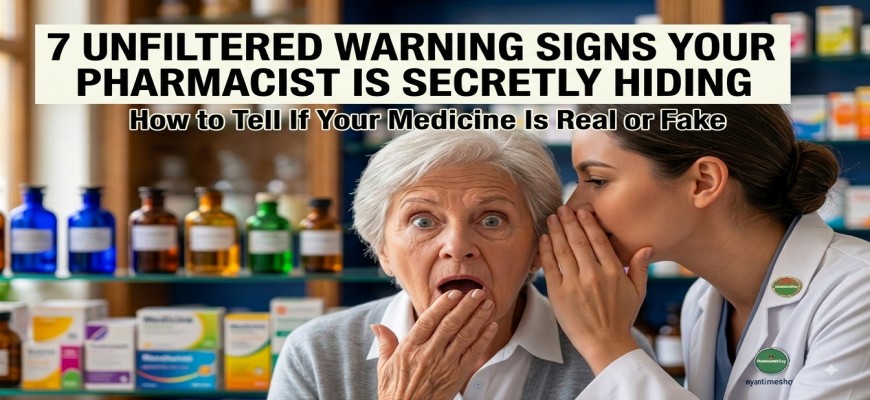
How to Tell If Your Medicine Is Real or Fake: 7 Warning Signs Your Pharmacist Never Mentions
Most people check the expiry date on a medicine bottle and stop there. But counterfeit medicine rarely announces itself with an obvious red flag — it hides in details most of us have never been trained to notice: a slightly duller imprint, a seal that peels a little too easily, a price that seemed like a lucky find.
A pharmacist doesn't catch a counterfeit by intuition. They catch it by running through a mental checklist — the same one, every time, without exception. This article walks through that checklist, in plain language, so you can run it yourself the next time something about a medicine feels slightly off.
Counterfeit medicine isn't a rare problem confined to back-alley markets. It shows up in online pharmacies with professional-looking websites, in supply chains that get quietly interrupted somewhere between manufacturer and shelf, and occasionally even in legitimate-looking packaging that has been tampered with after the fact. Fakes range from products with slightly incorrect doses to ones that contain no active ingredient at all — or, in the worst cases, an entirely different and potentially harmful substance.
The unsettling part is that a counterfeit is often designed to look convincing at a glance. That's exactly why a glance isn't enough, and why pharmacists are trained to slow down and look closer.
Genuine pharmaceutical packaging is produced to exacting, repeatable standards. Counterfeiters, even skilled ones, are almost always working from a copy of a copy — and small inconsistencies creep in.
Look for blurry or misaligned printing, text in a font that seems subtly different from a previous refill, a box seal that feels flimsy or was already broken, or a color that's slightly off from what you remember. None of these signs alone is proof of anything — printing runs do vary slightly between manufacturing batches — but two or three together are worth a phone call to your pharmacy.
Did you know? Many manufacturers deliberately use packaging features — fine-line printing, color-shifting ink, or micro-text — that are genuinely difficult to reproduce well. A counterfeit often gets the big picture right and the fine detail wrong.
Most tablets and capsules carry an imprint — a combination of letters, numbers, or a manufacturer's logo pressed or printed directly onto the medicine itself. This imprint is registered and searchable, which makes it one of the most reliable checks available to an ordinary consumer.
If the imprint is smudged, incomplete, oddly spaced, or simply missing from a tablet that should have one, that's a genuine cause for concern — not a cosmetic flaw. You can typically confirm what a specific medicine's imprint should look like through your pharmacy or a reputable pill-identification tool, and compare it directly against what's in your hand.
A generic swap between manufacturers can occasionally change a pill's appearance, so this sign works best as a comparison against your own most recent refill rather than against a photo online. If a tablet that has always been a uniform pale blue oval suddenly arrives noticeably chalkier, a different shade, or an inconsistent size within the same bottle, it's worth pausing.
Legitimate manufacturing produces remarkable batch-to-batch consistency. Counterfeit production, especially from informal operations, often doesn't — and that inconsistency can show up as pills within the very same bottle that don't quite match each other.
This is the sign people notice but often talk themselves out of. A tablet that crumbles unusually easily, has a chalky or gritty texture where it used to be smooth, dissolves oddly in your mouth, or carries an unfamiliar chemical or musty smell is sending you real information.
Active ingredients and inactive fillers both affect how a tablet feels and behaves, and a counterfeit formulation frequently gets this balance wrong even when it nails the outward appearance. Trust this instinct rather than dismissing it.
Every legitimately manufactured medicine carries a lot number (or batch number) and an expiry date, both traceable back to a specific production run. This isn't bureaucratic decoration — it's what allows a manufacturer to issue a recall for one affected batch without affecting every other bottle on every other shelf.
A missing lot number, an expiry date that seems handwritten or added separately from the rest of the printing, or a lot number that a pharmacist can't verify against manufacturer records are all signs worth taking seriously.
Legitimate medicines, particularly brand-name and specialty drugs, are expensive to manufacture and distribute through regulated channels, and that cost is reflected in the price. A price dramatically below what every licensed pharmacy in your area charges for the identical product isn't a bargain — it's a signal that the supply chain behind it may not be what it claims to be.
This is especially worth remembering when shopping online, where a professional-looking website can be built by anyone, regardless of whether the pharmacy behind it is licensed or the medicine it ships is genuine.
The single biggest predictor of counterfeit risk isn't anything about the pill itself — it's where it came from. Medicine purchased from a licensed pharmacy, whether in person or through a verified online pharmacy, passes through a regulated, traceable supply chain from manufacturer to patient. Medicine purchased from an unverified website, a social media seller, or brought back informally from abroad has often skipped that entire chain of accountability.
If you can't clearly identify who dispensed a medicine and confirm they're licensed to do so, that uncertainty matters more than any single physical detail on the pill itself.
None of these six checks takes more than a few seconds individually, and running through all of them becomes second nature after you've done it a couple of times. One inconsistency alone usually isn't cause for alarm. Two or more together is your cue to call your pharmacist before taking another dose.
Pharmaceutical manufacturers and regulators are not standing still on this issue. Many products now ship with features specifically designed to be hard to copy — holograms that shift color or pattern when tilted, scannable barcodes tied to a specific batch, tamper-evident seals that visibly change once broken, and security inks that respond differently under light.
You don't need to know how each of these technologies works to benefit from them. You just need to know they exist, and to notice when a security feature that used to be there suddenly isn't — or looks like it was added as an afterthought rather than built in from the start.
| What Pharmacists Check | Why It Matters |
|---|---|
| Packaging print quality | Counterfeits often reproduce the big picture but miss fine printing detail |
| Tablet imprint | Registered and verifiable against official pill-identification records |
| Batch/lot number | Traceable to a specific manufacturing run and recall history |
| Security features | Holograms, barcodes, and seals are deliberately difficult to replicate |
| Supply chain source | A licensed pharmacy means an accountable, regulated chain of custody |
If you're also trying to understand how a medicine is supposed to behave once you take it — useful context for noticing when something feels off — our guide on what happens to your medicine after you swallow it is a helpful companion read.
If you have genuine reason to suspect a medicine is counterfeit, stop taking it and set it aside rather than throwing it away — your pharmacist or local health authority may want to inspect it. Don't simply swap it for another supply from the same source before getting confirmation.
Seek prompt medical attention if you experience a new, unexpected, or unusually severe symptom after taking a suspect medicine, including signs of an allergic reaction such as difficulty breathing or swelling of the face or throat. When in doubt, treat the uncertainty itself as a reason to call — not as something to wait out.
Counterfeit medicine is built to pass a quick glance, which is exactly why a quick glance isn't the standard to hold it to. Packaging detail, tablet imprint, color and shape consistency, texture and smell, batch traceability, price, and source are the same seven things a pharmacist checks — and now you know to check them too. When something feels even slightly off, trust that instinct enough to make one phone call before the next dose.
It varies significantly by product, region, and where the medicine was purchased, but it's far more common through unverified online sellers than through licensed pharmacies. Sticking to a regulated supply chain remains the single most effective protection.
Can a counterfeit medicine look completely identical to the real thing?High-quality counterfeits can be very convincing at a glance, which is why relying on a single check — like appearance alone — isn't enough. Combining several checks together is far more reliable.
What should I do if I think I've already taken a counterfeit medicine?Stop taking further doses from that supply, keep the remaining product rather than discarding it, and contact your pharmacist or a healthcare professional promptly, especially if you've noticed any new or unusual symptoms.
Are online pharmacies safe to use?Many are perfectly safe and legitimate, provided they are properly licensed and require a valid prescription where one is needed. A price that seems unusually low or a site with no verifiable licensing information are both reasons for extra caution.
Does a broken or unusual seal always mean a medicine is fake?Not necessarily — seals can occasionally be damaged in shipping or handling. But it's still worth mentioning to your pharmacist, especially if it's combined with any other warning sign on this list.
Is it safe to compare pills against pictures I find online?It's a reasonable first step, but pill appearance can legitimately vary between manufacturers of the same generic medicine. A pharmacist can confirm what your specific product should look like.
Medical Disclaimer: This article is provided by the MyOnlineMedShop Health Content Team for general educational purposes only and does not constitute individualized medical advice. It is not a substitute for guidance from a qualified healthcare professional or pharmacist. If you suspect a medicine you have is counterfeit, contact your pharmacist, prescriber, or local health authority, and seek prompt medical attention for any severe or rapidly worsening symptom.
 Fetroja (Cefiderocol) for Complicated UTIs: First Siderophore Cephalosporin and the Mortality Warning Every Patient Should Know (FDA Approved 2019)
Exblifep for Complicated UTIs: FDA Approval, Efficacy, & Usage Guide
Fetroja (Cefiderocol) for Complicated UTIs: First Siderophore Cephalosporin and the Mortality Warning Every Patient Should Know (FDA Approved 2019)
Exblifep for Complicated UTIs: FDA Approval, Efficacy, & Usage Guide
 Nuzyra (Omadacycline) for Pneumonia and Skin Infections: Modernized Tetracycline with IV-to-Oral Options (FDA Approved 2018)
 Zemdri (Plazomicin) for Complicated UTIs: Newer IV Aminoglycoside for Resistant Infections (FDA Approved 2018)