How Medicines Are Approved Before Reaching Patients: The Complete Journey from Laboratory to Pharmacy
Every medicine sitting on a pharmacy shelf has a hidden history. Before it ever reached a patient, it likely spent a decade or more moving through laboratories, animal studies, human clinical trials, and government review — all designed to answer one question: does this medicine do more good than harm? That question matters because the alternative is real. Before modern drug regulation existed, unsafe or mislabeled products caused documented poisonings and deaths, which is exactly why the review systems described in this guide were built in the first place.
This guide walks through that entire journey in plain language — from the first laboratory idea to the moment a medicine is monitored for safety years after it's approved. Whether you're a patient trying to understand why a new treatment "isn't available yet," a caregiver comparing a generic to a brand-name product, or simply curious how a medicine becomes legal to sell, this is the complete picture, grounded in guidance from the FDA, WHO, CDC, NIH, EMA, MHRA, Health Canada, CDSCO, and the Institute for Safe Medication Practices (ISMP).
- What Does "Medicine Approval" Actually Mean?
- The Complete Journey: From Discovery to Pharmacy
- Stage 1 — Drug Discovery
- Stage 2 — Preclinical Testing
- Stage 3 — Clinical Trials (Phases 1–4)
- The FDA Review Process
- How Other Countries Approve Medicines
- Generic Medicine Approval
- Why Some Medicines Are Rejected
- Emergency Approvals (EUA)
- Drug Recalls Explained
- Medicine Safety After Approval
- Myths vs. Facts
- Frequently Asked Questions
- Key Takeaways
Sources: U.S. FDA drug review process documentation; international bioequivalence guideline literature comparing FDA, EMA, WHO, and CDSCO standards.
What Does "Medicine Approval" Actually Mean?
"Approval" is not a single stamp — it's a bundle of separate judgments that all have to come back positive. When a regulator like the FDA approves a medicine, it is really approving five distinct things at once:
- Safety — the medicine's risks, at the studied dose and duration, are acceptable relative to its benefit for the specific condition it treats.
- Effectiveness — clinical trial evidence shows the medicine actually does what it claims to do, better than a placebo or, often, an existing treatment.
- Quality — the chemical formulation is consistent, pure, and stable from batch to batch.
- Manufacturing — the facility making the medicine follows Good Manufacturing Practice (GMP) standards, verified through inspection.
- Monitoring plan — there is a system in place to track real-world safety after the medicine reaches patients, since no clinical trial can catch every rare side effect.
This is why "FDA approved" is a meaningful phrase rather than a marketing label — it represents years of evidence across all five categories, reviewed by a team of scientists, physicians, and statisticians who did not develop the medicine themselves.
The Complete Journey: From Discovery to Pharmacy
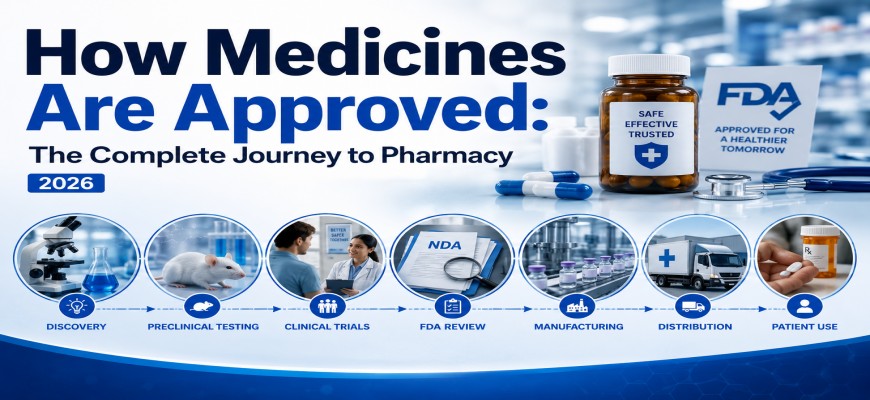
The full path a medicine travels can be summarized as eight major checkpoints. Each one has to be passed before the next begins.
- Idea — a scientific hypothesis about a biological target connected to a disease.
- Laboratory research — testing whether a molecule can act on that target in a lab dish.
- Animal testing — preclinical studies assessing toxicity and basic safety before any human exposure.
- Clinical trials — three phases of human testing for safety, dosing, and effectiveness.
- FDA review — a formal application and multi-department evaluation of all collected evidence.
- Manufacturing — scaling production under inspected, quality-controlled conditions.
- Distribution — moving the approved medicine through wholesalers to pharmacies.
- Patient use — ongoing real-world monitoring for safety once the medicine is in general use.
Most people only ever see the last step. Everything before it can take a decade or more, and most candidate medicines never make it that far at all.
Stage 1 — Drug Discovery
Every medicine starts as an idea about biology: a protein, enzyme, or receptor involved in a disease process that scientists believe can be influenced by a molecule. Researchers then search for — or design — a compound that interacts with that target in a useful way.
How scientists find candidate molecules
- High-throughput screening tests thousands to millions of chemical compounds against a biological target to see which ones bind or react in a promising way.
- Natural product research studies compounds found in plants, fungi, marine organisms, and other natural sources — the origin of many existing medicines, including some antibiotics and cancer treatments.
- Rational drug design uses knowledge of a target's exact molecular structure to design a compound intended to fit it, rather than testing compounds at random.
- AI and computational modeling now play a growing role, helping predict which candidate molecules are likely to bind effectively, absorb well, and avoid toxicity — narrowing thousands of possibilities down to a manageable shortlist before any lab testing begins.
Out of thousands of compounds screened at this stage, only a small number will ever be promising enough to advance to the next stage — and most of those will still fail before reaching a pharmacy shelf.
Stage 2 — Preclinical Testing
Before any compound touches a human being, it must pass through preclinical testing — laboratory and animal studies designed to answer a basic question: is there any early sign this could be safe enough to test in people?
- In-vitro (lab dish) testing examines how the compound behaves at a cellular level, including early toxicity signals.
- In-vivo (animal) studies assess how the compound is absorbed, distributed, broken down, and eliminated by a living organism, and look for organ toxicity across multiple species.
- Dose-finding establishes a safe starting range before any human trial is designed.
This stage typically takes three to six years and is a major reason why medicine development is slow: researchers would rather spend years ruling out danger in animal models than risk exposing a human volunteer to an unpredictable compound. Compounds that show unacceptable toxicity, poor absorption, or no meaningful biological effect are dropped here — the majority of candidates never proceed past this point.
Stage 3 — Clinical Trials: Every Phase Explained
Once preclinical data looks safe enough, a company submits an Investigational New Drug (IND) application to the FDA. If accepted, the medicine can now be tested in humans, split across three (sometimes four) distinct phases, each answering a different question.
| Phase | Who Participates | Main Purpose | Typical Size | Typical Duration |
|---|---|---|---|---|
| Phase 1 | Small group, often healthy volunteers | Safety, dosage range, how the body processes the drug | 20–100 people | Several months to about a year |
| Phase 2 | Patients who have the condition | Early effectiveness signal, refining the correct dose, continued safety monitoring | Roughly 100–300 people | Several months to two years |
| Phase 3 | Large, diverse patient groups | Confirming effectiveness, comparing to existing treatments, catching rarer side effects | Several hundred to several thousand people | One to several years |
| Phase 4 | General patient population after approval | Long-term monitoring, rare side effects, real-world effectiveness | Entire treated population | Ongoing for the life of the product |
Phase 1 — Is it safe?
Phase 1 trials exist to answer the most basic question first: does this compound cause unacceptable harm in a human body, and what dose range is tolerable? Researchers start at very low doses and increase gradually, watching closely for adverse effects, and studying how the body absorbs, processes, and eliminates the drug.
Phase 2 — Does it work, and at what dose?
Once a safe dose range is established, Phase 2 shifts to actual patients who have the condition the medicine is meant to treat. Researchers look for an early effectiveness signal and continue narrowing in on the optimal dose — one that's high enough to work but not so high that side effects outweigh the benefit.
Phase 3 — Does it work reliably, and how does it compare?
Phase 3 is the largest and most expensive phase, often involving multiple countries and study sites. It's designed to confirm effectiveness in a large, diverse population, directly compare the new medicine to an existing standard treatment or placebo, and catch side effects that are too rare to appear in the smaller Phase 1 and 2 groups. This is the evidence base that ultimately supports (or fails to support) an approval application.
Phase 4 — What happens once everyone can use it?
Phase 4, or post-marketing surveillance, begins after approval and continues for the life of the product. No trial — even one with thousands of participants — can catch a side effect that only appears in 1 out of 50,000 people. Phase 4 monitoring, through systems like the FDA's MedWatch and international pharmacovigilance networks, is how these rare, long-term, or population-specific effects are eventually identified.
The FDA Review Process
Once Phase 3 trials are complete, the sponsor compiles everything — laboratory data, animal studies, all three clinical trial phases, proposed manufacturing details, and proposed labeling — into a New Drug Application (NDA) for standard small-molecule drugs, or a Biologics License Application (BLA) for biologic products like vaccines and antibody therapies.
- Data review — FDA scientists, physicians, and statisticians independently re-analyze the submitted trial data rather than simply accepting the sponsor's conclusions.
- Manufacturing inspection — FDA inspectors evaluate the actual facility where the medicine will be produced, checking for Good Manufacturing Practice compliance.
- Label review — the proposed prescribing information and patient labeling are checked for accuracy, clarity, and completeness, including warnings and interactions.
- Risk-benefit analysis — reviewers weigh the demonstrated benefits against the identified risks for the specific population and condition studied.
- Approval decision — the FDA can approve the application, issue a Complete Response Letter requesting more information or additional studies, or decline to approve it.
This full review typically takes 6 to 10 months once a complete application is submitted, though for serious or life-threatening conditions, programs like Fast Track, Breakthrough Therapy, Priority Review, and Accelerated Approval can shorten review timelines without skipping the underlying evidence requirements — they change the pace and sometimes the type of data required, not whether safety and effectiveness must be shown.
Do Other Countries Approve Medicines Differently?
Every country has its own regulatory body, but the underlying scientific standards — safety, effectiveness, and manufacturing quality — are broadly similar, and international harmonization efforts (through bodies like the WHO and the International Council for Harmonisation) have aligned many core requirements across regions.
| Region | Agency | Full Name | Key Notes |
|---|---|---|---|
| United States | FDA | Food and Drug Administration | Reviews via NDA/BLA; uses Fast Track, Breakthrough, Priority Review, and Accelerated Approval pathways for serious conditions |
| European Union | EMA | European Medicines Agency | Coordinates centralized scientific evaluation; final approval decision made by the European Commission based on EMA's recommendation |
| United Kingdom | MHRA | Medicines and Healthcare products Regulatory Agency | Operates independently post-Brexit; runs its own national approval pathway alongside international recognition procedures |
| Canada | Health Canada | Health Canada (Health Products and Food Branch) | Reviews via a New Drug Submission; requires demonstrated safety, efficacy, and quality similar to FDA/EMA standards |
| India | CDSCO | Central Drugs Standard Control Organization | Regulates both new drug and generic approvals nationally; plays a major role given India's large generic manufacturing base |
The practical difference for patients is mostly about timing, not safety philosophy — a medicine may become available in one country before another simply because the sponsor filed there first, or because a regional agency requested additional local population data. It is not unusual, and not necessarily a red flag, for approval timing to differ by months or even a couple of years between regions.
Generic Medicine Approval: Why They Cost Less (Not Because They're Weaker)
Generic medicines go through a different, but not lesser, approval pathway. Because the original branded product already proved the medicine is safe and effective, a generic manufacturer doesn't need to repeat the full clinical trial program. Instead, it must demonstrate:
- Same active ingredient, strength, dosage form, and route of administration as the brand-name reference product.
- Bioequivalence — proof that the generic version delivers the active ingredient into the bloodstream at a similar rate and extent as the brand-name version, typically measured through blood-level comparisons in volunteers.
- Same quality and manufacturing standards, inspected under the same Good Manufacturing Practice rules that apply to brand-name facilities.
Because the generic manufacturer skips repeating the original discovery research and large-scale clinical trials, development costs are dramatically lower — which is the real reason generics are priced lower, not because they use a lower-quality process.
Why Some Medicines Are Rejected
Not every application succeeds, even after years of investment. The FDA and comparable agencies most commonly decline approval, or request more evidence, for these reasons:
- Poor effectiveness — the trial data doesn't clearly show the medicine outperforms a placebo or existing treatment by a meaningful margin.
- Safety concerns — the observed risk, even if uncommon, is judged too severe relative to the benefit for the studied population.
- Unacceptable side effects — side effects that are technically "safe" in a strict sense but too disruptive to justify routine use compared to alternatives.
- Manufacturing issues — inspection findings at the proposed production facility raise quality or contamination concerns.
- Incomplete evidence — trials were too small, too short, or didn't include enough of the population the medicine is intended for.
A rejection is not always the end of the road. Companies frequently receive a Complete Response Letter, address the specific concerns raised, and resubmit — sometimes successfully, sometimes not.
Emergency Approvals: What EUA Really Means
Emergency Use Authorization (EUA) is a distinct legal pathway, separate from full approval, that allows the FDA to authorize the use of an unapproved product — or an approved product for an unapproved use — during a declared public health emergency, based on the best available evidence at the time.
| Feature | Emergency Use Authorization (EUA) | Full Approval |
|---|---|---|
| Legal basis | Declared public health emergency | Standard drug/biologic approval law |
| Evidence required | Available data suggesting benefits outweigh known and potential risks | Complete standard package from all clinical trial phases |
| Duration of data reviewed | Often shorter-term follow-up available at time of authorization | Longer-term follow-up data typically required |
| Duration of authorization | Tied to the emergency declaration; can be revoked or converted | Ongoing, subject to standard post-market obligations |
| Example | Initial COVID-19 vaccine and treatment authorizations during the pandemic | Subsequent full approval of those same vaccines after complete data was submitted |
The best-known recent example is the COVID-19 vaccines, several of which were first made available under EUA based on strong early trial data and an urgent public health need, and later received full approval once the complete standard evidence package — including longer follow-up data — was submitted and reviewed. An EUA is not a shortcut around safety evidence; it is a different risk calculation made appropriate by the severity of an active public health emergency.
Drug Recalls: Why They Happen and What Patients Should Do
A recall is not a sign that the entire approval system failed — it's a sign that the safety-monitoring part of the system is working. Recalls target a specific problem, usually tied to particular lot numbers, not necessarily every unit of a medicine ever made.
Why recalls happen
- Contamination discovered during manufacturing or after distribution
- Incorrect labeling, including wrong dosage strength printed on a package
- Stability or potency issues discovered after approval
- Packaging defects that could compromise sterility or dosing accuracy
- New safety information that changes the risk-benefit balance for a specific batch or formulation
| Class | Risk Level | Definition | What Patients Should Do |
|---|---|---|---|
| Class I | Most serious | Reasonable probability the product will cause serious health consequences or death | Stop use immediately and contact your pharmacist or prescriber right away |
| Class II | Moderate | May cause temporary or medically reversible effects; serious harm is remote but possible | Contact your pharmacy for guidance; you may be able to continue use unless told otherwise |
| Class III | Least serious | Not likely to cause adverse health consequences; often a labeling or packaging violation | Continue use as directed unless your pharmacy advises otherwise |
If you hear about a recall affecting a medicine you take, check the specific lot number on your bottle against the recall notice — recalls are usually lot-specific, not brand-wide — and call your pharmacist before stopping a medicine on your own, especially one you rely on daily.
Medicine Safety After Approval: Pharmacovigilance
Approval is a milestone, not a finish line. Every medicine continues to be watched for the rest of its time on the market, through a coordinated system involving regulators, healthcare professionals, and patients themselves.
- FDA MedWatch — the FDA's voluntary reporting system that allows healthcare professionals and patients to report suspected adverse events, product problems, or medication errors directly to the agency.
- WHO global monitoring — the World Health Organization coordinates an international database of adverse drug reaction reports, helping identify safety signals that might not be visible within a single country's data alone.
- Healthcare professional reporting — pharmacists and physicians are often the first to notice a pattern of unexpected side effects and are encouraged to report them formally.
- Pharmacovigilance — the overarching science and set of activities dedicated to detecting, assessing, understanding, and preventing adverse effects, active for the entire life of a medicine, not just its first few years.
Myths vs. Facts About Medicine Approval
Fact: No medicine is completely risk-free. Approval means the demonstrated benefits outweigh the known risks for its intended use.
Fact: Generics must contain the same active ingredient and demonstrate bioequivalence under the same manufacturing quality standards.
Fact: Dietary supplements are regulated differently and are not held to the same pre-market evidence requirements as approved medicines, which is exactly why they can vary widely in quality and effectiveness.
Fact: EUA requires available evidence showing benefits outweigh risks; it reflects an emergency timeline for evidence review, not an absence of evidence.
Fact: Post-market surveillance (Phase 4) continues for the life of the product, and labels are regularly updated as new safety data emerges.
Fact: Most recalls target specific lot numbers or manufacturing batches, not every unit of the medicine ever produced.
Fact: Preclinical animal testing is a required step for essentially all new chemical entities before human trials can begin.
Fact: Trials also establish correct dosing, identify side effects, and compare the medicine against existing treatments or placebo.
Fact: Expedited pathways like Priority Review change the review timeline, not the underlying evidence standard required for approval.
Fact: Generic medicines, biosimilars, and even manufacturing changes to existing approved medicines all require regulatory review.
Fact: Each regulatory agency reviews evidence independently, though many now share data and align on core scientific standards.
Fact: Prescribing an approved medicine reflects clinical evidence and patient need; it is a separate matter from the approval process itself, which involves no prescriber financial incentive.
Fact: OTC medicines are regulated too, either through individual approval or by conforming to an FDA OTC monograph that specifies approved ingredients, doses, and labeling.
Fact: Phase 3 trials can still fail to show sufficient effectiveness or reveal new safety concerns, ending development even at this late stage.
Fact: Approval is tied to a specific population, condition, and dose studied in trials — which is why labels specify who the medicine is (and isn't) intended for.
Fact: While companies pay application fees that help fund review staff, the reviewers themselves are independent government scientists separate from the sponsor's research team.
Fact: Price is driven by development cost, patent status, manufacturing complexity, and market factors — not by the rigor of its safety testing.
Fact: Compounded medicines are prepared for individual patients by a pharmacy and are not individually FDA-approved the way mass-manufactured products are.
Fact: Labels are updated as new adverse event reports accumulate; a side effect can be real and still take time to appear on official labeling.
Fact: Only licensed pharmacies sourcing from approved supply chains guarantee the product matches the approved formulation; unverified sellers can supply counterfeit or substandard versions.
Frequently Asked Questions
How long does it take for a medicine to be approved?
On average, the full journey from initial discovery through FDA approval takes roughly 10 to 15 years, including preclinical testing and all three clinical trial phases before a New Drug Application is even submitted.
Does FDA approval mean a medicine has zero side effects?
No. Approval means the demonstrated benefits outweigh the known risks for the intended use and population. Nearly every medicine has some possible side effects listed on its label.
Why does drug development take so many years?
Each stage — laboratory research, animal testing, and three phases of human trials — is designed to progressively rule out safety concerns and confirm effectiveness before a larger population is exposed, which naturally takes time to do responsibly.
What is the difference between an NDA and a BLA?
A New Drug Application (NDA) is used for traditional chemical, small-molecule drugs, while a Biologics License Application (BLA) is used for biologic products like vaccines, antibodies, and other products derived from living organisms.
What is an Investigational New Drug (IND) application?
An IND is the application a sponsor submits to the FDA requesting permission to begin testing a new compound in human clinical trials, based on preclinical safety data.
Are generic medicines as safe and effective as brand-name medicines?
Yes. Generics must contain the same active ingredient, strength, and route of administration, and must demonstrate bioequivalence to the brand-name reference product.
Why do generic medicines cost less than brand-name medicines?
Generic manufacturers don't need to repeat the original discovery research and large-scale clinical trials, dramatically lowering development costs — not because of lower manufacturing standards.
What does "bioequivalence" mean?
It means a generic medicine delivers its active ingredient into the bloodstream at a similar rate and extent as the brand-name product, typically required to fall within 80% to 125% of the brand's measured blood levels.
What is the difference between Emergency Use Authorization and full approval?
EUA allows use during a declared public health emergency based on available evidence; full approval requires the complete standard evidence package, including longer-term follow-up data.
Were COVID-19 vaccines "rushed" through approval?
They were authorized on an accelerated emergency timeline due to the pandemic, using large clinical trial data sets collected in parallel rather than sequentially — the same phases and safety thresholds still applied, and several vaccines later received full approval once complete data was reviewed.
What happens during FDA manufacturing inspections?
Inspectors evaluate the actual production facility for compliance with Good Manufacturing Practice standards, checking equipment, processes, documentation, and quality controls.
Can a medicine be approved in one country but not another?
Yes. Each regulatory agency reviews evidence independently and may request different data, meaning approval timing can differ by months or years between regions.
What is a Complete Response Letter?
It's the FDA's formal notice that an application cannot be approved in its current form, outlining the specific deficiencies that must be addressed before resubmission.
Why are some medicines rejected after years of testing?
Common reasons include insufficient evidence of effectiveness, safety concerns identified during trials, manufacturing quality issues, or incomplete data for the intended population.
What is Priority Review?
It's an FDA program that shortens the review timeline for medicines that would offer significant improvement over existing treatments for serious conditions, without lowering the evidence standard required.
What is Breakthrough Therapy designation?
It's a designation intended to speed the development and review of medicines that show early evidence of substantial improvement over available therapies for serious conditions.
What is Accelerated Approval?
It allows approval based on a surrogate marker reasonably likely to predict clinical benefit, typically for serious conditions with unmet need, with a requirement for continued post-approval studies to confirm the expected benefit.
What should I do if my medicine is recalled?
Check the recall notice for the specific lot number and class. For Class I, stop use and contact your pharmacist immediately. For Class II or III, contact your pharmacy for guidance before assuming you must stop.
Who can report a suspected side effect?
Both healthcare professionals and patients can report suspected adverse events directly through the FDA's MedWatch program.
What is pharmacovigilance?
It's the ongoing science and set of activities dedicated to detecting, assessing, and preventing adverse effects of medicines throughout their entire time on the market.
Do supplements go through the same approval process as medicines?
No. Dietary supplements are regulated under a different framework and are not required to prove safety and effectiveness before reaching the market the way approved medicines are.
Are over-the-counter (OTC) medicines regulated less strictly than prescription medicines?
OTC medicines are regulated too, either through individual approval or by meeting an established FDA OTC monograph specifying approved ingredients, doses, and labeling requirements.
What is the role of the WHO in medicine safety?
The WHO coordinates international guidance, harmonizes standards across countries, and maintains global databases that help detect safety signals that might not be visible from a single country's data alone.
Can a medicine's approval be withdrawn after it's on the market?
Yes. If post-market data reveals safety concerns that outweigh the medicine's benefit, a regulator can require label changes, restrict use, or withdraw approval entirely.
Is it safe to buy medicine from an online pharmacy?
It can be, as long as the pharmacy is licensed, requires a valid prescription where appropriate, and sources from an approved supply chain — unverified sellers carry a real risk of counterfeit or substandard product.
Why do some medicine labels get updated years after approval?
Labels are living documents. As post-market surveillance accumulates new safety data, warnings, interactions, or dosing guidance can be added long after the original approval date.
Key Takeaways
- Medicine approval evaluates five things together: safety, effectiveness, quality, manufacturing, and a post-market monitoring plan.
- The journey from discovery to pharmacy typically takes 10–15 years and includes three (sometimes four) phases of human clinical trials.
- FDA review of a complete application usually takes 6–10 months, though special programs can shorten timelines for serious conditions without lowering the evidence standard.
- Generic medicines are not lower quality — they must prove bioequivalence to the brand-name product under the same manufacturing standards.
- Approval is not the end of a medicine's evaluation. Post-market surveillance and pharmacovigilance continue for the entire time it's on the market.
- Recalls are targeted safety actions, usually tied to specific lot numbers, not evidence that the whole approval system failed.
Final Thoughts
Understanding how medicine approval works doesn't just satisfy curiosity — it helps you ask better questions the next time a doctor prescribes something new, a pharmacist recommends a generic, or a headline mentions an emergency authorization. None of this replaces personalized medical advice. If you're ever unsure about a specific medicine — why it was prescribed, whether a generic is right for you, or what a recall notice means for your prescription — your pharmacist and doctor are the right people to ask, and asking is always a reasonable thing to do.