
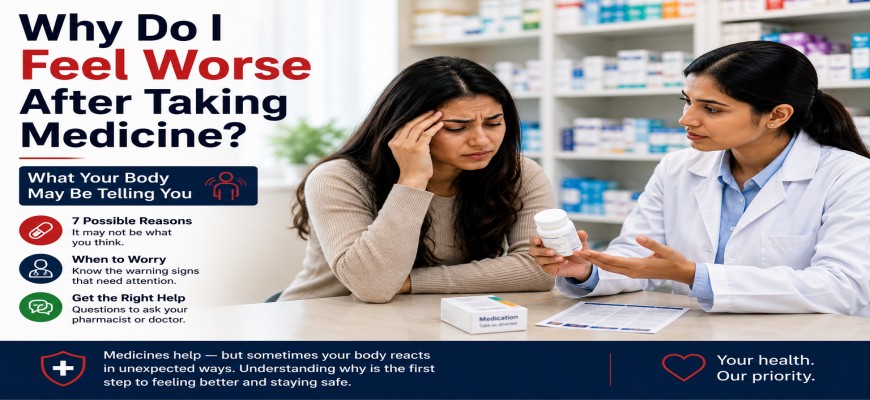
Why Do I Feel Worse After Taking Medicine? What Your Body May Be Telling You
By the MyOnlineMedShop Health Content Team | Reviewed for general medical accuracy | Last updated August 2026
You took your medicine exactly as directed. You expected to feel a little better, or at least no worse. Instead, you feel nauseous, dizzy, unusually tired, or your original symptoms seem stronger than before. It's an unsettling moment — and a common one.
Feeling worse after taking a medicine doesn't automatically mean something has gone wrong, and it doesn't automatically mean the medicine is unsafe for you. There are several genuine explanations, ranging from mild and expected to something that genuinely needs medical attention. This article walks through what's actually going on, how to think about the timing of what you're feeling, and when it's time to call a doctor or pharmacist rather than wait it out.
In short: feeling worse after medicine can come from the medicine's known side effects, the illness itself still running its course, an interaction with something else you've taken, or a handful of other explanations covered below. None of these can be reliably sorted out from a symptom alone — that's what a pharmacist or prescriber is for.
Table of Contents
- Why Can Medicine Sometimes Make You Feel Worse?
- 7 Possible Reasons You May Feel Worse After Taking Medicine
- How Common Are Side Effects, Really?
- How Quickly Can Medication Side Effects Appear?
- How Can You Tell a Side Effect From Your Illness Getting Worse?
- A Few Terms Worth Knowing
- When Should You Contact a Doctor or Pharmacist?
- When Is It an Emergency?
- Should You Stop Taking the Medicine If You Feel Worse?
- Why the Same Medicine Can Affect Two People Differently
- A Realistic Example
- Questions to Ask Your Pharmacist or Doctor
- Key Takeaway
- Frequently Asked Questions
Why Can Medicine Sometimes Make You Feel Worse?
Medicines work by changing something in your body — a hormone level, an enzyme, a nerve signal, blood flow, or immune activity. Any change powerful enough to help a condition is also powerful enough to produce effects you didn't expect, especially in the first few days as your body adjusts.
On top of that, many medicines are started while an illness is still active. If you begin an antibiotic while an infection is still peaking, or a new medicine while your body is already under stress from the underlying condition, it can be genuinely difficult to tell which symptoms belong to the illness and which belong to the treatment.
Neither of these possibilities means the medicine has failed or that something is dangerously wrong. They simply mean there's more going on than "medicine in, better feeling out." If you've also been wondering whether your medicine seems slow to help rather than making you feel worse, that's a related but different question — our companion piece on why the same medicine can affect people differently is a useful next read either way.
7 Possible Reasons You May Feel Worse After Taking Medicine
1. The Medicine Itself Can Cause Side Effects
Every medicine that's approved for use has a known profile of possible side effects, discovered during clinical testing and confirmed through ongoing real-world use. Nausea, headache, dizziness, fatigue, and stomach discomfort are among the most commonly reported effects across many medicine types, particularly in the first days of treatment while your body adjusts.
Many of these effects are mild and settle down within days to a couple of weeks as your body adapts. Others are worth reporting even if they're mild, simply so your pharmacist or prescriber has the full picture. You can find a plain-language explanation of how these effects are identified and documented in the first place in our article on how medicines are approved before they reach a pharmacy shelf.
2. Your Underlying Illness May Still Be Causing Symptoms
Starting treatment doesn't instantly switch off the condition being treated. If you begin a new medicine while you're still acutely unwell, some of what you're feeling may simply be the illness continuing its natural course rather than a reaction to the medicine at all.
This is especially true for infections, inflammatory flares, and conditions that naturally worsen before they improve. Separating "still sick" from "reacting to treatment" is genuinely difficult without professional input.
3. The Medicine May Not Be the Right Treatment for the Condition
Occasionally, a symptom doesn't ease — or a new one appears — because the medicine isn't well matched to what's actually going on. This can happen when an initial diagnosis needs to be revisited, or when a first-line treatment simply isn't the right fit for a particular person.
This isn't a reflection of anything done incorrectly by you or your prescriber. It's a normal, expected part of how treatment sometimes needs to be adjusted based on how a person actually responds.
4. Drug Interactions Can Change How a Medicine Affects You
Taking two or more medicines together — including over-the-counter products — can change how each one behaves in your body. Some combinations increase the level of a medicine in your bloodstream, intensifying its effects and side effects. Others reduce a medicine's effectiveness or create an entirely new effect neither medicine would cause alone.
This is one of the more overlooked reasons for feeling unexpectedly unwell, particularly for people managing more than one health condition or recently starting something new, even a supplement.
5. Food, Drinks, Supplements, or Other Substances Can Affect the Medicine
Certain foods, beverages (including alcohol and, for some medicines, grapefruit juice), and herbal supplements can change how a medicine is absorbed or processed. This can intensify side effects, reduce effectiveness, or, in some combinations, create a genuinely different reaction.
It's easy to overlook these factors because they don't feel like "medicine," but they can meaningfully affect how a treatment behaves in your body.
6. Individual Differences Can Change How People Respond
Age, genetics, body weight, kidney and liver function, and other health conditions all influence how a person absorbs, processes, and clears a medicine. Two people taking the identical medicine and dose can have noticeably different experiences, including different side effects.
We go into more depth on this in our related article on why the same medicine can affect people differently, which is worth reading if this pattern sounds familiar to you.
7. Timing, Missed Doses, or Incorrect Use Can Affect the Response
How and when a medicine is taken can change its effect. Taking a dose too close to another one, doubling up after a missed dose, taking it with the wrong food timing, or using an inhaler or injection incorrectly can all lead to a stronger, weaker, or different effect than intended.
If you're not fully sure your technique or timing is correct, that's a quick and genuinely useful thing to confirm with a pharmacist — you can find contact details on our contact page if you'd like to reach our team directly.
How Common Are Side Effects, Really?
It's worth saying plainly: experiencing some effect beyond the intended one is common, not rare. Regulatory agencies require every approved medicine to list known side effects precisely because they occur in a meaningful share of people who take it — that's not a flaw in the system, it's the system working as intended. A side effect being "common" on a label doesn't mean it will happen to you, and it doesn't mean it's dangerous; it means enough people experienced it during testing and real-world use that patients deserve to be told about it in advance.
This is also why medicine labels and patient information leaflets separate side effects into categories — common, uncommon, rare, and serious — rather than listing everything with equal weight. Understanding that distinction can take some of the alarm out of reading a long list of possible effects.
How Quickly Can Medication Side Effects Appear?
There's no single timeline that applies to every medicine. Some effects can appear within minutes to hours of a dose, particularly for medicines that act quickly on the body, such as those affecting blood pressure or the digestive system. Others build gradually over days or weeks as the medicine accumulates in your system or as your body adjusts to a new hormonal or chemical balance.
Allergic reactions typically appear more quickly, often within minutes to a few hours of a dose, though delayed allergic responses over several days are also possible with some medicines. Because timing varies so widely by medicine, dose, and individual, it's more useful to track when a symptom started relative to your dose than to assume a fixed rule about how fast side effects "should" appear.
How Can You Tell a Side Effect From Your Illness Getting Worse?
There's no reliable way to sort this out from a checklist alone, and it's worth being honest about that rather than pretending otherwise. That said, a few observations can help you describe what's happening more clearly to a healthcare professional:
- Timing relative to your dose: A symptom that consistently appears shortly after each dose points more toward the medicine; a symptom that's been present continuously since before you started treatment may be the underlying illness.
- Whether it's a new symptom or a familiar one: A completely new symptom you've never had before is more likely related to the medicine than a worsening of a symptom you already had.
- How it changes over the day: Symptoms that improve as a dose wears off suggest a medicine effect; symptoms that stay constant regardless of dosing timing may point elsewhere.
| Observation | Leans Toward Medicine Effect | Leans Toward Underlying Illness |
|---|---|---|
| Timing | Starts shortly after each dose | Present continuously, regardless of dosing |
| Symptom type | Something entirely new | A familiar symptom, now stronger |
| Pattern through the day | Eases as the dose wears off | Stays roughly constant |
| Progression | Tends to lessen over days as your body adjusts | May fluctuate with the natural course of the illness |
These are useful observations to bring to a conversation with a pharmacist or prescriber — not a way to self-diagnose which one is happening.
A Few Terms Worth Knowing
A short glossary can make these conversations easier:
- Side effect: Any effect of a medicine other than the one it's intended to produce, whether mild or serious.
- Adverse reaction: A harmful or unpleasant reaction to a medicine, generally used to describe effects significant enough to need medical attention.
- Drug interaction: A change in how a medicine behaves caused by another medicine, supplement, food, or substance taken at the same time.
- Allergic reaction: An immune-system response to a medicine, ranging from mild skin symptoms to a severe, rapid reaction requiring emergency care.
- Tolerability: How well a person can continue taking a medicine given the side effects they experience, distinct from whether the medicine is effective.
When Should You Contact a Doctor or Pharmacist?
It's reasonable to contact a pharmacist or prescriber whenever a new or worsening symptom appears after starting a medicine, even if it seems mild, simply to get a professional read on whether it's expected or worth a closer look. This is especially worth doing if:
- The symptom is persistent rather than easing after the first few days
- The symptom is affecting your ability to function day to day
- You're not sure whether what you're feeling is a known side effect of your specific medicine
- You've recently started another medicine, supplement, or made a diet change
- You simply feel uneasy about what you're experiencing
Pharmacists are generally easy to reach without an appointment and are well placed to advise whether a symptom is a recognized effect of your medicine or something that needs to go back to your prescriber.
When Is It an Emergency?
Most medication-related discomfort is not an emergency, but certain symptoms require urgent medical attention. Seek emergency care promptly if you experience signs of a severe allergic reaction — such as swelling of the face, lips, or throat, difficulty breathing, or widespread hives — or if you experience chest pain, severe difficulty breathing, fainting, confusion, or any symptom that feels rapidly worsening or severe. If you are ever unsure whether a symptom is serious, it's appropriate to seek urgent medical advice rather than wait to see if it passes.
Should You Stop Taking the Medicine If You Feel Worse?
In general, you should not stop, skip, or change a prescription medicine on your own, even if you're feeling unwell after taking it. Stopping some medicines suddenly can cause its own problems, separate from whatever you're currently experiencing, and a professional needs the full picture to advise safely.
The exception is a genuine emergency, such as the warning signs described above — in that situation, seeking urgent medical care takes priority, and the medical team will guide next steps regarding the medicine itself. Outside of an emergency, the safest path is to contact your pharmacist or prescriber promptly and let them help you decide what, if anything, should change.
Why the Same Medicine Can Affect Two People Differently
It's genuinely common for two people on the identical medicine and dose to have different experiences. Age can change how efficiently the body processes a medicine. Genetic differences affect how quickly certain liver enzymes break medicines down. Body weight, kidney and liver function, and other existing health conditions all influence how much of a medicine ends up active in your system at any given time. Other medicines you're taking can add another layer of variation on top of all of this.
None of these factors are something you can assess on your own with confidence, which is exactly why reporting your experience clearly to a pharmacist or prescriber is more useful than trying to interpret it yourself. If you'd like a deeper look at this topic, our article on why the same medicine can affect people differently explores it in more detail, and our guide to how medicines are approved explains how side effects are identified and documented before a medicine ever reaches a pharmacy shelf.
A Realistic Example
Consider someone who starts a new medicine for a chronic condition and feels noticeably more tired and mildly nauseous for the first several days. Nothing about their routine has changed except the new medicine, so it's reasonable to suspect a connection. Rather than stopping the medicine outright, they call their pharmacist, describe exactly when the tiredness and nausea occur relative to their dose, and mention the one other supplement they've recently started taking.
The pharmacist recognizes the symptoms as a known, generally temporary effect of that medicine class, confirms there's no concerning interaction with the supplement, and advises taking the dose with food going forward while monitoring for the first two weeks. If the symptoms haven't eased by then, the plan is to follow up with the prescriber. This is a realistic picture of how these situations are usually resolved — through a short, specific conversation with a professional, not through guesswork.
Questions to Ask Your Pharmacist or Doctor
- Is what I'm experiencing a known side effect of this specific medicine?
- Is this something that typically improves with time, or should it be reported right away?
- Could this be related to another medicine, supplement, or food I've had recently?
- Is there anything about how or when I'm taking this medicine that could be contributing?
- What symptoms would mean I should contact you again, or seek urgent care?
- Is there an alternative worth considering if this continues?
Key Takeaway
Feeling worse after taking a medicine is unsettling, but it isn't automatically a sign that something is wrong. It can reflect a known side effect settling in, an illness still running its course, an interaction with something else you're taking, or simply how your particular body responds to that particular medicine. What matters most is paying attention to timing, being honest with yourself about what's changed, and bringing that information to a pharmacist or prescriber rather than trying to work it out — or fix it — entirely on your own. If anything feels severe or rapidly worsening, treat it as urgent and seek medical care right away.
About This Article
This article was written and reviewed by the MyOnlineMedShop Health Content Team for general medical accuracy, drawing on publicly available information from recognized health authorities. It is intended as general educational content and does not replace individualized medical advice from a qualified healthcare professional. You can learn more about our approach to health content on our About Us page, browse our full range of products on our product page, or get in touch through our contact page if you have questions about an order or a medicine you've purchased through us. For medical questions about your own treatment, please contact your pharmacist or prescriber directly rather than relying on this article alone.
Always speak with your pharmacist or prescriber before making any changes to a prescribed medicine, and seek emergency care for any severe or rapidly worsening symptom.
Frequently Asked Questions
Why do I feel worse after taking medicine?
It can reflect a known side effect as your body adjusts, your underlying illness still running its course, an interaction with another medicine or substance, or simply how your individual body responds to that particular treatment. A pharmacist or prescriber can help narrow down which applies to you.
Can side effects start immediately after taking medicine?
Some can, particularly for fast-acting medicines or allergic reactions, while others build gradually over days or weeks. Timing varies by medicine, dose, and person.
Should I stop taking medicine if I feel sick after a dose?
Generally no — stopping a prescription medicine on your own isn't recommended. Contact your pharmacist or prescriber, and seek emergency care immediately if you notice severe warning signs such as difficulty breathing or facial swelling.
Can two medicines interact and cause new symptoms?
Yes. Combining medicines, including over-the-counter products and supplements, can intensify side effects, reduce effectiveness, or create a new effect. Keeping a full, current medicine list and reviewing it with a pharmacist helps catch this.
Can food or alcohol affect how medicine makes me feel?
Yes, certain foods, alcohol, and some drinks like grapefruit juice can change how a medicine is absorbed or processed, which can affect both its side effects and how well it works.
Why does the same medicine affect people differently?
Age, genetics, body weight, organ function, and other medicines all influence how a person processes a given medicine, which is why two people on the same treatment can have different experiences.
When does feeling worse after medicine become an emergency?
Seek emergency care for signs of a severe allergic reaction, chest pain, severe difficulty breathing, fainting, confusion, or any symptom that feels rapidly worsening or severe.
Sources & References
- MedlinePlus (U.S. National Library of Medicine) — general information on medicine side effects and safe use: medlineplus.gov
- U.S. Food and Drug Administration (FDA) — medication safety and side-effect reporting information: fda.gov
- NHS — guidance on medicine side effects and when to seek help: nhs.uk