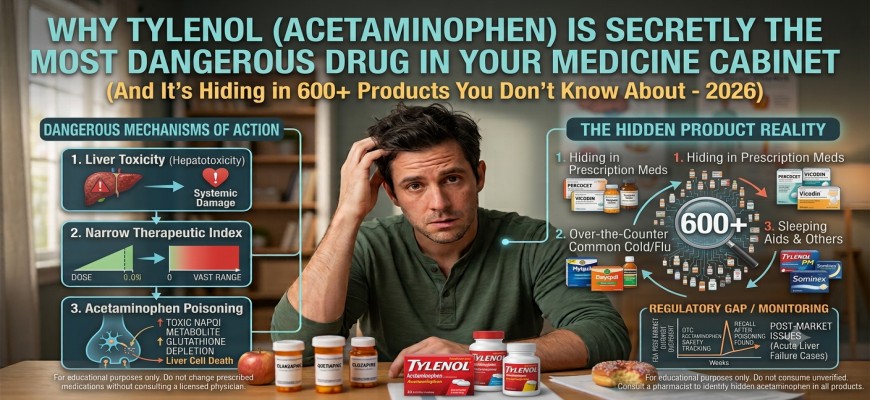
Why Tylenol (Acetaminophen) Is Secretly the Most Dangerous Drug in Your Medicine Cabinet — And It's Hiding in 600+ Products You Don't Know About
A pharmacist's guide to the "safe" over-the-counter painkiller that's the leading cause of acute liver failure in America — and why most people accidentally overdose without ever touching an extra Tylenol bottle.
Acetaminophen is so common, so cheap, and so heavily marketed as gentle that most people never think of it as a real drug at all. It doesn't require a prescription. It's given to infants. It sits next to the candy bars at gas stations. And yet acetaminophen overdose — most of it entirely unintentional — is the single leading cause of acute liver failure in the United States, sending tens of thousands of people to the emergency room every year.
The reason isn't that people are recklessly popping extra Tylenol tablets. It's that acetaminophen is quietly stacked into more than 600 different over-the-counter and prescription products — cold medicine, sleep aids, prescription painkillers, period-cramp formulas, even some cough syrups — and almost nobody adds up the total milligrams they're taking across all of them in a single day. This guide breaks down exactly why that happens, what the drug actually does to your liver, where it's hiding that you'd never expect, and how to protect yourself without giving up pain relief entirely.
Acetaminophen (known as paracetamol outside the U.S.) is a pain reliever and fever reducer sold under brand names like Tylenol, Panadol, and Excedrin PM, and used as a generic ingredient in hundreds of combination products. It works differently from NSAIDs like ibuprofen — it doesn't primarily reduce inflammation, and its exact mechanism in the brain is still debated among researchers, but it reliably lowers pain signaling and resets the body's fever "thermostat" in the hypothalamus.
Its ubiquity comes down to three things that make it a manufacturer's dream ingredient:
To understand why this "gentle" drug can destroy a liver, you need to understand what happens to it after you swallow it.
At normal doses, roughly 90-95% of acetaminophen is processed by the liver through two safe metabolic pathways (glucuronidation and sulfation) and excreted harmlessly in urine. This is the pathway your body relies on for the vast majority of a standard dose.
A small remaining fraction — normally around 5-10% — is processed through a different liver enzyme system (CYP2E1) that converts it into a toxic byproduct called NAPQI. Under normal circumstances, your liver instantly neutralizes NAPQI using a molecule called glutathione, rendering it harmless.
Your liver only stores a limited supply of glutathione at any given time. At normal doses, this supply comfortably neutralizes the small amount of NAPQI produced. At high or repeated doses, NAPQI production outpaces your glutathione supply.
Once glutathione runs out, unneutralized NAPQI begins binding directly to liver cell proteins, causing direct cellular damage and triggering an inflammatory cascade.
Damaged liver cells die (hepatocyte necrosis), and if enough cells are affected, the liver's ability to filter toxins, produce clotting factors, and regulate metabolism collapses — this is acute liver failure.
What makes this mechanism especially dangerous is that it isn't a single-dose phenomenon. Taking moderately excessive doses repeatedly over several days — never once taking a single "overdose" amount — can deplete glutathione just as effectively as one large dose, which is exactly how most accidental cases happen.
The FDA has identified acetaminophen as an ingredient in more than 600 over-the-counter and prescription medications. Most people can name Tylenol. Very few people can name the other products sitting in their medicine cabinet right now that contain the exact same drug.
| Product Category | Common Examples | Why People Miss It |
|---|---|---|
| Cold & flu multi-symptom formulas | NyQuil, DayQuil, Theraflu, Sudafed PE combo products | Label emphasizes "cold and flu relief," not the acetaminophen dose inside |
| Sleep aids | Tylenol PM, Excedrin PM, various "nighttime" formulas | Marketed around the sleep ingredient, not the pain reliever bundled in |
| Migraine / headache combo formulas | Excedrin Migraine, Excedrin Extra Strength | People assume it's "just caffeine and aspirin" |
| Prescription opioid combination pills | Percocet (oxycodone/acetaminophen), Vicodin (hydrocodone/acetaminophen), some Tramadol combos | Patients focus on the opioid component and don't realize acetaminophen is co-formulated |
| Menstrual / period pain formulas | Midol Complete, Pamprin | Branding emphasizes "cramp relief," not the specific drug |
| Allergy/sinus combo products | Various "sinus" labeled multi-symptom tablets | Consumers assume it's only an antihistamine/decongestant |
| Pediatric fever/pain products | Children's Tylenol, various infant drops | Parents dosing multiple children's products at once without cross-checking |
A person takes two Extra Strength Tylenol (1,000 mg) for a headache in the morning. That night, feeling like they're coming down with a cold, they take a dose of NyQuil (which also contains acetaminophen) to sleep. The next morning, still achy, they take Excedrin Migraine (also acetaminophen) for a lingering headache. None of these choices looks unreasonable in isolation — but stacked together across 24 hours, this person may have unknowingly exceeded the recommended daily maximum without ever taking a single product labeled as "too much."
Public health data consistently shows that unintentional acetaminophen overdose is far more common than people assume, and it clusters around a few predictable patterns:
| Pattern | How It Happens | Why It's Missed |
|---|---|---|
| Product stacking | Combining two or more acetaminophen-containing products in the same day | Different brand names obscure the shared ingredient |
| "If one didn't work, more will" logic | Taking extra tablets when pain doesn't improve, without waiting the recommended interval | Acetaminophen doesn't produce a noticeable "too much" sensation the way sedatives do |
| Chronic daily overuse for persistent pain | Taking near-maximum doses every day for weeks for chronic pain (e.g., arthritis, back pain) | Cumulative liver stress builds slowly and silently over time |
| Pediatric dosing confusion | Concentration differences between infant drops and children's liquid formulas leading to miscalculated doses | Parents dosing by "teaspoon" habit rather than checking concentration on the specific bottle |
| Opioid combination confusion | Patients not realizing their prescription painkiller already contains acetaminophen, then adding OTC Tylenol on top | Prescription label lists the opioid prominently; the acetaminophen component is easy to overlook |
Acetaminophen overdose is also, unfortunately, one of the most common substances involved in intentional self-poisoning, precisely because it is so widely available and perceived as harmless. If this section brings up anything personal for you, please see the note near the end of this article — you deserve support, not just information.
Package labeling gives per-dose instructions ("take 2 tablets every 4-6 hours") but rarely makes the cumulative daily ceiling obvious at a glance, especially across multiple products.
Most current guidance sets the maximum total daily acetaminophen dose for a healthy adult at 3,000-4,000 mg per 24 hours from all sources combined — not per product, per all products combined. Many clinicians and current OTC labeling now recommend staying closer to the lower end of that range (around 3,000 mg) for routine use, reserving the higher end only for short-term use under guidance.
Regular strength tablets are typically 325 mg; extra strength tablets are typically 500 mg. Combination cold/flu products often contain 325-650 mg per dose, which is easy to lose track of when it's the fourth ingredient listed on a busy label.
Doses should generally be spaced at least 4-6 hours apart, with no more than the labeled number of doses in 24 hours — a rule that's easy to break when switching between multiple different combination products throughout the day.
The only reliable way to stay under the daily limit is to read the "active ingredients" section on every product you take in a 24-hour window — not just the front-of-box marketing name — and add up every instance of "acetaminophen" or "APAP" (a common pharmacy shorthand for the drug) listed.
The standard dosing limits above assume a healthy adult liver with normal glutathione reserves. Several common, everyday factors lower that safety margin significantly:
| Risk Factor | Why It Matters | Practical Implication |
|---|---|---|
| Regular alcohol use | Chronic alcohol use induces the same CYP2E1 enzyme pathway that produces toxic NAPQI, meaning more toxic byproduct is generated per dose | Regular drinkers should use a lower daily ceiling and consult a pharmacist about a safe personal limit |
| Fasting or poor nutrition | Glutathione production depends partly on adequate nutrition; fasting or malnourishment lowers glutathione reserves | Illness with reduced appetite (like the flu) is exactly when people reach for acetaminophen most, which is a dangerous overlap |
| Existing liver disease | A liver already under stress has less reserve capacity to handle even normal doses safely | Anyone with hepatitis, fatty liver disease, or cirrhosis should use acetaminophen only under medical guidance |
| Certain other medications | Some anti-seizure and tuberculosis medications also induce the same enzyme pathway | Always disclose all medications to a pharmacist before adding regular acetaminophen use |
| Low body weight | Standard adult dosing assumes an average body size; smaller adults reach a toxic threshold at a lower total dose | Consider a proportionally lower personal ceiling and check with a pharmacist |
| Older age | Liver metabolism and clearance can slow with age, and older adults are more likely to be on multiple medications that also contain acetaminophen | Extra vigilance checking combination products is especially important |
One of the most dangerous features of acetaminophen overdose is the delay between ingestion and symptoms — by the time you feel obviously unwell, significant liver damage may already be underway.
What you might feel: Mild nausea, vomiting, sweating, or sometimes nothing noticeable at all.
Why it's dangerous: Many people feel essentially fine during this window and assume no harm occurred, even as liver injury may already be beginning internally.
What you might feel: Right upper abdominal pain, worsening nausea, fatigue — or, again, potentially very few obvious symptoms.
Why it's dangerous: This is often when liver enzyme levels are actually rising most sharply on lab tests, even if the person still feels only mildly unwell.
What you might feel: Jaundice (yellowing skin/eyes), confusion, easy bruising or bleeding, severe abdominal pain, dramatically reduced urine output.
Why it's dangerous: This is the window where acute liver failure becomes clinically apparent, and by this point treatment options narrow considerably.
Acetaminophen is often reached for specifically because it's perceived as "gentler" than ibuprofen or aspirin. That perception is only partly accurate — the two drug classes simply carry different risk profiles, not a clear "safer" and "less safe" hierarchy.
Primary organ risk: Liver
GI/stomach risk: Minimal
Anti-inflammatory effect: Little to none
Danger pattern: Silent, cumulative, delayed symptoms
Hidden-product risk: Very high (600+ combo products)
Primary organ risk: Stomach lining, kidneys
GI/stomach risk: Notable, especially with regular use
Anti-inflammatory effect: Significant
Danger pattern: More often produces noticeable stomach discomfort as an early warning sign
Hidden-product risk: Moderate (fewer combination products than acetaminophen)
Neither category is universally "safer" — the right choice depends on individual health conditions (liver disease favors avoiding acetaminophen; kidney disease or stomach ulcers favor avoiding NSAIDs), and for many people, occasional alternating or combination use under guidance is reasonable. The point isn't to villainize acetaminophen relative to alternatives — it's that its risk is dramatically underestimated precisely because it doesn't announce itself with stomach pain the way NSAIDs often do.
Before taking any new over-the-counter product, check the "active ingredients" panel specifically for "acetaminophen" or "APAP," not just the front-of-box brand name or symptom claim.
On days you're combining multiple products (a cold, a headache, menstrual cramps), jot down every dose and its milligram amount so you can see your running 24-hour total at a glance.
If you're prescribed an opioid painkiller, ask your pharmacist directly whether it already contains acetaminophen (many do) before adding any OTC Tylenol on top.
Discuss a personalized safe daily maximum with a pharmacist if you consume alcohol regularly, have any liver condition, or are on other liver-metabolized medications.
Infant and children's acetaminophen formulas can have different concentrations even within the same brand family — always confirm the concentration on the specific bottle in hand, and use the dosing device that comes with that product rather than a kitchen spoon.
Keep acetaminophen products out of easy reach of children and out of a communal "junk drawer" where dosing history is impossible to track.
In the United States, Poison Control can be reached 24/7 for free, confidential guidance — you don't need to be certain an overdose occurred to call.
If anything in this article brought up thoughts of hurting yourself rather than concerns about an accidental overdose, please know that support is available and you don't have to navigate that alone — I'm glad to help you find the right resources if that would be useful.
Not universally "more dangerous" — the two carry different types of risk. Acetaminophen's danger is concentrated in the liver and is notably silent until damage is already underway, while NSAIDs like ibuprofen carry more stomach and kidney risk that often produces earlier warning symptoms. The safest choice depends on your individual health history, which is exactly why checking with a pharmacist about your specific situation is worthwhile.
Check the "active ingredients" section on the drug facts label, which is required by law on all OTC products in the U.S. Look specifically for the word "acetaminophen," sometimes abbreviated "APAP" on prescription bottles. This is the only reliable way to know, since brand names and marketing language are not required to flag it prominently.
Generally, yes — because they work through different mechanisms and are processed differently by the body, many clinicians consider alternating or combining standard doses of the two an acceptable option for pain that isn't controlled by either alone. That said, this should be done within each drug's own separate daily maximum, and it's worth confirming with a pharmacist, especially if you have any existing liver, kidney, or stomach conditions.
Occasional use at recommended doses in a healthy adult is generally considered safe — the concern in this article is specifically about accidental cumulative overdose from unknowingly stacking multiple acetaminophen-containing products, chronic daily near-maximum use, or use alongside risk-multiplying factors like regular alcohol consumption. The goal isn't to frighten people away from appropriate use, but to close the awareness gap that leads to accidental harm.
Regulatory guidance has shifted over time, and many manufacturers and clinicians have already moved toward recommending a lower routine ceiling than the older maximum. However, changing labeling requirements across hundreds of individual products, and changing decades of ingrained consumer habits, moves far more slowly than the underlying safety science — which is a large part of why the awareness gap described in this article persists.
Yes — N-acetylcysteine (NAC) is a well-established antidote that works by replenishing the liver's glutathione supply, allowing it to neutralize the toxic NAPQI byproduct before it causes further cell damage. It is most effective when given early, which is exactly why prompt medical evaluation after a suspected overdose matters so much, rather than waiting for symptoms to confirm the concern.
Children can be especially vulnerable to dosing errors specifically because of concentration mix-ups between different children's and infant formulas, and because their smaller body size means a given absolute milligram amount represents a larger dose per body weight. Always use the specific dosing device provided with a given product and confirm the concentration listed on that exact bottle before dosing.
Food doesn't meaningfully reduce acetaminophen's liver-metabolism risk the way it can reduce NSAID-related stomach irritation. However, chronic poor nutrition or fasting can lower glutathione reserves and increase vulnerability, so being reasonably well-nourished, especially during illness when acetaminophen use often increases, is a sensible general precaution.
This article is for educational purposes only and does not constitute medical advice. Dosing guidance varies based on individual health status, age, weight, liver function, and other medications, and general figures cited here should not replace product labeling or a healthcare provider's specific guidance. Do not start, stop, or change any medication regimen based on this article alone. If you suspect an acetaminophen overdose, contact Poison Control or seek emergency medical care immediately rather than waiting for symptoms to appear. This content reflects general pharmacological understanding current as of September 2026.
 Xerava (Eravacycline) for Complicated Intra-Abdominal Infections: Fluorocycline Antibiotic Explained (FDA 2018)
Dalvance (Dalbavancin) for Skin Infections: Single-Dose and Two-Dose Options Explained (FDA 2014)
Xerava (Eravacycline) for Complicated Intra-Abdominal Infections: Fluorocycline Antibiotic Explained (FDA 2018)
Dalvance (Dalbavancin) for Skin Infections: Single-Dose and Two-Dose Options Explained (FDA 2014)
 Fetroja (Cefiderocol) for Complicated UTIs: First Siderophore Cephalosporin and the Mortality Warning Every Patient Should Know (FDA Approved 2019)
 Exblifep for Complicated UTIs: FDA Approval, Efficacy, & Usage Guide