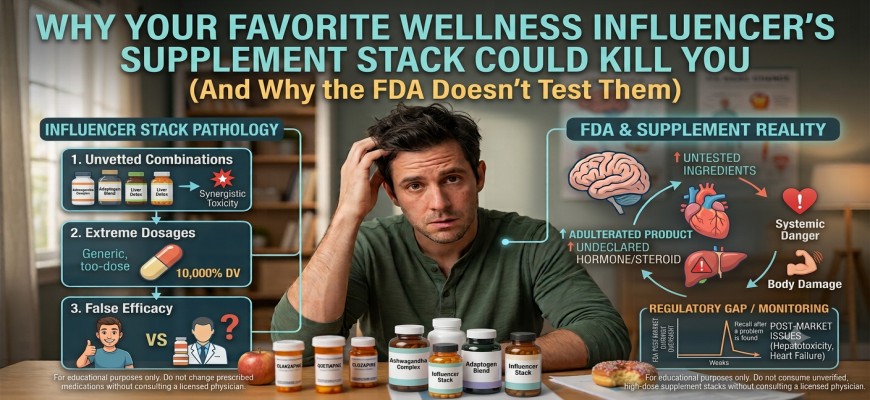
Why Your Favorite Wellness Influencer's Supplement Stack Could Kill You (And Why the FDA Doesn't Test Them)
A pharmacist's guide to the regulatory blind spot behind the 20-pill morning routine, the "natural" fat burner in your cart, and the liver damage nobody's Instagram caption warns you about.
Open any wellness influencer's page and you'll find the same ritual: a marble countertop, a row of amber bottles, and a caption promising "this changed my life." Ashwagandha for cortisol. NAD+ precursors for longevity. A "proprietary blend" fat burner. Twelve, fifteen, sometimes twenty capsules before 9 a.m., all framed as harmless, natural, optimized self-care.
Here's what almost none of those captions mention: in the United States, no government agency verifies that any of those products are safe, effective, or even contain what the label says, before they reach your bloodstream. This guide explains exactly why that regulatory gap exists, which categories of supplements carry the highest real-world risk, how influencer marketing exploits psychological shortcuts that bypass your normal skepticism, and how to protect yourself without giving up on wellness altogether.
Most people assume that if a product is legally sold in a store or shipped through a checkout page, someone in a lab coat has confirmed it's safe. For prescription drugs, that assumption is correct. For dietary supplements, it is not, and the reason comes down to a single piece of legislation.
The Dietary Supplement Health and Education Act of 1994 (DSHEA) classifies vitamins, minerals, herbs, amino acids, and "other botanicals" as a category separate from both food and drugs. Under this framework:
Influencers frequently reassure followers that a product is "third-party tested," which sounds like independent verification. In practice, this phrase is unregulated and can mean almost anything:
Without a recognized third-party seal — NSF Certified for Sport, USP Verified, or ConsumerLab Approved — the phrase "third-party tested" is a marketing claim, not a guarantee.
Understanding why influencer supplement stacks spread so effectively requires understanding a few well-documented psychological patterns that marketers — intentionally or not — exploit.
Years of daily videos create a parasocial relationship: viewers feel they "know" the influencer the way they know a friend, even though the relationship is entirely one-directional. That borrowed intimacy transfers to product recommendations. A stranger selling pills on a billboard triggers skepticism; the same pills recommended by someone whose morning routine you've watched for two years trigger almost none.
Humans reliably rate "natural" products as safer than synthetic ones, even when the actual risk profile is identical or worse. Arsenic, cyanide, and hemlock are natural. Many pharmaceutical-grade medications are safer, at correct doses, than unregulated herbal extracts at influencer-recommended megadoses. The word "natural" carries no legal or safety meaning on a supplement label.
A single testimonial ("this fixed my energy in 3 days") is cognitively far more persuasive than a statistic about population-level risk, even when the testimonial is unverifiable and the statistic is well-established. This is a known bias, not a personal failing — but it's precisely what supplement marketing is built to trigger.
A "stack" of 12-20 products feels thorough and scientific, as if each pill covers a different gap. In reality, stacking dramatically increases three risks simultaneously: nutrient megadosing, unknown interactions between the products themselves, and cumulative liver/kidney burden from processing everything at once — none of which show up until damage has already begun.
Not all supplements carry equal risk. Based on FDA adverse-event reports, poison control data, and published case series, these categories account for a disproportionate share of documented harm:
| Category | Common Marketing Angle | Primary Risk | Risk Level |
|---|---|---|---|
| Weight-loss / fat-burner blends | "Natural" thermogenic, appetite suppressant | Hidden stimulants, liver injury, cardiac events | Very High |
| Pre-workout / energy "stacks" | Focus, pump, endurance | Stimulant overload, arrhythmia, heat stroke risk | High |
| Sexual-enhancement supplements | "Natural Viagra" alternatives | Undisclosed PDE5-inhibitor drugs, dangerous BP drops with nitrates | Very High |
| High-dose fat-soluble vitamins (A, D, E, K) | Immune support, "optimization" | Accumulate in fat tissue; toxicity at sustained high doses | Moderate-High |
| Botanical liver/detox blends | "Cleansing," gut reset | Herb-induced liver injury (several botanicals directly hepatotoxic) | High |
| NAD+ / longevity precursor megadoses | Anti-aging, cellular energy | Limited long-term human safety data at influencer-level doses | Moderate (Unknown) |
| Bodybuilding "prohormones" | Natural muscle/testosterone support | Liver strain, hormonal disruption, some are unlisted anabolic steroids | Very High |
| Ayurvedic / imported traditional blends | Ancient wisdom, holistic healing | Heavy-metal contamination (lead, mercury, arsenic) in a meaningful subset of tested products | High |
These two categories are consistently the most frequent source of FDA warning letters because they have the strongest commercial incentive to work fast and feel dramatic — and the easiest way to guarantee a dramatic effect is to spike an herbal product with an actual, undisclosed drug. This is not a rare fringe problem; it is a recurring, well-documented pattern across more than a decade of FDA enforcement actions.
The single most dangerous category of supplement adulteration is the covert inclusion of active pharmaceutical ingredients that are never listed on the label. This isn't a theoretical risk — it is one of the FDA's most consistently documented enforcement problems.
Undisclosed sildenafil (Viagra) or tadalafil (Cialis) analogs are frequently found in products marketed as purely herbal. This is dangerous specifically for anyone taking nitrate medications for heart disease, where the combination can cause a life-threatening drop in blood pressure — a risk the consumer has no way of knowing about because the drug isn't on the label.
Undisclosed stimulants (including banned compounds like DMAA), and in some documented cases prescription-strength appetite suppressants or even antidepressants, have been found in products marketed as all-natural. Some historical outbreaks of acute liver failure have been traced directly to adulterated "natural" fat-burner supplements.
Unlisted synthetic anabolic steroids or steroid-like compounds have repeatedly been identified in products marketed as "natural testosterone boosters" or "prohormones."
Undisclosed prescription glucose-lowering drugs have been found in some "natural" blood-sugar supplements — extremely dangerous for anyone already on diabetes medication, since it can stack and cause severe hypoglycemia.
Independent lab testing of supplement products has repeatedly found a meaningful share of products with problems that have nothing to do with the intended ingredient at all:
| Contamination Type | Most Affected Categories | Health Concern |
|---|---|---|
| Heavy metals (lead, arsenic, mercury, cadmium) | Imported herbal/Ayurvedic blends, some protein powders, some greens powders | Neurological effects, kidney damage, cumulative toxicity with repeated dosing |
| Wrong dose (over-fill or under-fill) | Compounded and lightly-regulated supplement brands | Under-dosing wastes money; over-dosing raises toxicity risk unexpectedly |
| Wrong ingredient entirely | Cheaper botanical products with lookalike plant substitution | Unpredictable; the consumer has no way to anticipate the actual effect |
| Undeclared allergens | Protein powders, multi-ingredient blends | Allergic reactions in sensitive individuals with no warning on label |
| Microbial contamination | Poorly manufactured probiotic and greens products | Infection risk, especially in immunocompromised users |
Because pre-market testing isn't required, this kind of contamination is typically only discovered when an independent lab, a state health department, or an injured consumer flags it — often long after a product has been widely sold and consumed.
A supplement doesn't need to be adulterated or contaminated to be dangerous. Many well-known, legitimately herbal supplements have real, pharmacologically significant interactions with common prescription medications — interactions that influencer content almost never mentions because "ask your pharmacist about interactions" doesn't make for a compelling reel.
| Supplement | Interacts With | Effect |
|---|---|---|
| St. John's Wort | Antidepressants, birth control, blood thinners, many others | Dramatically speeds drug metabolism, reducing effectiveness of dozens of medications |
| Fish oil / high-dose omega-3 | Blood thinners (warfarin, aspirin) | Additive bleeding risk |
| Ginkgo biloba | Blood thinners, certain antidepressants | Increased bleeding risk; possible serotonin-related effects |
| High-dose vitamin K / green supplement blends | Warfarin | Directly counteracts blood-thinning effect |
| Red yeast rice | Statins | Contains a naturally occurring statin-like compound; combined use raises muscle-toxicity risk |
| Kava | Sedatives, alcohol, acetaminophen | Additive sedation; documented liver toxicity risk on its own |
| Licorice root (high dose) | Blood pressure medications, diuretics | Can raise blood pressure and deplete potassium |
| Calcium / iron megadoses | Thyroid medication, certain antibiotics | Blocks absorption when taken close together |
Your liver processes nearly everything you swallow, including every capsule in a 15-item stack. Herb- and supplement-induced liver injury is a well-recognized, actively studied category of drug-induced liver disease, and several popular categories — high-dose green tea extract, certain "detox" and weight-loss blends, kava, and some bodybuilding products — are repeatedly implicated in documented case reports of acute liver injury, in some cases severe enough to require hospitalization.
Megadoses of certain minerals (particularly excess vitamin C converting to oxalate, and chronically high protein-powder intake without adequate hydration) place sustained extra filtration burden on the kidneys. This kind of harm is typically silent for a long time before it shows up in lab work.
Combining caffeine, other plant-based stimulants (yohimbine, synephrine), and pre-workout "pump" formulas can push heart rate and blood pressure into dangerous territory, particularly in people with undiagnosed cardiac conditions who have no idea they're at elevated risk.
"Natural" testosterone and hormone-support products can measurably shift hormone levels, sometimes suppressing the body's own natural production over time — an effect users rarely connect back to the supplement because it develops gradually.
This phrase is one of the most reliable markers of low-quality supplement marketing. It reframes legitimate safety skepticism as a conspiracy to be dismissed, which conveniently removes the one habit — asking a pharmacist or doctor — most likely to catch a dangerous interaction or hidden ingredient before it causes harm.
NSF Certified for Sport, USP Verified, and ConsumerLab Approved are the three most credible independent verification programs currently available in the U.S. market. Their logos should be visibly printed on the label, not just claimed in marketing copy.
A legitimate manufacturer can provide a batch-specific CoA showing potency and contaminant testing results for the exact lot you purchased. If a company can't or won't provide this, treat that as a significant warning sign.
The FDA maintains public lists of tainted products and warning letters. A quick search of the product or brand name against these databases takes under a minute and can flag a known problem before you ever take the first dose.
Pharmacists have free, immediate access to interaction-checking tools that cross-reference your actual prescription list. This single step catches more real-world danger than any amount of Instagram research.
Legitimate nutrient repletion (correcting an actual deficiency) can feel noticeable within days. Nearly everything else marketed as "transformative in days" is either a stimulant effect, a diuretic effect, a placebo response, or — in the riskiest cases — an undisclosed drug doing the work.
Only after the fact, and only for specific ingredients or products where enough harm has already been documented to justify enforcement action. The FDA can issue warning letters, seize products, or ban a specific compound, but it does this reactively — after adverse events are reported — not proactively before a product reaches shelves.
No. Many genuinely believe in what they promote, and plenty of supplement categories (basic vitamin D, documented deficiencies, some evidence-backed options like creatine or magnesium) are reasonably safe for most healthy adults at sensible doses. The risk isn't influencers as a category — it's the combination of unregulated products, financial incentives to overstate benefits, and an audience that trusts the messenger more than the evidence.
Not on its own. "Natural" describes origin, not safety or dose. Many of the most dangerous substances known are entirely natural, and many synthetic pharmaceuticals are extremely well-studied and predictable at correct doses. Safety depends on the specific compound, the dose, the person's health status, and their other medications — not on whether it came from a plant.
There's no universal number, but every additional product adds interaction complexity that grows faster than the count itself. A stack of five products already creates ten possible two-way interactions; a stack of fifteen creates over a hundred. Beyond a small, deliberately chosen list — ideally reviewed by a pharmacist against your actual medications — the marginal benefit of adding more products drops sharply while the risk keeps climbing.
No. Price reflects marketing, packaging, and brand positioning far more than it reflects safety testing. Some of the most reassuring-looking premium brands have still been implicated in mislabeling or contamination findings by independent testers. Price is not a substitute for verification.
Stop taking it immediately, save the bottle and any remaining product (useful for testing and for reporting), and contact your doctor or pharmacist to discuss whether any monitoring — such as liver function tests — is warranted based on how long you took it and at what dose. You can also file a report with the FDA's MedWatch adverse event reporting program, which helps flag the product for further investigation.
Generally lower risk, but not risk-free. Independent testing has periodically found heavy-metal levels in some greens and protein powders that exceed recommended safety thresholds, particularly with daily long-term use. They're a much lower-harm category than adulterated weight-loss or sexual-enhancement products, but "lower risk" isn't the same as "no risk" — verification still matters.
Not necessarily. Some supplementation is genuinely useful — correcting a lab-confirmed deficiency, for example, or a small number of options with reasonably solid evidence behind them. The goal of this guide isn't to say "never take a supplement." It's to replace influencer-driven, unverified stacking with a smaller, deliberate, professionally reviewed approach.
This article is for educational purposes only and does not constitute medical advice. It is not a comprehensive list of every risky supplement, ingredient, or interaction, and it should not be used to diagnose or rule out any health condition. Do not start, stop, or change any supplement or medication regimen based on this article alone. Consult a licensed healthcare provider — ideally a pharmacist or physician familiar with your full medication list — before adding any new supplement, especially if you take prescription medications or have an existing health condition. If you experience any of the serious symptoms listed above, seek immediate medical attention. This content reflects general pharmacological understanding current as of September 2026; individual product risks change as new information and enforcement actions emerge.
 Fetroja (Cefiderocol) for Complicated UTIs: First Siderophore Cephalosporin and the Mortality Warning Every Patient Should Know (FDA Approved 2019)
Exblifep for Complicated UTIs: FDA Approval, Efficacy, & Usage Guide
Fetroja (Cefiderocol) for Complicated UTIs: First Siderophore Cephalosporin and the Mortality Warning Every Patient Should Know (FDA Approved 2019)
Exblifep for Complicated UTIs: FDA Approval, Efficacy, & Usage Guide
 Nuzyra (Omadacycline) for Pneumonia and Skin Infections: Modernized Tetracycline with IV-to-Oral Options (FDA Approved 2018)
 Zemdri (Plazomicin) for Complicated UTIs: Newer IV Aminoglycoside for Resistant Infections (FDA Approved 2018)