
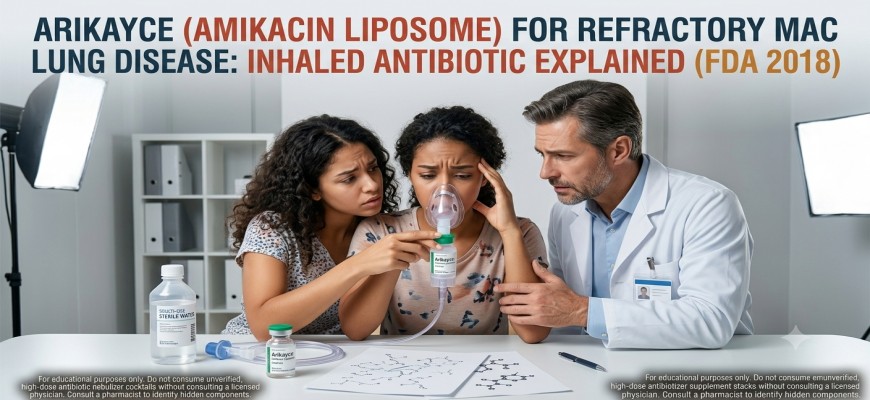
Arikayce (Amikacin Liposome) for Refractory MAC Lung Disease: Inhaled Antibiotic Explained (FDA Approved 2018)
Quick answer: Arikayce (amikacin liposome inhalation suspension) is an inhaled aminoglycoside antibiotic given by nebulizer. The U.S. Food and Drug Administration approved it on September 28, 2018, under an accelerated approval pathway, for adults with Mycobacterium avium complex (MAC) lung disease that is refractory, meaning it has not responded to conventional multidrug treatment. Arikayce is used as part of a combination antibacterial regimen, not alone. In the CONVERT trial, 29 percent of patients receiving Arikayce had no mycobacterial growth on three consecutive monthly sputum cultures by month six, compared with 9 percent of those receiving background therapy alone. The FDA required a post-market study to confirm clinical benefit. Bronchospasm is the key inhalation warning, and aminoglycoside-related hearing and kidney effects are possible. Treatment decisions belong to a lung specialist or infectious disease team.
Reading time: about 12 to 14 minutes. This article is educational and does not replace medical advice. MAC lung disease is a chronic condition that requires specialist care, so discuss any symptoms or treatment questions with your clinician.
Why MAC Lung Disease Is Hard to Treat
A Nontuberculous Mycobacterial Infection
Mycobacterium avium complex is a group of nontuberculous mycobacteria found in water and soil. Most people are exposed without becoming ill, but in some, particularly older adults and people with chronic lung disease, MAC can cause a slowly progressive lung infection. Symptoms often include chronic cough, fatigue, weight loss, and sputum production.
Long Treatment With Limited Options
Standard treatment usually combines several drugs, including a macrolide, rifamycin, and ethambutol, for many months. Some patients do not respond, or they relapse, and the infection can cause irreversible lung damage.
Why a New Approach Was Needed
For patients whose disease is refractory, clinicians needed an option that could deliver high drug levels to the lungs while limiting whole-body exposure to aminoglycoside toxicity. Inhaled delivery was designed to address that gap.
Key Takeaways
- Arikayce (amikacin liposome inhalation suspension) received FDA accelerated approval on September 28, 2018, for adults with refractory MAC lung disease.
- It is approved only as part of a combination antibacterial regimen for patients with limited or no alternative treatment options.
- In CONVERT, 29 percent of Arikayce recipients achieved three consecutive negative monthly sputum cultures by month six, compared with 9 percent of those receiving background therapy alone.
- The approval is accelerated, and the sponsor must complete a post-market study to confirm clinical benefit.
- Bronchospasm is the key warning for inhaled use. Aminoglycoside-related hearing and kidney effects are possible.
- Arikayce is not recommended for patients with non-refractory MAC lung disease, and it is not used alone.
What Is Arikayce
Brand and Generic Names
Arikayce is the brand name for amikacin liposome, developed by Insmed. Amikacin is an aminoglycoside antibiotic that has been used for decades as an IV drug. The liposome formulation packages amikacin in lipid particles designed for inhaled delivery.
Dosage Form
Arikayce is an inhalation suspension given through a nebulizer. It is not a tablet or IV drug, and patients use it according to a prescribed schedule with equipment and instructions from their care team.
Drug Class
Aminoglycosides work by binding bacterial ribosomes and disrupting protein synthesis. Their activity is concentration-dependent. Inhaled delivery aims to concentrate the drug in the lungs, where the infection sits.
FDA Approval: September 28, 2018
The Decision
The FDA approved Arikayce on September 28, 2018, under the accelerated approval pathway. The label covers adults with MAC lung disease that is refractory, used as part of a combination antibacterial regimen in patients with limited or no alternative treatment options.
Limited Population Pathway
Arikayce was the first drug approved under the Limited Population Pathway for Antibacterial and Antifungal Drugs, known as LPAD. This pathway is designed for serious infections in small populations where traditional trials may be difficult.
Post-Market Requirement
Because the approval relied on a surrogate endpoint, the FDA required the sponsor to conduct a randomized, placebo-controlled study to describe clinical benefit. Patients and clinicians should check the current label for updates from that work.
What Refractory Disease Means
Definition
Refractory MAC lung disease generally means persistent positive cultures despite appropriate multidrug therapy over time. The label states that Arikayce has only been studied in patients with this form of disease.
Why This Limit Exists
The evidence supporting Arikayce comes from patients with refractory disease. Its use in other patients is not established, which is why the label says it is not recommended for non-refractory disease.
Confirming Eligibility
Your specialist reviews culture history, prior treatment, and imaging to decide whether your disease meets the refractory definition.
How the Liposome Delivery Works
Concentrating Drug in the Lungs
Inhalation delivers amikacin directly to the airways and lung tissue. The liposome carrier is designed to keep drug levels high in lung tissue for longer while reducing the amount that reaches the bloodstream.
Reduced Whole-Body Exposure
Because systemic exposure is much lower than with IV amikacin, the goal is to limit aminoglycoside toxicity in other organs. Systemic effects are still possible, so monitoring remains important.
Action Against Mycobacteria
Once in the lung, amikacin acts on the bacterial ribosome to disrupt protein synthesis. Combined with other drugs in the regimen, this helps clear the organism.
Which Organisms It Targets
Labeled Organisms
The label covers MAC lung disease caused by Mycobacterium avium complex organisms, including Mycobacterium avium and Mycobacterium intracellulare, in patients with refractory disease.
Susceptibility Testing
Laboratory testing determines whether a specific isolate is susceptible. Some MAC strains are resistant to amikacin, which is why testing matters before and during treatment.
Not for Other Infections
Arikayce is not indicated for tuberculosis, other nontuberculous mycobacteria beyond the labeled MAC indication, or non-pulmonary infections.
Approved Use and Labeling Limits
Who Is Eligible
The labeled population is adults with refractory MAC lung disease who have limited or no alternative treatment options, as part of a combination antibacterial regimen.
Not Recommended For
Patients with non-refractory MAC lung disease are not recommended for Arikayce under the label. Children are also outside the labeled population.
Stewardship Statement
The label emphasizes using Arikayce as part of a regimen and reserving it for patients who need it. This protects its usefulness for people with limited options.
The CONVERT Trial: Design
Overview
CONVERT was a randomized, controlled phase 3 trial in patients with refractory MAC lung disease. Participants received guideline-based therapy with or without Arikayce. The FDA's approval relied on the trial's sputum culture endpoint.
Comparator
The comparator arm received background guideline-based therapy alone. This design isolates the contribution of adding Arikayce to an existing regimen.
Primary Endpoint
The endpoint was culture conversion, defined as three consecutive negative monthly sputum cultures by month six of treatment.
The CONVERT Trial: Results
Culture Conversion
According to the FDA, 29 percent of patients receiving Arikayce achieved three consecutive negative monthly sputum cultures by month six, compared with 9 percent of patients not receiving it.
What Culture Conversion Means
Sputum culture conversion indicates that the organism is no longer detected in lung samples over several months. It is a surrogate marker, not a direct measure of symptoms, quality of life, or survival.
Reading the Results
The difference is meaningful, but the absolute response rate was modest. Many patients did not convert, and the long-term clinical benefit is what the post-market study is meant to define.
Why Accelerated Approval Matters
What Accelerated Means
Accelerated approval allows a drug to reach patients based on a surrogate endpoint likely to predict clinical benefit. The sponsor must then confirm benefit through additional studies.
Why It Was Used Here
MAC lung disease in refractory patients is serious, and options are limited. The FDA judged that patients should have access while the confirmatory study proceeds.
What Patients Should Know
Accelerated approval means the evidence is still developing. Ask your specialist about the latest data and whether participation in research is an option.
Dosing and Nebulizer Use
Labeled Regimen
Arikayce is given by nebulizer, with the labeled dose and schedule specified in the prescribing information. Confirm the current dose and frequency with your prescriber rather than relying on this summary.
Equipment
Patients use a specific nebulizer system. Using other equipment can change the delivered dose, so follow your team's training carefully.
Schedule and Adherence
Treatment is given on a set schedule as part of a long-term regimen. Missed doses should be reported to the care team so they can advise on what to do.
Pretreatment With a Bronchodilator
Why It Matters
Because inhaled drugs can trigger airway narrowing, the label recommends a bronchodilator before each Arikayce dose in many patients. This helps reduce the risk of bronchospasm.
Follow the Plan
Use the bronchodilator exactly as your specialist directs, including timing before the nebulizer treatment.
Rescue Medicines
Keep any prescribed rescue inhaler available and know when to use it. Report wheezing or breathlessness promptly.
Bronchospasm Warning
What It Is
Bronchospasm is sudden narrowing of the airways causing wheezing, chest tightness, and shortness of breath. It is the key warning for inhaled Arikayce and was reported in clinical trials.
What to Do
If you develop wheezing or breathing difficulty during or after a treatment, use your rescue inhaler as directed and contact your care team. Severe breathing trouble requires emergency care.
Who Is at Higher Risk
People with asthma, COPD, or airway hyperresponsiveness need careful monitoring, and their team may adjust pretreatment.
Hearing and Balance Effects
Aminoglycoside Risk
Aminoglycosides can damage the inner ear. Systemic exposure from inhaled Arikayce is much lower than from IV amikacin, but hearing and balance effects remain possible.
Monitoring
Your team may check hearing during long-term treatment, especially if you already have hearing loss or balance problems.
What to Report
Report ringing in the ears, hearing loss, dizziness, or unsteadiness. Some ototoxic effects can persist after treatment stops.
Kidney Effects and Monitoring
Why Kidney Function Matters
Aminoglycosides can affect the kidneys. Because Arikayce is inhaled, systemic kidney exposure is lower than with IV therapy, but monitoring remains part of safe care.
Monitoring Plan
Your team may check kidney function periodically, especially if you take other medicines that can affect the kidneys.
What to Report
Report reduced urine output, swelling, unusual tiredness, or changes in how you feel.
Common Side Effects
Respiratory Effects
Cough, throat irritation, and voice changes can occur with inhaled therapy. Bronchospasm is the most important respiratory warning.
Other Effects
Nausea, headache, and changes in taste have been reported in clinical use. Report any side effects that are bothersome or persistent.
Infection Risk
Because MAC lung disease is chronic and treatment is long, your team monitors for new respiratory infections and other complications.
Who Should Not Use Arikayce
Known Allergy
People with a known allergy to amikacin or other aminoglycosides should not use Arikayce without specialist review.
Non-Refractory Disease
Patients with non-refractory MAC lung disease are not recommended for the drug under the label.
Airway Conditions
People with significant airway hyperresponsiveness or recent bronchospasm need individualized planning and close monitoring.
Drug Interactions
Other Aminoglycosides and Nephrotoxic Drugs
Combining aminoglycosides with other drugs that affect the kidneys or ears increases risk. Your team will review your medicines carefully.
Neuromuscular Blockers
Aminoglycosides can affect neuromuscular transmission. Tell your team about any medicines that relax muscles.
Full Medication Review
Give your care team a full list of medications, including prescriptions, over-the-counter products, and supplements.
Why It Is Used in Combination
Multidrug Therapy
MAC treatment relies on multiple drugs to reduce the risk of resistance. Arikayce is added to a background regimen rather than replacing it.
Resistance Concerns
Using a single drug against MAC can lead to resistance. The combination approach helps protect the effectiveness of each drug.
Your Regimen
Your specialist selects the background drugs based on your culture results, prior treatment, and tolerance.
How Arikayce Compares With Other Options
Background Therapy
Background guideline-based therapy, typically including a macrolide, is the foundation of MAC treatment. Arikayce is an add-on for refractory disease.
Intravenous Amikacin
IV amikacin has broader systemic exposure and greater toxicity risk. Inhaled delivery aims to concentrate the drug in the lungs while limiting whole-body effects.
Other Options
Other treatments for MAC are selected based on the patient's organism, prior therapy, and tolerance. Surgery is sometimes considered in carefully chosen cases.
Monitoring Sputum Cultures
Why Cultures Matter
Sputum cultures track whether the organism is cleared over time. Regular testing guides decisions about continuing, adjusting, or stopping therapy.
What to Expect
Culture conversion can take months. Your team will explain how often cultures are checked and what results mean for your plan.
Sample Quality
Producing a good sputum sample is important. Your team can give guidance on collecting samples correctly.
Antibiotic Stewardship
Use for Appropriate Patients
Arikayce is reserved for refractory disease with limited alternatives, which protects its usefulness and limits unnecessary exposure.
Resistance Monitoring
Laboratories test MAC isolates for amikacin susceptibility. Resistance findings guide whether continued use is appropriate.
Protecting the Drug
Because amikacin is an important antibiotic class, responsible use helps preserve it for future patients.
Availability and Cost
Availability
Arikayce is dispensed through specialty pharmacy channels and requires coordination with the prescriber. Your care team can confirm access.
Cost
Arikayce is a specialty drug and is expensive. Costs and coverage vary, so ask your insurer, specialty pharmacy, or manufacturer support program for current details.
Coverage
Coverage for FDA-approved indications is generally more straightforward. Prior authorization is usually required.
Pregnancy, Breastfeeding, and Children
Pregnancy
Aminoglycosides can affect fetal hearing. Decisions about Arikayce in pregnancy require careful review by the treating specialists.
Breastfeeding
Discuss breastfeeding with your care team before starting treatment.
Children
The labeled population is adults. Use in children is outside the labeled indication.
Questions to Ask Your Care Team
- Does my disease meet the definition of refractory MAC lung disease?
- Which background drugs will I take with Arikayce?
- What bronchodilator should I use before each dose, and when?
- How will my hearing, kidney function, and sputum cultures be monitored?
- What breathing symptoms should I report right away?
Frequently Asked Questions
Q: What is Arikayce used for?
A: It is approved for adults with refractory MAC lung disease, used as part of a combination antibacterial regimen.
Q: When was it approved?
A: The FDA granted accelerated approval on September 28, 2018.
Q: Is it taken by mouth?
A: No. It is inhaled using a nebulizer.
Q: How well did it work?
A: In CONVERT, 29 percent of patients receiving Arikayce achieved culture conversion at month six, compared with 9 percent without it. A post-market study is ongoing.
Q: What is the main safety concern?
A: Bronchospasm. Hearing and kidney effects are also possible because it is an aminoglycoside.
Q: Can I use it alone?
A: No. It is used with other drugs as part of a regimen.
Q: Who should not use it?
A: People with known aminoglycoside allergy should not use it. Patients with non-refractory disease are not recommended for it under the label.
Medical Disclaimer
This article is for general education only and does not provide medical advice, diagnosis, or treatment. MAC lung disease is a chronic condition that requires evaluation by a lung or infectious disease specialist. Do not start, stop, or change any medication without guidance from your care team. For dosing, warnings, and interactions, consult the current U.S. prescribing information on DailyMed. If you have severe breathing difficulty, chest pain, or coughing up blood, seek emergency care immediately.
Sources and Further Reading
- U.S. FDA approval package for Arikayce (NDA 207356), approval date September 28, 2018
- FDA press announcement on approval of Arikayce for refractory MAC lung disease, 2018
- Insmed press release announcing FDA approval, September 28, 2018
- Drugs.com Arikayce FDA approval history
- CONVERT phase 3 trial publications and summaries
- ATS/IDSA guidelines on nontuberculous mycobacterial disease
- Arikayce U.S. Prescribing Information, including dosing, bronchodilator pretreatment, warnings, and adverse reactions
This article reflects information available as of October 2026. Confirm current prescribing details with your healthcare provider and the latest FDA labeling. For more on MyOnlineMedShop, visit our blog or contact us.