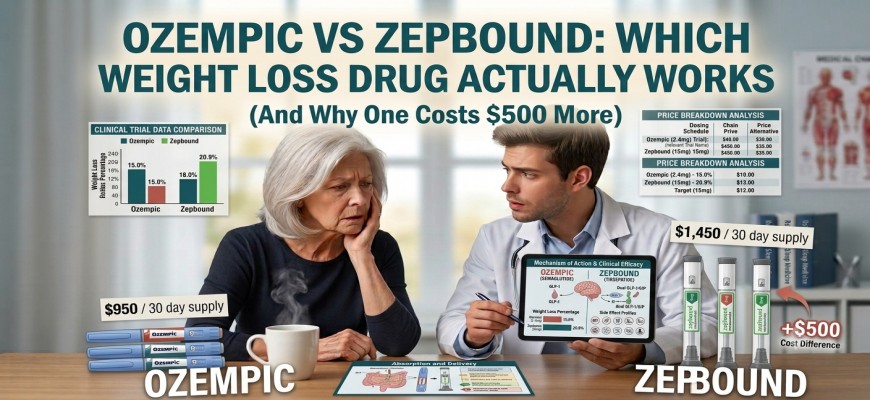
Ozempic vs Zepbound: Which Weight Loss Drug Actually Works (And Why One Costs $500 More)
You've heard the hype. Celebrities are using them. Your friend lost 30 pounds in three months. Social media is obsessed. But when you look at the price — Ozempic $900-1200/month, Zepbound $500-700/month, sometimes even more — and the confusion about which one you should actually use, you freeze. Are they the same drug? Is one "better"? Why does one cost double? And most importantly: which one will actually work for you?
After 17 years as a licensed pharmacist watching the GLP-1 agonist market explode, I've filled hundreds of prescriptions for both. I've seen real results, real side effects, real people confused by marketing. Here's what the pharmaceutical companies don't explain clearly, but you need to understand before spending $1000+ per month.
No. They're related but fundamentally different compounds, even though the marketing makes them sound interchangeable.
Here's what you need to know immediately:
Both are injectable medications that affect how your body regulates appetite and blood sugar. But they work on different receptors in your brain and body, which means they have different effects, different potency, and different side effect profiles.
Critical Point: Ozempic was never designed for weight loss. It was designed for diabetes. The fact that people lose weight on it was a side effect. Zepbound was specifically engineered to maximize weight loss. This distinction matters more than you think.
This is where the real difference lives. Understanding this 60-second explanation changes everything about how you think about these drugs.
Ozempic (semaglutide): Targets GLP-1 receptors exclusively. GLP-1 is a hormone that tells your brain "you're full, stop eating." It also slows digestion and helps with blood sugar regulation.
Zepbound (tirzepatide): Targets both GLP-1 AND GIP receptors. GIP is another hormone — it adds an additional appetite suppression signal on top of what GLP-1 does.
Think of it like this: Ozempic hits one brake pedal on appetite. Zepbound hits two brake pedals simultaneously. More signals = stronger appetite suppression = more weight loss for most people.
This dual-agonist design is why Zepbound is consistently more effective at weight loss in clinical trials. It's not marketing — it's chemistry.
Here's a fact that confuses everyone:
Ozempic is FDA-approved ONLY for type 2 diabetes. When doctors prescribe it for weight loss, they're using it off-label — medically sound, but technically not FDA-approved for that indication.
Zepbound is FDA-approved specifically for weight loss. This means clinical trials tested it for weight loss, not as a side benefit of diabetes management.
Why does this matter?
Bottom line: Zepbound was purpose-built for weight loss. Ozempic was purpose-built for diabetes and happens to cause weight loss. This difference affects everything downstream.
Before GLP-1 agonists, weight loss drugs didn't really work. Appetite suppressants were stimulants (dangerous), and most had serious side effects.
GLP-1 agonists changed everything because they work WITH your body's natural systems instead of fighting them.
Here's what happens when you inject Ozempic or Zepbound:
This is why people can lose weight without starving themselves. They're genuinely not hungry. A person on Ozempic or Zepbound might naturally eat 500-800 fewer calories per day because they feel satisfied with less.
The Zepbound advantage: the dual GLP-1/GIP targeting amplifies this effect, making the appetite suppression stronger and weight loss faster.
Clinical trials tell the real story. Here are the actual numbers:
| Medication | Trial Duration | Average Weight Loss | % of Body Weight | Study Population |
|---|---|---|---|---|
| Ozempic 2.4mg (diabetes studies, weight loss observed) | 52 weeks | 5-8 kg (11-18 lbs) | 5-9% | Type 2 diabetes patients |
| Wegovy 2.4mg (same as Ozempic, weight loss studies) | 68 weeks | 10-16 kg (22-35 lbs) | 10-16% | Weight loss patients without diabetes |
| Zepbound 15mg (highest maintenance dose) | 72 weeks | 20-22 kg (44-49 lbs) | 20-22% | Weight loss patients without diabetes |
The numbers are clear: Zepbound users lose roughly 2-3x more weight than Ozempic users in comparable time periods.
Why such a dramatic difference? Multiple factors:
Real-world experience: Users report faster weight loss with Zepbound, usually noticing effects by week 2-3. Ozempic users typically see results after 4-6 weeks.
Pharmacist's Note: "Better" weight loss doesn't always mean "better for you." Some people lose weight faster than their skin can adjust, leading to loose skin. Some people's bodies respond better to one compound than the other. The data says Zepbound works better on average — but individual variation is huge.
Both drugs are dosed weekly via injection, but the dose ranges are different, and that changes the cost-effectiveness calculation.
| Drug | Standard Doses | Ramp-Up Schedule | Maintenance |
|---|---|---|---|
| Ozempic (semaglutide) | 0.25mg, 0.5mg, 1mg, 2.4mg | Start 0.25mg, increase weekly | Usually 0.5-2.4mg weekly |
| Zepbound (tirzepatide) | 2.5mg, 5mg, 7.5mg, 10mg, 15mg | Start 2.5mg, increase every 4 weeks | Usually 10-15mg weekly |
Key differences:
For weight loss specifically, Zepbound's slower ramp-up is actually an advantage — your body adjusts gradually, side effects are more manageable, and you reach the effective dose with fewer nausea complaints.
Both drugs have side effects. Both are generally tolerable. But they differ in frequency and intensity.
| Side Effect | Ozempic Users | Zepbound Users | Notes |
|---|---|---|---|
| Nausea | 25-40% | 20-35% | Both high; Zepbound slightly lower due to slower ramp-up |
| Vomiting | 5-10% | 3-7% | Zepbound generally better tolerated |
| Diarrhea/Constipation | 15-25% | 12-20% | Fluctuates; usually improves with time |
| Fatigue/Weakness | 8-15% | 6-12% | Often diet-related (too little protein/calories) |
| Headache | 5-12% | 4-10% | Usually mild, improves over time |
| Muscle Aches | 2-5% | 2-4% | Rare; usually protein deficiency |
The pattern: Zepbound has a slight advantage in side effect profile, likely because the slower dose escalation gives your body time to adapt. But honestly, both are well-tolerated for most people once they get past the first 2-3 weeks.
Nausea is the #1 complaint about both drugs. It's also the #1 reason people quit them. So let's address it directly.
Why does it happen?
GLP-1 agonists slow your digestion. Your stomach empties slower. You feel full faster. This is great for weight loss, but in week 1-2, your brain thinks something is wrong (nausea signal). It gets better as your body adapts, usually by week 3-4.
How to manage it:
Real talk: If you can get past week 3 without quitting, nausea usually becomes manageable. Most people report it goes from "noticeable" to "minor" to "gone" over the first month.
This is the number that makes people's heads explode. Let's break down why.
| Drug & Dose | List Price/Month (1 pen) | Price Per mg | Notes |
|---|---|---|---|
| Ozempic 2.4mg (1 pen/month) | $900-1200 | $375-500/mg | Novo Nordisk brand name |
| Generic Semaglutide 2.4mg | $400-600 | $167-250/mg | Compounded or authorized generic |
| Zepbound 15mg (1 pen/month) | $500-700 | $33-47/mg | Eli Lilly brand; newer on market |
| Generic Tirzepatide 15mg | $250-400 | $17-27/mg | More generic options emerging |
Why does Ozempic cost so much?
The real cost comparison:
If we normalize for weight loss effectiveness, Zepbound is often 50-70% cheaper per actual result. You lose more weight on Zepbound for less money, despite both costing $500-1200/month.
Cost Hack: Check GoodRx, manufacturer savings cards, and compounded versions. Compounded semaglutide often costs $300-400/month. Generic tirzepatide costs $250-350/month. Insurance coverage varies wildly — some people pay $0 copay, others $300+ OOP. Always check before committing.
This is where dreams meet reality for most people.
Ozempic coverage:
Zepbound coverage:
The access problem:
Both drugs face insurance barriers. Most people end up paying cash or using manufacturer savings programs. Novo Nordisk and Eli Lilly both offer patient assistance programs that reduce cost to $0-250/month if you qualify (usually based on income).
Real strategy: Apply for both manufacturer programs. Whichever you get approved for cheapest, that becomes your choice — not the drug's merits, but the affordability reality.
In 2023-2024, Ozempic/Wegovy faced massive shortages. People couldn't get them. This changed everything.
Current status (August 2026):
The availability difference favors Zepbound. Ozempic had brand recognition during the shortage, which led to shortages. Zepbound came late but Eli Lilly learned from that mistake and prepared manufacturing capacity.
For practical purposes: Zepbound is easier to obtain right now. This could change, but it's a real advantage today.
Everyone asks the same question: "What happens when I stop?"
Honest answer: You regain weight if you don't change your eating habits and exercise. These drugs don't teach you new behaviors — they suppress appetite while you take them.
What the data shows:
People who lose 20 lbs on semaglutide/tirzepatide and then stop typically regain 50-75% of it within 6-12 months if nothing else changes (diet, exercise, habits).
People who lose 20 lbs AND establish exercise habits and lower calorie preference often maintain 60-70% of the loss long-term.
The real strategy: These drugs buy you time and appetite suppression while you build new habits. They're not permanent solutions. Use them to establish a pattern of eating less and moving more — then you can potentially reduce or discontinue them while maintaining results.
Both drugs seem equivalent for long-term use. Neither provides lasting appetite suppression after discontinuation. The difference is minimal.
Here's my decision framework based on 17 years of filling these prescriptions and seeing real outcomes:
My honest take: If money is equal and you don't have diabetes, Zepbound is the better choice. It was engineered for weight loss, the efficacy data is stronger, and your body will adapt more easily. But Ozempic works — it's just older technology in a newer application.
People often ask: "Can I take this with other weight loss drugs? Can I combine them?"
Ozempic + Zepbound: NEVER — Don't combine two GLP-1/GIP agonists. You'd be amplifying the same mechanism dangerously. Risk: severe nausea, hypoglycemia, kidney issues.
Ozempic/Zepbound + Phentermine: Possible but risky. Phentermine is a stimulant; GLP-1 agonists also affect your nervous system. Combination can cause heart palpitations, severe anxiety. Only do this with doctor oversight.
Ozempic/Zepbound + Naltrexone/Bupropion (Contrave): Generally safe. Different mechanisms. Some physicians do this combination for additive effects. Safe but requires monitoring.
Ozempic/Zepbound + Orlistat: Safe. Different mechanisms (one appetite suppression, one fat absorption blocking). No contraindication. Can work together.
Real talk: Most people don't need to stack. A good GLP-1 agonist + diet + exercise works well enough that adding more drugs just adds side effects. Start with one, optimize it, then consider adding if needed.
No established evidence of pancreas damage. Thyroid concern comes from animal studies (rodents on very high doses developed thyroid tumors). Human data doesn't show this risk at therapeutic doses. Get baseline thyroid labs and monitor, but it's not a contraindication.
Both are Category C in pregnancy — animal studies show some risk, human data is limited. General guidance: stop before conception, use contraception while on them. Not recommended for pregnancy.
No. But you need to change eating habits to maintain weight loss after stopping. These drugs work while you take them. Off them, your appetite returns to baseline unless you've established new patterns.
Both are generally safe in healthy people. Ozempic has longer track record (diabetes use since 2017). Zepbound is newer but made by a reputable company (Eli Lilly). Safety profiles are similar. Choose based on efficacy and cost.
Compounded versions exist, gray-market sources exist. Quality control is questionable. Manufacturer assistance programs are safer and often cheaper than sketchy online sources. Use legitimate programs first.
Week 2-3 typically. First sign: nausea (means the drug is working). By week 4: appetite suppression is real, weight loss becomes measurable. Full effect takes 8-12 weeks at stable dose.
You can switch. Both work on similar mechanisms but different receptors, so individual variation exists. If Ozempic doesn't work, Zepbound might. If neither works, you might need different approach entirely.
No. These are FDA-approved medications. Using them is medical care, not cheating. Anyone with significant weight to lose should consider them if they have the means.
Ozempic and Zepbound are both legitimate, effective weight loss medications — but they're not the same. Zepbound is newer, more potent, and purpose-built for weight loss; Ozempic is proven but originally designed for diabetes. Zepbound will work better for most people wanting maximum weight loss. Ozempic is better if you have diabetes or prefer a gentler approach. The price difference ($200-500/month) is real, but manufacturer programs can cut it in half. The real limitation isn't which drug is "better" — it's finding affordable access. Start with manufacturer assistance, then decide based on actual cost and medical fit, not marketing hype.
Medical Disclaimer: This article is provided for general educational purposes and reflects current pharmacological information about semaglutide (Ozempic/Wegovy) and tirzepatide (Zepbound). It does not constitute personal medical advice. Both medications are prescription-only. Weight loss medications are not appropriate for everyone. Always consult with a qualified healthcare provider before starting, changing, or discontinuing any medication. Individual results vary based on health status, lifestyle, genetics, and other factors. This article is for information only and should not replace professional medical guidance.
 Fetroja (Cefiderocol) for Complicated UTIs: First Siderophore Cephalosporin and the Mortality Warning Every Patient Should Know (FDA Approved 2019)
Exblifep for Complicated UTIs: FDA Approval, Efficacy, & Usage Guide
Fetroja (Cefiderocol) for Complicated UTIs: First Siderophore Cephalosporin and the Mortality Warning Every Patient Should Know (FDA Approved 2019)
Exblifep for Complicated UTIs: FDA Approval, Efficacy, & Usage Guide
 Nuzyra (Omadacycline) for Pneumonia and Skin Infections: Modernized Tetracycline with IV-to-Oral Options (FDA Approved 2018)
 Zemdri (Plazomicin) for Complicated UTIs: Newer IV Aminoglycoside for Resistant Infections (FDA Approved 2018)