
Scientists Just Found a Hidden Cause of High Blood Pressure That Your Doctor's Office Can't Detect — What Nighttime Hormone Surges Are Doing to Your Heart
A pharmacist's guide to a newly published wearable-device study revealing nighttime hormone surges behind one of the most commonly missed, and most treatable, causes of high blood pressure — and why the standard blood test you've probably had may not be catching it.
Roughly one in three American adults has high blood pressure, and for most of them, the explanation their doctor offers is broad and familiar: genetics, weight, salt intake, stress, aging arteries. But new research published this month in the journal Science Translational Medicine points to something far more specific hiding underneath a meaningful share of those cases — a hormone disorder called primary aldosteronism, and a nighttime pattern of hormone surges that routine daytime blood tests are structurally unlikely to ever catch.
This matters enormously because, unlike most high blood pressure, primary aldosteronism is often directly treatable, and in some cases curable, once it's actually identified. Researchers from the University of Bristol, the University of Manchester, the University of Bergen, and collaborators in Stockholm and Athens used a novel wearable device to track hormone levels around the clock, including through sleep, and found a hidden nighttime signal that conventional testing — built around single daytime blood draws — is simply not designed to detect. This guide breaks down what primary aldosteronism actually is, why it's been so persistently underdiagnosed, what this new study found, and what it means for anyone managing blood pressure that doesn't quite behave the way it's "supposed to."
Primary aldosteronism is a hormone disorder in which one or both adrenal glands — small glands that sit above each kidney — produce too much aldosterone, a hormone that normally helps regulate the body's balance of salt, water, and blood pressure. When aldosterone production runs persistently or intermittently too high, the result is elevated blood pressure that stems from a specific, identifiable hormonal cause rather than the more diffuse, harder-to-pin-down factors behind most "essential" hypertension.
This isn't a rare or obscure condition. Research estimates it may affect up to one in five people with high blood pressure, making it one of the most common identifiable, specific causes of hypertension — and yet it remains dramatically underdiagnosed relative to how frequently it actually occurs.
If primary aldosteronism is this common and this consequential, a reasonable question is why it isn't caught more often. The answer, according to the new research, comes down to a structural mismatch between how the condition actually behaves and how it's conventionally tested for.
Conventional blood tests for primary aldosteronism are built around the assumption that if someone has the condition, their aldosterone levels will be consistently elevated whenever tested — a single daytime blood draw, taken at essentially any reasonably convenient clinic appointment, should be enough to catch it.
The new study found that this assumption doesn't hold for a meaningful number of patients. Rather than staying persistently high, aldosterone levels in people with the condition often fluctuate substantially over the course of a day and night, with repeated surges rather than one continuously elevated level. Critically, the researchers found that even in some of the more severe cases studied, hormone levels periodically dipped below the thresholds conventionally used to diagnose the condition — meaning a patient tested during one of those lower windows could receive a falsely reassuring, "normal-looking" result despite having the disorder.
To get around the limitations of single-timepoint blood testing, the research team used a wearable device developed at the University of Bristol, called U-RHYTHM, roughly the size of a mobile phone and worn at the waist. The device continuously sampled hormones through the skin approximately every 20 minutes, allowing researchers to track hormone patterns over a full 24-hour period while participants went about ordinary daily life at home, including sleeping in their own bed rather than a hospital setting.
| Finding | What It Means |
|---|---|
| Repeated hormone surges rather than constant elevation | Patients with primary aldosteronism showed distinct bursts of hormone production throughout the day and night, rather than one flat, persistently high level |
| Prominent nighttime bursts, particularly during sleep | A previously unrecognized pattern of nocturnal hormone secretion was identified — occurring specifically at a time when routine clinical blood testing essentially never happens |
| Pattern especially pronounced in single-gland (unilateral) disease | The nighttime surge pattern was particularly noticeable in patients whose condition originated from an abnormality in just one adrenal gland rather than both |
| Pattern disappeared after surgical treatment | When the affected adrenal gland was surgically removed, the abnormal hormone pattern went away — strong supporting evidence that the nighttime bursts were directly caused by the disease itself, not an unrelated artifact |
According to the study's senior author, continuous 24-hour monitoring revealed a previously hidden pattern of nocturnal hormone bursts that gives researchers and clinicians a much clearer picture of how the disease actually behaves — insight that could eventually help doctors both detect the condition earlier and treat it more precisely.
The nighttime timing of these hormone surges isn't incidental — it's arguably the central finding of the study, and it explains a structural blind spot that's likely existed in hypertension care for a long time.
Routine blood draws are, for entirely practical reasons, performed during clinic hours while a patient is awake and available — meaning conventional testing has essentially never been able to observe what's happening hormonally while someone sleeps, which is precisely when this new research found some of the most significant activity occurring.
Notably, the researchers found that the overall day-night rhythm of hormone secretion remained intact in these patients — the abnormality was in the form of repeated bursts layered on top of that rhythm, not a wholesale disruption of it. This subtlety likely made the pattern especially easy to overlook without the kind of continuous, high-frequency monitoring this new device provided.
Understanding the existing diagnostic pathway helps clarify exactly where this new research fits in, and what hasn't changed yet.
The standard first step is a blood test measuring the ratio between aldosterone and renin (another hormone involved in blood pressure regulation), typically performed during a routine daytime clinic visit.
If the initial screening result is suggestive, further confirmatory testing is generally used to verify the diagnosis before proceeding further.
Once confirmed, imaging (such as a CT scan) and sometimes additional specialized testing help determine whether the excess hormone production is coming from one adrenal gland or both, which directly affects treatment choice.
Based on whether the condition affects one gland or both, treatment proceeds either toward surgery or toward specific medication, covered in more detail below.
This entire pathway still relies on conventional, single-timepoint testing as its starting point — which is exactly the step the new wearable-device research suggests may be missing a meaningful number of true cases, particularly those whose abnormal hormone activity is concentrated during sleep.
Not everyone with high blood pressure needs to be screened for primary aldosteronism, but certain patterns and risk factors make it substantially more worth raising with a doctor.
| Pattern or Risk Factor | Why It Raises Suspicion |
|---|---|
| Blood pressure that's difficult to control despite multiple medications | Primary aldosteronism is disproportionately common among people with treatment-resistant hypertension |
| High blood pressure combined with unexplained low potassium levels | Excess aldosterone can cause the kidneys to excrete more potassium than normal, though notably, many people with the condition have entirely normal potassium levels, so its absence doesn't rule anything out |
| High blood pressure diagnosed at a younger age than typical | An identifiable hormonal cause is more likely to be found when hypertension develops earlier than the general population average |
| A family history of early-onset high blood pressure or stroke | Certain hereditary forms of the condition run in families |
| An incidentally discovered adrenal mass on imaging done for another reason | A visible adrenal abnormality warrants hormonal evaluation even without other suggestive symptoms |
| High blood pressure combined with sleep apnea | The two conditions frequently co-occur, and current guidelines already recommend considering aldosteronism screening in this population |
Chronically elevated blood pressure from any cause raises the risk of heart disease, stroke, and kidney damage over time. Primary aldosteronism appears to carry additional, independent risk beyond that shared by other forms of hypertension, because excess aldosterone has direct effects on the heart and blood vessel walls that go beyond simply raising blood pressure numbers.
This means that two people with the exact same blood pressure reading — one from primary aldosteronism, one from more general, diffuse hypertension — may not carry identical long-term cardiovascular risk, and the aldosteronism-driven case may benefit disproportionately from a specific, targeted treatment rather than generic blood pressure management alone.
Unlike many causes of chronic high blood pressure, primary aldosteronism has treatment options capable of directly addressing the underlying hormonal cause, rather than only managing the downstream blood pressure number.
When the excess hormone production is traced to a single adrenal gland, surgical removal of that gland (adrenalectomy) can, in many cases, resolve or substantially improve blood pressure — and in the new study, surgical removal was directly shown to eliminate the abnormal nighttime hormone pattern, supporting the connection between the two.
When both glands are involved, surgery isn't typically the appropriate approach; instead, treatment centers on specific medications called mineralocorticoid receptor antagonists (such as spironolactone), which directly counteract aldosterone's effects on the body.
The key clinical significance is this: a meaningful share of people currently managed with a growing list of general blood pressure medications may, if properly diagnosed, be candidates for a treatment that addresses the actual root cause — including, for some, a path toward a genuine cure rather than lifelong symptom management.
It's important to be precise about what this research does and doesn't establish, since early findings in a promising area are easy to overstate.
The most actionable takeaway isn't "ask for the wearable device" — it's recognizing whether you fit the risk-factor profile above (treatment-resistant hypertension, early-onset high blood pressure, unexplained low potassium, an incidental adrenal finding, or coexisting sleep apnea) and raising that specifically with your doctor.
If your blood pressure has been difficult to control or started unusually early, ask specifically whether aldosterone-to-renin ratio screening has ever been done — it's a reasonably accessible, already-available test, distinct from the newer wearable technology described in this research.
Given what this new research reveals about fluctuating hormone patterns, a single unremarkable result in someone who strongly fits the risk profile may be worth discussing further with a specialist rather than treated as fully ruling out the condition.
If blood pressure remains difficult to control despite multiple medications, a referral to an endocrinologist experienced in hypertension can ensure a more thorough hormonal workup than routine primary care testing alone typically provides.
None of this is a reason to stop or reduce existing blood pressure treatment on your own — pursuing a more specific diagnosis is a parallel process to, not a replacement for, ongoing blood pressure management.
Not yet as a standard, widely available clinical test. The device used in this research is a research tool at this stage, and the study's authors themselves describe it as a proof-of-concept requiring further, larger studies before it could become part of routine hypertension care. The clinically actionable takeaway today is awareness of the risk factors and existing aldosterone-to-renin ratio testing, not a specific new device to request.
Not necessarily wrong, but potentially incomplete for some patients, according to this research. Because the study found that hormone levels can fluctuate and occasionally dip below diagnostic thresholds even in confirmed cases, a single normal-looking result doesn't entirely rule out the condition in someone who strongly fits the clinical risk profile — this is worth discussing with your doctor rather than assuming on your own.
When the condition is caused by an abnormality in a single adrenal gland, surgical removal of that gland can, in many cases, significantly improve or resolve the associated high blood pressure. When both glands are involved, it's generally managed rather than cured, using medications that specifically counteract aldosterone's effects.
Research estimates suggest primary aldosteronism may affect up to one in five people with high blood pressure, making it one of the more common identifiable hormonal causes of hypertension — though it remains substantially underdiagnosed relative to that estimated prevalence.
Many people with primary aldosteronism have no symptoms beyond elevated blood pressure itself, which is part of why it's so easy to miss. Some people also experience symptoms related to low potassium, such as muscle weakness, cramping, or fatigue, though normal potassium levels are also common and don't rule out the condition.
Current clinical guidance generally recommends targeted screening for people who fit specific risk patterns — treatment-resistant hypertension, early-onset disease, unexplained low potassium, coexisting sleep apnea, or an incidental adrenal finding — rather than universal screening of everyone with elevated blood pressure. If you're unsure whether you fit that profile, it's a reasonable question to raise directly with your doctor.
The exact underlying mechanism is still being studied, but the researchers found the nighttime hormone bursts were particularly pronounced in patients whose primary aldosteronism was caused by an abnormality in just one adrenal gland, and that this pattern disappeared once the affected gland was surgically removed — suggesting the bursts are a direct physiological signature of that specific form of the disease.
Treating sleep apnea can meaningfully help blood pressure in people who have it, but the two conditions are also known to frequently coexist independently, which is part of why current guidance already suggests considering aldosteronism screening in people with both. Treating one condition isn't a substitute for evaluating the other if risk factors are present.
This article is for educational purposes only and does not constitute medical advice. It summarizes findings from a proof-of-concept research study and general information about primary aldosteronism, and does not diagnose or rule out any individual's condition. Do not start, stop, or change any blood pressure medication based on this article alone. If you have concerns about difficult-to-control blood pressure or believe you may fit the risk profile described here, discuss testing options, including aldosterone-to-renin ratio screening and a possible endocrinology referral, with your doctor. This content reflects research findings and general clinical understanding current as of September 2026, and further studies may refine or expand on what's described here.
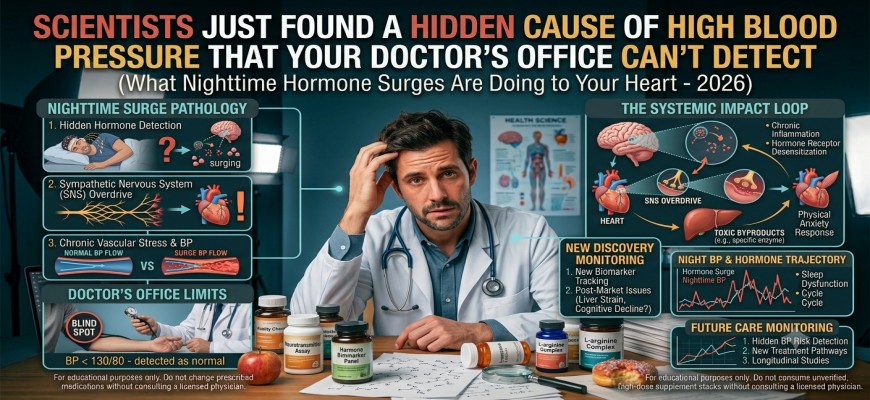

 Scientists Just Found a Hidden Cause of High Blood Pressure That Your Doctor's Office Can't Detect — What Nighttime Hormone Surges Are Doing to Your Heart (2026)
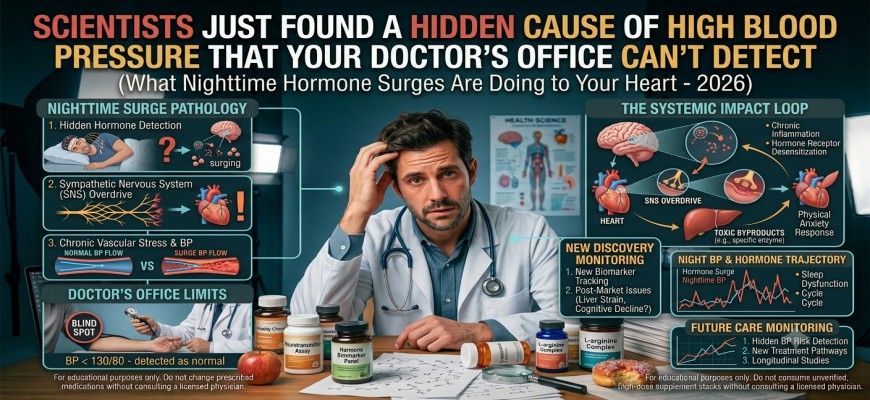 Scientists Just Found a Hidden Cause of High Blood Pressure That Your Doctor's Office Can't Detect — What Nighttime Hormone Surges Are Doing to Your Heart (2026)
Libido Gummies and "Hormone-Balancing" Powders Are 2026's Hottest Wellness Trend — Here's What's Actually in Them (And Why No One's Regulating It)
The "Doctor" Recommending Your Supplement on Instagram Might Not Be Real — Inside the AI-Generated Influencer Epidemic Flooding Wellness Marketing (2026)
Scientists Just Found a Hidden Cause of High Blood Pressure That Your Doctor's Office Can't Detect — What Nighttime Hormone Surges Are Doing to Your Heart (2026)
Libido Gummies and "Hormone-Balancing" Powders Are 2026's Hottest Wellness Trend — Here's What's Actually in Them (And Why No One's Regulating It)
The "Doctor" Recommending Your Supplement on Instagram Might Not Be Real — Inside the AI-Generated Influencer Epidemic Flooding Wellness Marketing (2026)