
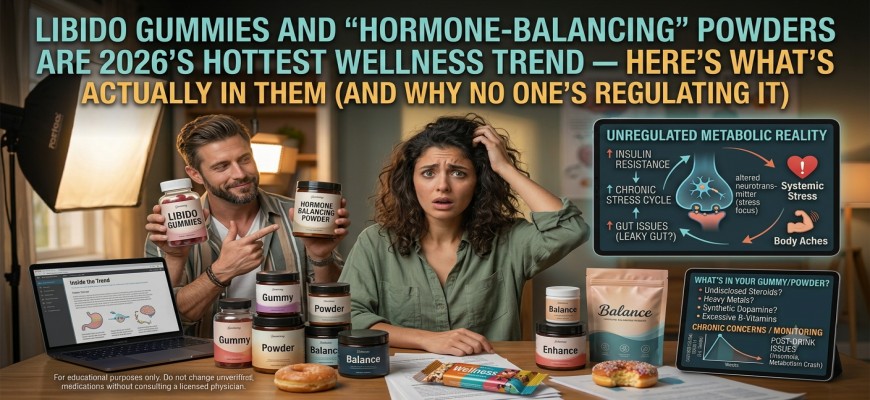
Libido Gummies and "Hormone-Balancing" Powders Are 2026's Hottest Wellness Trend — Here's What's Actually in Them (And Why No One's Regulating It)
A pharmacist's guide to the exploding sexual wellness category — the real pharmacology behind popular ingredients, the hidden risks in "hormone-balancing" marketing claims, and why this fast-growing shelf sits in almost exactly the same regulatory blind spot as every other unregulated supplement category.
Walk down the wellness aisle, open a telehealth app, or scroll ten seconds of sponsored content this year, and you'll run into it: libido gummies in soft pastel packaging, "hormone-balancing" powders promising to fix everything from low energy to low desire, and direct-to-consumer platforms making the entire category feel as casual as picking up a multivitamin. Sexual wellness has become one of the fastest-growing corners of the wellness industry, explicitly reframed away from clinical embarrassment and toward everyday self-care.
That destigmatization is, in many ways, genuinely positive — sexual health is a legitimate part of overall health, and it deserves to be discussed openly rather than hidden. But normalization and regulation are two completely different things, and this category has grown almost entirely inside the same regulatory blind spot that has produced real, documented harm in other supplement categories. Many of these products make specific hormonal and physiological claims — "balances your hormones," "restores libido naturally," "supports testosterone" — without any requirement to prove those claims, test the product for safety, or disclose everything actually inside the bottle. This guide breaks down what's really in these products, which ingredients carry real risk, why "hormone balancing" is a much bigger claim than it sounds, and how to evaluate any sexual wellness product before you trust it with your body.
Sexual wellness has moved from a niche, somewhat clinical category into one of the most visible growth areas across the entire wellness industry. Products that once sat behind a pharmacy counter or required an awkward in-person conversation are now sold with the same minimalist branding, subscription models, and influencer-driven marketing as skincare or protein powder.
Several forces are driving this shift simultaneously: growing openness about sexual health as a legitimate wellness topic, the rise of discreet telehealth platforms that make ordering feel private and low-friction, and a broader wellness culture increasingly comfortable framing hormone health, libido, and energy as interconnected, "optimizable" systems. All of that cultural momentum is real. What hasn't kept pace with it is oversight.
Libido gummies and hormone-balancing powders are, legally, dietary supplements in the United States, which means they fall under the same framework covered in earlier pharmacist coverage of the supplement industry generally: no pre-market approval, no required safety testing before sale, and enforcement that happens only after harm has already been reported.
What's new isn't the regulatory framework — it's the packaging, the tone, and the platform. A product sold through a slick subscription app with a friendly quiz and pastel branding is operating under exactly the same oversight (or lack of it) as a bottle on a gas station shelf.
Few phrases in wellness marketing are used as casually, and mean as little in a regulatory sense, as "hormone balancing." It's worth taking seriously exactly how large a claim this actually is.
Sex hormones, like cortisol, are governed by tightly controlled feedback loops between the brain and the relevant glands (the hypothalamic-pituitary-gonadal axis, in this case). "Balance" in this context isn't a vague wellness concept — it's a specific, measurable physiological state that can only be meaningfully assessed through actual hormone testing, not inferred from symptoms like low energy or reduced libido, which have dozens of possible causes.
A supplement marketed to "balance hormones" is, definitionally, making a claim it cannot back up without first knowing whether your hormone levels are actually imbalanced, and in which direction. Someone with low testosterone and someone with normal or even elevated testosterone experiencing low libido for an entirely different reason would need completely different interventions — yet both are sold the identical bottle.
Reduced sexual desire can stem from stress, relationship dynamics, sleep deprivation, medication side effects, mental health, thyroid function, or genuine hormonal changes, among other causes. A product addressing only one hypothetical mechanism (and often not even directly testing for it) is unlikely to meaningfully help if the actual cause lies elsewhere.
Not every ingredient in this category carries equal risk. Here's how commonly used ingredients compare based on available evidence and known safety profiles.
| Ingredient | Marketed For | Evidence Level | Risk Level |
|---|---|---|---|
| Maca root | Libido, energy | Modest evidence for some libido benefit in limited studies | Low for most healthy adults |
| L-arginine / L-citrulline | Blood flow, arousal support | Some physiological plausibility via nitric oxide pathways; limited robust human trial data for libido specifically | Low-Moderate; caution with certain heart medications and low blood pressure |
| Tribulus terrestris | Testosterone, libido | Weak and inconsistent evidence for meaningful hormonal effect in humans | Low-Moderate |
| Fenugreek | Libido, testosterone support | Some modest evidence for libido effects; less clear for actual hormone level changes | Low-Moderate; can affect blood sugar and interacts with blood thinners |
| Ashwagandha | Stress reduction, indirect libido support | Reasonable evidence for stress and cortisol effects; libido evidence more limited and indirect | Moderate; real interactions with thyroid medication, sedatives, and immunosuppressants; not advisable in pregnancy or certain autoimmune conditions |
| Horny goat weed (Epimedium) | Arousal, erectile support | Limited, low-quality human evidence; most data from animal studies | Moderate; contains compounds with genuine pharmacological activity and potential interaction with blood thinners and blood pressure medications |
| Yohimbe / yohimbine | Arousal, erectile support | Some evidence for a specific pharmacological effect, but with a narrow safety margin (see dedicated section below) | High; documented cardiovascular and anxiety-related adverse events |
Among common libido-product ingredients, yohimbe (derived from the bark of a West African tree, containing the active compound yohimbine) stands out for having a genuinely narrow safety margin, and deserves specific attention given how frequently it still appears in this product category.
Yohimbine works as an alpha-2 adrenergic receptor antagonist, which increases the release of norepinephrine in the body. This mechanism is plausibly linked to its arousal-related effects, but the same mechanism is also directly responsible for its most concerning side effects.
Yohimbe use has been associated with elevated blood pressure, rapid heart rate, anxiety, and in more severe or high-dose cases, more serious cardiovascular events. Because over-the-counter yohimbe products are not standardized or dose-verified the way a regulated pharmaceutical would be, actual yohimbine content can vary significantly and unpredictably between products and even between batches of the same product.
As with weight-loss supplements, the single most dangerous documented pattern in the sexual wellness supplement space is covert adulteration — products marketed as purely herbal or "natural" that independent lab testing has found to secretly contain actual pharmaceutical compounds not listed on the label.
Regulators have repeatedly identified undisclosed PDE5-inhibitor drugs (the same class of compound found in prescription erectile dysfunction medications) hidden inside products marketed as natural libido or performance supplements. This is especially dangerous for a specific, well-defined reason:
This risk exists specifically because these products are marketed and perceived as harmless "natural" supplements, which means the normal safety questions a doctor would ask before prescribing an actual PDE5-inhibitor medication — about heart disease, blood pressure medications, and nitrate use — never happen.
Much of the current sexual wellness boom flows through direct-to-consumer telehealth platforms, which occupy a genuinely different regulatory category than the supplement gummies and powders covered above, and it's worth separating the two clearly.
When these platforms prescribe an actual FDA-approved medication (such as a legitimate PDE5-inhibitor prescription) following a real, if brief, clinical intake process, that medication itself has gone through standard drug approval and manufacturing oversight — a meaningfully different risk profile than an unregulated supplement.
The same platforms frequently also sell their own branded supplement lines — gummies, powders, and "support" products — marketed alongside the prescription offerings with similar branding and tone, blurring the line for consumers between a regulated medication and an unregulated supplement sold by the same company. The supplement side of these businesses is still subject to the exact same DSHEA framework as any other supplement brand, regardless of how clinical the overall platform feels.
| Group | Why Extra Caution Is Warranted |
|---|---|
| Anyone with heart disease or taking nitrate medications | Highest risk group for the hidden PDE5-inhibitor adulteration pattern described above |
| Anyone with high blood pressure or an anxiety disorder | Several common ingredients, particularly yohimbe, can meaningfully worsen both conditions |
| Anyone on blood thinners | Several botanical ingredients in this category (including horny goat weed and fenugreek) carry genuine bleeding-risk interaction potential |
| Anyone on thyroid medication or with an autoimmune condition | Ashwagandha, a frequent addition to these blends, has documented interactions and cautions in these specific situations |
| Pregnant or breastfeeding individuals | Most ingredients in this category lack adequate safety data for pregnancy and lactation, and several (including ashwagandha) carry specific caution in this context |
| Anyone managing diabetes or blood sugar | Fenugreek and some other common ingredients can affect blood sugar levels |
| Supplement Ingredient | Interacts With | Effect |
|---|---|---|
| Yohimbe / yohimbine | Certain antidepressants, stimulant medications, blood pressure medications | Additive cardiovascular and blood pressure effects; risk of dangerous interactions with certain antidepressant classes |
| L-arginine / L-citrulline | Blood pressure medications, nitrate medications, PDE5-inhibitor prescriptions | Additive blood-pressure-lowering effect |
| Ashwagandha | Thyroid medication, sedatives, immunosuppressants | Can alter thyroid hormone levels; additive sedation; potential immune-system interaction |
| Fenugreek | Blood thinners, diabetes medications | Additive bleeding risk; additive blood-sugar-lowering effect |
| Horny goat weed | Blood thinners, blood pressure medications | Additive bleeding risk; potential additive blood-pressure effect |
Because talking openly about sexual wellness is relatively new and feels refreshing after years of stigma, that same sense of relief and openness can make people less likely to apply the same scrutiny they might to a more familiar supplement category.
Buying discreetly through an app, without an in-person conversation with a pharmacist or doctor, removes a natural opportunity where a knowledgeable professional might otherwise flag an interaction or a red flag ingredient.
Minimalist, lab-coat-adjacent branding and quiz-based intake flows create an impression of medical rigor that doesn't necessarily reflect what's actually happening on the supplement side of these platforms, as distinguished above.
Because sexual wellness remains a more private topic than, say, a multivitamin, people may be less likely to openly discuss a bad reaction or compare notes with friends and family the way they would with other supplement categories — reducing the informal social check that sometimes catches problematic products in other categories.
NSF Certified for Sport, USP Verified, or ConsumerLab Approved logos on the actual label are the strongest available independent safety signal in this unregulated category.
A quick search takes under a minute and can immediately flag a product already known to contain undisclosed pharmaceutical ingredients.
Before taking anything with an ingredient you don't recognize, research its known risk profile and interaction potential specifically, rather than relying on the product's own marketing description.
A legitimate manufacturer should be able to provide potency and contaminant testing results for the specific batch you purchased; reluctance or inability to provide this is a meaningful red flag.
Pharmacists have interaction-checking tools that can screen a specific ingredient list against your actual medication list — a step that catches real, individualized risk that no amount of online research can replace.
Given its documented cardiovascular risk profile and unpredictable dosing in unregulated products, treat any yohimbe-containing product with a higher baseline of caution than other ingredients in this category.
No. Many contain relatively low-risk ingredients like maca or modest amounts of amino acids, and are unlikely to cause harm for most healthy adults at labeled doses. The concern outlined in this article is concentrated in specific higher-risk ingredients like yohimbe, in the possibility of undisclosed pharmaceutical adulteration, and in the broad "hormone balancing" marketing claims that aren't backed by any actual testing of your individual hormone levels.
You genuinely can't, without first getting actual hormone testing done by a doctor. A supplement marketed generically for "hormone balance" has no way of knowing whether your specific hormone levels are low, normal, or elevated, and taking the same product regardless of your actual status isn't a personalized or evidence-based approach.
This should be discussed with your prescriber before combining, particularly given the risk that a supplement could be undisclosedly adulterated with the same class of drug already in your prescription, or that ingredients like L-arginine could have an additive blood-pressure-lowering effect when combined with a PDE5-inhibitor medication.
Yohimbe has a documented history of cardiovascular and anxiety-related adverse effects tied to its specific pharmacological mechanism, combined with unpredictable, unstandardized dosing in most over-the-counter products. This combination of real pharmacological activity and inconsistent dosing gives it a narrower safety margin than many other common libido-supplement ingredients.
The prescription medication side of a legitimate telehealth platform is generally more trustworthy, since it involves an actual FDA-approved drug and some clinical intake process. However, the supplement products these same platforms often sell alongside their prescription offerings are typically subject to the same unregulated supplement framework as any other brand, regardless of how clinical the overall platform feels — it's worth evaluating the two separately.
Yes. Chronic stress, poor sleep, certain medications, relationship factors, and mental health all play a well-documented role in sexual desire and function, often independently of or alongside hormonal factors. This is part of why a product addressing only one narrow hypothesized mechanism may not meaningfully help if the actual driving factor lies elsewhere.
Chemically, it's the same ingredient regardless of which wellness category it's marketed under, and it carries the same interaction cautions and dosing considerations wherever it appears. If you're taking ashwagandha from multiple different products simultaneously (a sleep gummy and a libido gummy, for example), it's worth adding up your total daily intake across all of them.
Not necessarily — for most healthy adults without the risk factors outlined above, occasional use of lower-risk ingredients like maca is reasonable. The goal of this guide isn't to discourage engaging with sexual wellness as a topic, but to bring the same verification habits to this category that are increasingly applied to other supplement categories, rather than assuming friendly branding equals safety.
This article is for educational purposes only and does not constitute medical advice. It is not a comprehensive list of every ingredient, risk, or interaction in the sexual wellness supplement category, and should not be used to diagnose or rule out any health condition. Do not start, stop, or change any supplement or medication regimen based on this article alone. Consult a licensed healthcare provider — ideally a pharmacist or physician familiar with your full medication list — before adding any new sexual wellness product, especially if you take prescription medications or have an existing heart, blood pressure, or thyroid condition. If you experience chest pain, severe dizziness, or a dangerous drop in blood pressure after taking any product, seek immediate medical attention. This content reflects general pharmacological understanding current as of September 2026; individual product risks change as new information and enforcement actions emerge.


 Libido Gummies and "Hormone-Balancing" Powders Are 2026's Hottest Wellness Trend — Here's What's Actually in Them (And Why No One's Regulating It)
The "Doctor" Recommending Your Supplement on Instagram Might Not Be Real — Inside the AI-Generated Influencer Epidemic Flooding Wellness Marketing (2026)
"SickTok" Is Sending People to the ER With Self-Diagnosed Conditions and Internet-Prescribed Treatment Plans — Here's Why Doctors Are Alarmed (2026)
The "Cortisol Cocktail" Everyone's Drinking to "Heal Adrenal Fatigue" Is Based on a Condition That Doesn't Exist
Libido Gummies and "Hormone-Balancing" Powders Are 2026's Hottest Wellness Trend — Here's What's Actually in Them (And Why No One's Regulating It)
The "Doctor" Recommending Your Supplement on Instagram Might Not Be Real — Inside the AI-Generated Influencer Epidemic Flooding Wellness Marketing (2026)
"SickTok" Is Sending People to the ER With Self-Diagnosed Conditions and Internet-Prescribed Treatment Plans — Here's Why Doctors Are Alarmed (2026)
The "Cortisol Cocktail" Everyone's Drinking to "Heal Adrenal Fatigue" Is Based on a Condition That Doesn't Exist