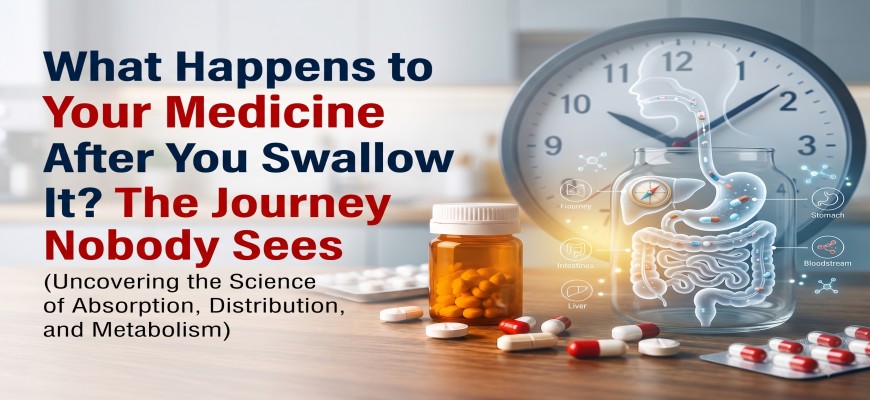
What Happens to Your Medicine After You Swallow It? The Journey Nobody Sees
It takes about two seconds to swallow a tablet. What happens after that takes hours — sometimes an entire day — and involves a sequence of events most people never think about. The tablet has to fall apart, cross into your bloodstream, survive a stop at your liver, travel to exactly the right tissue, do its job, and eventually be cleared out entirely.
Understanding this journey doesn't require a medical degree. Once you see the steps laid out, a lot of everyday questions — why some medicines work faster than others, why food timing matters, why the same tablet can feel different from one day to the next — start to make a lot more sense.
Swallowing feels instantaneous, but a tablet's journey begins the moment it touches saliva. Moisture starts softening the outer coating almost immediately, and by the time the tablet reaches your stomach — usually within seconds — the breakdown process is already underway.
This is also the point where timing instructions start to matter. Taking a tablet with a full glass of water helps it move through the esophagus efficiently and reach the stomach where the real work begins. Taking it with very little liquid can, in some cases, slow this initial movement down.
Once in the stomach, the tablet or capsule needs to physically fall apart — a process called disintegration — before anything inside it can be absorbed. Stomach acid and gentle churning motion break the tablet into smaller and smaller fragments, eventually reducing it to fine particles suspended in stomach fluid.
Capsules work slightly differently: the outer shell dissolves first, releasing the powder or granules inside, which then disintegrate the same way a tablet would.
Did you know? Some tablets are specifically coated to resist stomach acid and only dissolve once they reach the small intestine — a design used for medicines that would otherwise be broken down or irritate the stomach too early.
After disintegration, the medicine — now in tiny particle or dissolved form — moves from the stomach into the small intestine through a valve called the pyloric sphincter. How quickly this happens depends heavily on what else is in your stomach. An empty stomach generally empties faster than a full one, which is part of why food timing instructions exist for certain medicines.
Very little absorption actually happens in the stomach itself for most medicines. The stomach's main job here is preparation, not absorption — the real work happens just beyond it.
The small intestine is where the majority of oral medicines are absorbed into the body, and it's remarkably well designed for the job. Its inner lining is covered in millions of tiny, finger-like projections called villi, which dramatically increase the surface area available for absorption — if unfolded, the small intestine's absorptive surface would cover an area roughly the size of a tennis court.
Dissolved medicine particles pass through this lining and into a dense network of blood vessels waiting just beneath the surface, marking the true starting point of a medicine's journey through the body.
Crossing from the intestine into the bloodstream is called absorption, and it's one of the most important steps in the entire process — it determines how much of the medicine you took actually becomes available to work. Not every milligram of a tablet makes it into the blood; some is lost along the way, which is part of why doses are carefully calculated during a medicine's development, not guessed.
Once in the blood, the medicine doesn't go straight to work. There's one more stop first.
Blood leaving the small intestine travels through a dedicated pathway directly to the liver before reaching the rest of the body. The liver acts like a chemical processing plant, using specialized enzymes to break down substances — including medicines — into forms the body can use or eliminate more easily.
For most medicines, the liver reduces the amount that eventually reaches general circulation. This isn't a flaw in the process — it's a built-in step that medicine doses are designed around from the very beginning.
This early liver processing has a specific name: first-pass metabolism. It refers to the reduction in the amount of active medicine that occurs the very first time it passes through the liver, before reaching the rest of the body.
Some medicines are affected by first-pass metabolism so significantly that they can't be taken as a standard swallowed tablet at all — which is part of why certain medicines come as injections, patches, or dissolving tablets placed under the tongue instead, forms designed to bypass this early liver processing.
Once medicine leaves the liver and enters general circulation, your bloodstream acts as a distribution network, carrying it throughout the body within minutes. Blood flow isn't equal everywhere — organs with high blood flow, like the brain, liver, and kidneys, tend to receive medicine faster than areas with lower blood flow, like bone or fat tissue.
This is part of why some effects are felt quickly while others take longer to build — the medicine may simply be taking longer to reach the tissue where it needs to act.
Most medicines work by interacting with specific structures called receptors — think of them as molecular locks found on the surface of cells throughout the body. A medicine molecule is shaped to fit a particular receptor much like a key fits a lock, triggering a chain of events inside the cell that produces the medicine's intended effect.
This is also why a medicine designed for one purpose generally doesn't affect unrelated systems in the body — it's simply shaped to interact with a specific type of receptor, not every cell it passes.
Putting the whole journey together — disintegration, absorption, first-pass metabolism, distribution, and receptor binding — explains why medicines don't all act on the same timeline. A medicine designed to act quickly might complete this entire sequence in under thirty minutes. Others, particularly those that need to build up in the body gradually to produce a lasting effect, may take days or weeks of consistent use before their full effect becomes apparent.
Nothing stays in your system forever. Once a medicine has done its job — or sometimes even before that — your body begins clearing it out. The liver often converts medicine into a form that's easier to remove, and the kidneys filter this from the blood and pass it out through urine. Some medicines are eliminated through other routes as well, including the digestive system.
How efficiently this happens depends on kidney and liver function, hydration, and several other factors — which is part of why staying adequately hydrated is often mentioned as a simple, general way to support how your body processes medicine.
Every step of this journey can be nudged slightly by outside factors. None of these factors apply to every medicine equally, but understanding that they exist explains a lot about why medicine can feel different from person to person, or even day to day for the same person.
| Factor | How It Can Play a Role |
|---|---|
| Food | Can speed up, slow down, or change how much medicine is absorbed |
| Hydration | Can influence how efficiently the kidneys clear medicine from the body |
| Age | Can affect liver and kidney efficiency, changing how quickly medicine is processed |
| Genetics | Can affect how quickly certain liver enzymes break a medicine down |
| Other medicines | Can compete for the same liver enzymes or absorption pathways |
This is exactly why questions about food timing, hydration, and other medicines are such a routine — and genuinely important — part of any conversation with a pharmacist.
Not every medicine is designed to release all at once. Extended-release (sometimes labeled ER, XR, or SR) formulations are engineered to dissolve and release their contents gradually over many hours, producing a steadier level of medicine in the body rather than a sharp peak followed by a decline.
This is also why extended-release tablets generally should never be crushed, split, or chewed unless specifically instructed — doing so can release the entire dose at once, defeating the purpose of the design and potentially causing an effect far stronger than intended.
Given how many steps and variables are involved in this journey — disintegration speed, absorption efficiency, liver enzyme activity, blood flow, receptor sensitivity, and elimination rate — it's easy to see why two people taking the exact same medicine and dose can have noticeably different experiences. We explore this specific question in more depth in our article on why the same medicine can affect people differently.
If you'd like to understand how a medicine earns its way to a pharmacy shelf in the first place — including how these individual differences are studied — our guide on how medicines are approved is a useful companion read.
Timing and consistency also matter more than many people expect — our guide on what happens when you miss a dose is worth a read if you've ever wondered how much a delayed or skipped dose really changes things.
Most of what happens after you swallow a medicine proceeds smoothly and without any noticeable disruption. That said, it's worth contacting a pharmacist or doctor if you experience a new or worsening symptom after starting a medicine, if an effect feels significantly stronger or weaker than expected, or if you're simply unsure whether something you're feeling is related to a medicine you've recently started.
Seek prompt medical attention for signs of a serious reaction, such as difficulty breathing, swelling of the face or throat, or severe, rapidly worsening symptoms. Never stop, start, combine, or adjust the dose of a prescribed medicine on your own — always speak with a qualified healthcare professional first.
Swallowing a tablet takes a couple of seconds, but the process that follows — disintegration, absorption, liver processing, distribution, receptor binding, and eventual elimination — is a genuinely remarkable sequence your body carries out every single time. Understanding this journey doesn't just satisfy curiosity; it also explains why timing, food, hydration, and individual biology all play a real role in how a medicine feels. If anything about that journey ever feels unclear for a medicine you're taking, a pharmacist or prescriber is always the right person to ask.
Water helps the tablet move efficiently down the esophagus and into the stomach, where the breakdown process begins. Taking a tablet with very little liquid can sometimes slow this initial step down.
What is first-pass metabolism in simple terms?It's the reduction in active medicine that happens the first time it passes through the liver, before reaching the rest of the body. It's a normal, expected part of how many oral medicines are designed to work.
Why do some medicines work faster than others?Speed depends on how quickly a medicine disintegrates, how efficiently it's absorbed, how much the liver processes it on the first pass, and how quickly it reaches its target tissue — all of which vary by medicine.
Is it safe to crush an extended-release tablet?Generally, no, unless specifically instructed by a pharmacist or prescriber. Crushing can release the full dose at once instead of gradually, which can change the medicine's effect significantly.
Why do two people react differently to the same medicine?Differences in absorption, liver enzyme activity, blood flow, receptor sensitivity, and elimination rate can all vary from person to person, leading to different experiences with an identical medicine and dose.
Does food always affect how medicine works?Not always — it depends on the specific medicine. Some are meant to be taken with food, others on an empty stomach, and some aren't significantly affected either way. Checking the label or asking a pharmacist is the safest approach.
Medical Disclaimer: This article is provided by the MyOnlineMedShop Health Content Team for general educational purposes only and does not constitute individualized medical advice. It is not a substitute for guidance from a qualified healthcare professional. Always speak with your pharmacist or prescriber before making any changes to a prescribed medicine, and seek prompt medical attention for any severe or rapidly worsening symptom.

 Fetroja (Cefiderocol) for Complicated UTIs: First Siderophore Cephalosporin and the Mortality Warning Every Patient Should Know (FDA Approved 2019)
Exblifep for Complicated UTIs: FDA Approval, Efficacy, & Usage Guide
Fetroja (Cefiderocol) for Complicated UTIs: First Siderophore Cephalosporin and the Mortality Warning Every Patient Should Know (FDA Approved 2019)
Exblifep for Complicated UTIs: FDA Approval, Efficacy, & Usage Guide
 Nuzyra (Omadacycline) for Pneumonia and Skin Infections: Modernized Tetracycline with IV-to-Oral Options (FDA Approved 2018)
 Zemdri (Plazomicin) for Complicated UTIs: Newer IV Aminoglycoside for Resistant Infections (FDA Approved 2018)