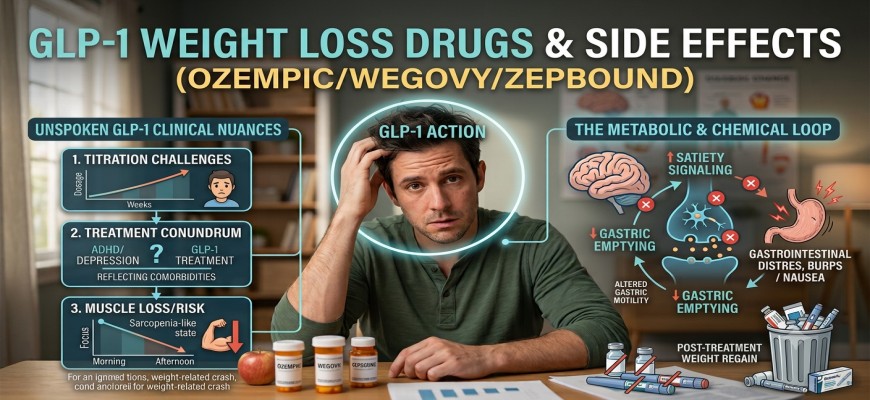
Complete Pharmacist's Guide to Understanding What 400k Reddit Users & Lawsuits Reveal About Real-World Side Effects
GLP-1 weight loss drugs have revolutionized obesity treatment—but they come with a dark side that clinical trials, FDA labels, and mainstream media rarely discuss. This comprehensive guide analyzes 400,000 Reddit posts from 70,000 real users, 4,022 pending lawsuits, and pharmacological research to reveal what's actually happening in patients' bodies when they take Ozempic, Wegovy, or Zepbound.
If you're considering GLP-1 therapy or already taking it, this guide will help you understand exactly why side effects happen, which ones matter most, and when to see your doctor immediately.
GLP-1 stands for glucagon-like peptide-1, a hormone your gut naturally produces when you eat. GLP-1 receptor agonists are medications that mimic this hormone, triggering three powerful effects:
GLP-1s bind to receptors in your brain's hypothalamus, the appetite control center. This sends a "full" signal that convinces your brain you're satiated—even with minimal food intake.
These drugs delay how fast food leaves your stomach. Food moves more slowly into your intestines, creating prolonged feelings of fullness and reducing hunger hormones (ghrelin).
GLP-1s trigger insulin release when blood sugar is high, which helps prevent the post-meal crashes that trigger cravings.
The result? Most people eat 40-60% less food and lose 15-22% of body weight within 6-12 months. But this powerful mechanism doesn't come without consequences.
Three GLP-1 drugs are currently FDA-approved specifically for chronic weight management in adults:
Manufacturer: Novo Nordisk
Form: Weekly injection
Dose Range: 0.25–2.4mg weekly
Weight Loss: 15–17% body weight average
Cost: $1,500+/month (uninsured)
Manufacturer: Eli Lilly
Form: Weekly injection
Dose Range: 2.5–15mg weekly
Weight Loss: 20–22% body weight average
Cost: $1,300+/month (uninsured)
Manufacturer: Novo Nordisk
Form: Daily oral tablet
Dose Range: 7–14mg daily
Weight Loss: 12–15% body weight (less than injections)
Cost: $900+/month (uninsured)
Note: Ozempic® (semaglutide 1mg) is FDA-approved for type 2 diabetes only, but many doctors prescribe it off-label for weight loss at higher doses.
GLP-1 receptors aren't just in your brain—they're throughout your body. When you flood your system with GLP-1 agonists, you're triggering effects far beyond appetite suppression:
GLP-1 receptors line your stomach, small intestine, and colon. Activation causes:
GLP-1 activation affects heart rate and blood pressure regulation. Some users experience dizziness, fatigue, or rapid heartbeat as cardiovascular systems adjust.
Rapid weight loss + appetite suppression = potential for muscle loss, nutrient deficiencies, and metabolic adaptation.
New research suggests GLP-1 agonists may trigger thyroid autoimmunity in genetically susceptible individuals, though this remains under investigation.
Analysis of 400,000+ Reddit posts from GLP-1 users reveals the side effects that matter most to real patients. Here's the ranking based on frequency and impact:
| Side Effect | Frequency (Reddit Data) | Timeline to Onset | Typical Severity | Usually Resolves? |
|---|---|---|---|---|
| Nausea | 55% of users report | Days 1-3 after injection | Mild to moderate | Yes, week 3-4 |
| Diarrhea or Constipation | 35-45% of users | Days 2-7 | Mild to moderate | Usually, but can persist |
| Vomiting | 12% of users report | Days 1-5 | Moderate | Yes, by week 4 |
| Stomach Pain / Cramping | 28% of users | Days 1-3 | Mild to moderate | Varies; often improves |
| Fatigue / Weakness | 22% of users | Week 1-2 | Mild | Usually by week 3 |
| Headaches | 18% of users | Days 1-4 | Mild to moderate | Usually yes |
| Dizziness | 15% of users | Days 2-5 | Mild | Yes, within 1-2 weeks |
| Loss of Appetite (Extreme) | 65% report desired effect but 10% report "too extreme" | Immediate | Can be concerning if too severe | Adjusts with dose management |
While common side effects usually improve within 2-4 weeks, serious complications are rare but real—and increasingly documented through legal proceedings.
What it is: Your stomach muscles lose the ability to contract and push food into your small intestine. Food stagnates, causing severe pain, vomiting, and malnutrition.
Frequency: Research suggests 3-4x higher risk in GLP-1 users vs. placebo. FDA received 33+ reports; 2 deaths associated.
Timeline: Can develop weeks to months into therapy.
Warning Signs:
Legal Status: 4,022 pending cases in federal MDL as of September 2026, alleging manufacturers failed to warn about gastroparesis risk.
What it is: Non-arteritic anterior ischemic optic neuropathy—sudden, partial loss of vision caused by reduced blood flow to the optic nerve.
Frequency: Multiple studies since 2024 suggest association; not yet officially established in labeling, but mounting evidence.
Timeline: Can occur weeks to years after starting therapy.
Warning Signs:
Legal Status: 216 pending lawsuits in federal NAION-specific MDL; new cases filed September 2026 alleging permanent vision loss.
What it is: Inflammation of the pancreas causing severe upper abdominal pain, nausea, and potential pancreatic damage.
Frequency: One JAMA study found pancreatitis risk ~9x higher in GLP-1 users vs. controls.
Timeline: Can occur anytime during therapy.
Warning Signs:
Action Required: Seek emergency medical care. Pancreatitis requires hospitalization and immediate lab work (lipase, amylase levels).
What it is: Complete or partial blockage of the intestine causing inability to pass food, gas, or stool.
Frequency: FDA label now carries warning after 33+ blockage reports; 2 deaths documented.
Timeline: Can occur within weeks of starting therapy, especially with rapid dose escalation.
Warning Signs:
Action Required: Seek emergency care. Bowel obstruction may require surgical intervention.
What it is: Rapid shedding of hair 2-3 months after starting therapy, caused by nutrient deficiency or metabolic stress.
Frequency: Systemic review of 24 studies found association between GLP-1s and increased hair loss risk.
Timeline: Typically weeks 8-16 into therapy.
Prevention Strategies:
What it is: Skeletal appearance with deepened wrinkles from rapid loss of facial fat. Some describe it as aging 5-10 years in weeks.
Frequency: Common enough to have a name; not in official labeling but widely discussed on social media.
Cause: Rapid weight loss affects facial subcutaneous fat disproportionately; loss of volume makes underlying bone structure more prominent.
Prevention Strategies:
What to expect: Nausea (55%), headache (18%), mild stomach pain (28%), fatigue (22%), dizziness (15%)
Why: Your body is responding to the sudden GLP-1 spike; your GI tract is adjusting to slower food movement.
Management: Small, frequent meals; ginger tea; anti-nausea medication if severe (ondansetron 4mg).
What to expect: Nausea typically peaks around day 3-4, then begins declining. Constipation or diarrhea begins.
Why: Your gut microbiome is adjusting; GI receptors are adapting to sustained GLP-1 activation.
Management: Psyllium husk for constipation; hydration 2.5-3L daily; probiotic if diarrhea.
What to expect: Most users report 50-70% improvement in nausea. Appetite suppression stabilizes.
Why: GI receptors have desensitized somewhat; your body has adapted to new appetite signals.
Management: Most users can discontinue anti-nausea meds by week 3.
What to expect: Acute GI side effects largely resolved, but now new side effects may emerge: hair loss signals, "ozempic face" becomes visible, mood changes possible.
Why: Chronic nutrient depletion; sustained appetite suppression affecting eating patterns; metabolic adaptation.
Management: Micronutrient supplementation; resistance training; psychological support if disordered eating patterns emerging.
What to expect: Gastroparesis, pancreatitis, and vision problems can emerge now if they're going to occur.
Why: Accumulated metabolic stress; chronic delayed gastric emptying can trigger true paralysis; pancreatic inflammation cumulative.
Management: Monthly check-ins with prescriber; immediate reporting of red-flag symptoms.
Not all GLP-1 drugs carry equal side effect risk. Here's how they rank based on clinical trial data and real-world reports:
| Rank | Drug | Nausea Rate | Vomiting Rate | GI Issues | Overall Side Effect Burden | Why the Difference |
|---|---|---|---|---|---|---|
| 1 (Lowest Risk) | Rybelsus (Oral Semaglutide) | 12-18% | 3-5% | Mild-Moderate | Low | Slower absorption reduces peak serum levels; gentler on GI tract |
| 2 | Wegovy (Weekly Semaglutide Injection) | 35-45% | 8-12% | Moderate | Moderate | Once-weekly dosing allows dose adjustment; established dose-titration protocols |
| 3 (Highest Risk) | Zepbound (Weekly Tirzepatide Injection) | 40-50% | 10-15% | Moderate-Severe | Highest | Dual GLP-1 + GIP receptor agonist = stronger appetite suppression AND stronger GI effects; more potent gastric slowing |
| Off-Label | Ozempic (High-Dose Semaglutide) | 45-60% | 12-18% | Severe | Very High | Ozempic was designed for diabetes at lower doses; high-dose off-label use = excessive GI suppression |
Most side effects are dose-dependent. Escalating too quickly is the #1 cause of severe adverse events.
First-line: Ondansetron (Zofran) 4-8mg daily or as-needed. Works on serotonin receptors in chemoreceptor trigger zone.
Second-line: Metoclopramide (Reglan) 10mg TID. Increases stomach contractions to speed gastric emptying (but use cautiously; can interact with GLP-1 mechanism).
First-line: Psyllium husk fiber 1-2 tbsp daily + 8-10 glasses water daily.
Second-line: Osmotic laxative (polyethylene glycol) 17g daily if fiber insufficient.
Avoid: Opioid-type laxatives (these worsen GLP-1 side effects).
First-line: Probiotic (Lactobacillus, Bifidobacterium) 10-50 billion CFU daily to restore gut flora.
Second-line: Loperamide (Imodium) 2-4mg daily if severe.
Some patients report better tolerability with "microdosing"—splitting weekly doses into smaller doses 2-3x weekly. This approach:
Not all side effects warrant discontinuation. But these warrant immediate medical attention and likely stopping therapy:
Most common GI side effects (nausea, diarrhea, constipation) peak around days 1-3 post-injection and improve significantly by week 3-4. About 85% of users report acceptable tolerability by week 4. However, some chronic side effects (hair loss, facial wasting, nutrient deficiencies) can persist if not actively managed. Serious side effects like gastroparesis or vision loss, if they occur, don't resolve on their own and require medical intervention.
Absolutely. Side effects are dose-dependent. Many patients achieve good weight loss (10-15 lbs/month) on lower doses with fewer side effects. Discuss with your doctor staying at 0.5mg or 1.0mg instead of escalating to 1.7-2.4mg. For tirzepatide (Zepbound), staying at 5mg vs. going to 15mg can significantly reduce GI symptoms while still providing substantial weight loss.
Acute GI side effects (nausea, vomiting, constipation) resolve within days to weeks after stopping. However, weight regain typically begins within 1-2 months—studies show average weight regain of 50% of lost weight within one year of stopping. Hair loss takes 6-12 months to fully resolve. "Ozempic face" (facial wasting) doesn't improve after stopping; you may need cosmetic procedures if severely affected. Most importantly, if you experienced serious side effects like gastroparesis, vision loss, or pancreatitis, stopping doesn't reverse damage—seek ongoing specialist care.
The longest clinical trials run ~2 years. Long-term safety (5+ years) is unknown since these drugs have only been used at scale since ~2020. That said, millions of people have used GLP-1s for diabetes management for over a decade without catastrophic outcomes. The key: regular monitoring (labs every 3-6 months), micronutrient supplementation, and vigilance for red-flag symptoms. If you're going to use long-term, work with a doctor who actively monitors rather than simply refilling prescriptions.
Combining GLP-1s with phentermine, topiramate, or other sympathomimetics is possible but requires careful medical supervision. Combination therapy may increase side effect risk (racing heart, anxiety, blood pressure elevation). Some doctors do combine, but this is specialist-level prescribing—don't attempt without working with an obesity medicine specialist.
Chemically, they're identical semaglutide. The difference is formulation and concentration: Ozempic (1mg/0.5mL for diabetes) vs. Wegovy (2.4mg/0.75mL for weight loss). Generic and compounded semaglutide should work the same IF properly formulated, but quality control varies significantly. Compounded versions are not FDA-regulated, and some have been found to contain wrong concentrations or contaminants. Stick with brand-name when possible; if using compounded, verify the pharmacy is accredited and runs quality-control testing.
Clinical trials show 5-15% discontinuation due to adverse events. Real-world data from Reddit and compounding pharmacies suggests higher rates—roughly 25-30% of people stop within 3-6 months, though not always solely from side effects (cost, insufficient weight loss, or boredom also factor in). The good news: most people who discontinue due to side effects don't try proper dose titration or side effect management first. Proper protocols can reduce this.
As of September 2026, 4,022 cases are pending in federal MDL (multi-district litigation) for general GLP-1 injuries, and 216 in a separate NAION (vision loss) MDL. No trials or settlements have been reached yet; these are early stages. If you developed gastroparesis, bowel obstruction, pancreatitis, or vision loss, consult with a pharmaceutical litigation attorney—there may be grounds for a claim, especially if you can document pre-existing conditions were not flagged by your prescriber.
This article is for educational purposes only and does not constitute medical advice. GLP-1 receptor agonists carry real risks and benefits that must be weighed individually. Do not start, stop, or change GLP-1 therapy based on this article alone. Consult with a licensed healthcare provider—ideally an obesity medicine specialist, endocrinologist, or pharmacist—before starting GLP-1s or modifying your regimen. If you experience any of the serious side effects listed above, seek immediate medical attention. This content reflects information current as of September 2026; medical knowledge evolves rapidly.

 Fetroja (Cefiderocol) for Complicated UTIs: First Siderophore Cephalosporin and the Mortality Warning Every Patient Should Know (FDA Approved 2019)
 Exblifep for Complicated UTIs: FDA Approval, Efficacy, & Usage Guide
 Nuzyra (Omadacycline) for Pneumonia and Skin Infections: Modernized Tetracycline with IV-to-Oral Options (FDA Approved 2018)
 Zemdri (Plazomicin) for Complicated UTIs: Newer IV Aminoglycoside for Resistant Infections (FDA Approved 2018)