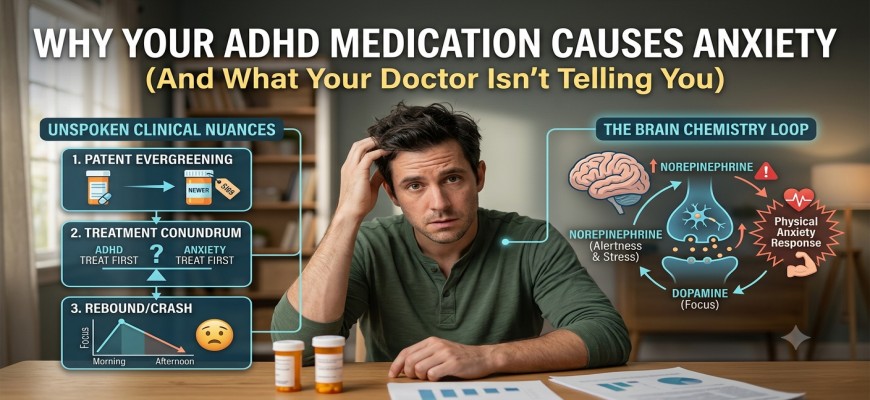
Why Your ADHD Medication Causes Anxiety (And What Your Doctor Isn't Telling You) 2026
A comprehensive pharmacist's guide to understanding stimulant-induced anxiety, which medications trigger it most, and practical strategies to manage it without sacrificing ADHD treatment efficacy.
You finally got the ADHD diagnosis. You started medication. For the first week, it was revolutionary. Your focus came back. Your productivity soared. You felt like yourself again.
Then something shifted. Your heart started racing at random moments. Your palms got sweaty during meetings. You felt this low-level anxiety humming in the background all day. By week three, you're checking your heart rate on your phone constantly, convinced something is medically wrong with you.
You call your doctor. They say: "That's a known side effect. Should go away in a few weeks." You wait. It doesn't completely go away. It's not unbearable, but it's there. And you're wondering: Is this anxiety the medication's fault, or is it just my baseline anxiety that I never noticed before my ADHD was treated?
The answer is probably: both. But there's a lot your doctor probably didn't explain about why this happens, which medications trigger it most severely, and what you can actually do about it besides just "waiting it out."
After 19 years of pharmaceutical practice and reviewing hundreds of ADHD treatment cases, I can tell you this with certainty: stimulant-induced anxiety is real, it's neurochemical, it's dose-dependent, and most importantly—it's manageable. But the management starts with understanding why it happens in the first place.
To understand why ADHD stimulants cause anxiety, you need to understand what ADHD is at the neurochemical level and what these medications do.
ADHD is fundamentally a neurotransmitter dysregulation disorder. Specifically, people with ADHD have:
This undersupply of dopamine and norepinephrine explains why ADHD presents as difficulty focusing, impulsivity, and executive dysfunction. Your brain literally has less of the "focus and executive function" chemicals than neurotypical brains.
ADHD medications (stimulants like methylphenidate/Ritalin, amphetamine/Adderall, dexamphetamine) work by increasing dopamine and norepinephrine availability in the brain. They do this by:
Result: Your prefrontal cortex gets the dopamine and norepinephrine it needs. Your focus improves. Your executive function returns. This is the intended effect.
Here's where it gets complicated: dopamine and norepinephrine don't just affect the prefrontal cortex (attention). They also affect the amygdala, which processes emotions and threat detection. When you increase dopamine and norepinephrine, you're not just upgrading the "attention" parts of your brain. You're also potentially overstimulating the "threat detection and emotional response" parts.
ADHD meds turn up the volume on dopamine and norepinephrine everywhere in your brain, not just in the attention regions. In some people and at some doses, this includes parts of the brain responsible for anxiety and threat detection. Your body perceives more threats. Your heart rate increases. Your vigilance spikes. This manifests as anxiety.
It's not that you're suddenly anxious because you're stressed. It's that your brain's threat-detection system is being chemically over-stimulated by the same medication that's helping your attention.
This comes down to individual neurochemistry variation. Some people have:
This is why your friend with ADHD can take a high dose of Adderall and feel fine, while you take half that dose and feel your heart racing. It's not weakness. It's biochemistry.
Not all ADHD medications trigger anxiety equally. Here's the evidence-based ranking from most to least likely to cause anxiety:
| Medication | Drug Class | Anxiety Incidence | Severity | Why? |
|---|---|---|---|---|
| Amphetamine (Adderall, Dexedrine) | Amphetamine stimulant | 20-30% | Moderate-High | Strong dopamine release + high norepinephrine effect = most overstimulation risk |
| Methylphenidate (Ritalin, Concerta) | Piperidine stimulant | 15-20% | Moderate | Blocks reuptake primarily; less raw dopamine release than amphetamine = less overstimulation |
| Lisdexamphetamine (Vyvanse) | Amphetamine prodrug | 15-18% | Mild-Moderate | Slowly converts to amphetamine; smoother curve; less peak overstimulation |
| Guanfacine (Intuniv) | Alpha-2 agonist (non-stimulant) | 5-10% | Mild | Works differently (not dopamine/norepinephrine release); rarely causes anxiety |
| Atomoxetine (Strattera) | Norepinephrine reuptake inhibitor (non-stimulant) | 5-8% | Mild | Only affects norepinephrine; no dopamine release; milder profile |
| Clonidine (Kapvay) | Alpha-2 agonist (non-stimulant) | 3-5% | Very Mild | Different mechanism; tends to calm rather than stimulate |
Amphetamines don't just block reuptake—they also trigger active dopamine release from nerve terminals. This means you get a bigger flood of dopamine than with methylphenidate, which primarily blocks reuptake. More dopamine = more overstimulation potential = higher anxiety incidence.
Clinical reality: If you're experiencing significant anxiety on Adderall, switching to Ritalin (or Vyvanse) often reduces anxiety substantially without sacrificing ADHD symptom control.
Non-stimulants like guanfacine, atomoxetine, and clonidine are significantly less likely to cause anxiety because they work through different neurochemical mechanisms. The tradeoff: they're generally less effective for ADHD than stimulants. Some people do very well on them; others find them insufficient for symptom control.
If anxiety is severe enough that it outweighs the ADHD symptom improvement, a non-stimulant might be worth discussing. But "any anxiety at all" doesn't automatically mean you need to switch. Most anxiety from stimulants is temporary and manageable.
Not everyone on ADHD stimulants gets anxiety. If you're predisposed, certain factors increase your risk dramatically:
| Risk Factor | Impact Level | Why | Controllable? |
|---|---|---|---|
| Pre-existing anxiety disorder or high anxiety sensitivity | Very High | Your amygdala is already hyperactive; stimulants push it further | Partially (with anxiety treatment) |
| Starting dose too high | Very High | Overwhelming overstimulation from day one | Yes (dose reduction) |
| Caffeine consumption while on medication | High | Caffeine + stimulant = compounded effect | Yes (eliminate caffeine) |
| Poor sleep quality/sleep deprivation | High | Sleep deprivation increases threat detection and anxiety sensitivity | Yes (improve sleep) |
| Taking medication on empty stomach | Moderate-High | Faster absorption = sharper peak = more overstimulation risk | Yes (take with food) |
| High stress/major life changes | Moderate-High | Stress already heightens anxiety; medication overstimulates on top of it | Partially (stress management) |
| Genetic predisposition to anxiety | Moderate | Baseline amygdala reactivity runs in families | No |
| Using extended-release without tolerance buildup | Moderate | Extended-release prevents any "off" periods; continuous overstimulation | Yes (switch to IR or adjust timing) |
| Dehydration | Mild-Moderate | Dehydration increases cardiovascular stress; worsens anxiety perception | Yes (drink more water) |
If you check multiple boxes in the "high impact" category, you have a much higher risk of experiencing anxiety. The good news: most of these are controllable or modifiable.
This is important because the treatment is different.
What it feels like:
When it happens: Usually peaks within 1-3 hours of taking medication; can last 4-6 hours for immediate-release formulations
Character: Physical, not psychological. You notice your body is amped up, but you're not catastrophizing or spiraling in thoughts.
What causes it: Direct stimulation of the sympathetic nervous system (the fight-or-flight system). It's the medication's pharmacological effect on your body's arousal systems.
Treatment: Usually resolves as your body adjusts (2-3 weeks). Can be managed with dose reduction, better timing, or food timing.
What it feels like:
When it happens: Can be throughout the day, doesn't always follow medication dosing pattern as directly
Character: Psychological. There's a thought component ("Something's wrong," "My heart's going to stop," "I'm having a heart attack") that accompanies the physical sensations.
What causes it: Amygdala overstimulation from excessive dopamine/norepinephrine in threat-detection regions.
Treatment: May require dose reduction, medication switch, concurrent anti-anxiety treatment, or anxiety-management strategies.
Physical only: Tremor, restlessness
Timing: Predictable; follows dose timing
Thoughts: "I'm amped up" (accurate assessment)
Timeline: Resolves in 2-3 weeks usually
Action: Usually wait it out; adjust dose/timing if severe
Physical + Psychological: Racing heart + fear something's wrong
Timing: Can occur throughout day; less predictable
Thoughts: "Something's wrong with me," catastrophizing
Timeline: Doesn't improve after 3+ weeks reliably
Action: Dose adjustment, medication switch, or anxiety treatment may be needed
If you experience side effects at all, they usually start on day 1-2 and peak around day 3-5. Your body is responding to the sudden surge in dopamine and norepinephrine. This is most likely to be "jitters" rather than true anxiety.
What to expect: Tremor, restlessness, maybe some racing heart sensation. Usually resolves by end of week 1 without intervention.
Some people experience worsening anxiety in the second and third weeks. This is when jitters have subsided, but true anxiety (amygdala overstimulation) might emerge.
This is your signal: This isn't "normal adjustment." If you're having anxious thoughts, rumination, or panic-like moments at this point, the medication dose might be too high for your particular neurochemistry.
By week 4, most transient side effects have resolved. If you're still experiencing significant anxiety:
This is when you should have a serious conversation with your doctor. Not to stop the medication (unless anxiety is severe), but to adjust strategy.
If you haven't started medication yet: insist on starting at a low dose and titrating slowly. Many doctors start at standard doses. For anxiety-sensitive people, this is a mistake.
Better approach:
Example with methylphenidate (Ritalin):
Slower titration reduces anxiety incidence dramatically.
Taking medication on a full stomach slows absorption, which means a gentler rise in dopamine rather than a sharp spike.
Strategy: Take immediate-release medication with a meal containing protein and fat. This slows the absorption curve and reduces the peak overstimulation risk.
Example: Instead of taking Ritalin on empty stomach at 7 AM, take it at 7:30 AM with breakfast (eggs, toast, avocado). The full stomach means slower, steadier absorption.
Trade-off: Onset of action is slightly slower (30-45 min instead of 15-20 min). Most people find this acceptable.
This is non-negotiable if you're experiencing anxiety on ADHD medication.
Caffeine and stimulants have additive effects on dopamine and norepinephrine. You're already getting pharmaceutical overstimulation; adding caffeine on top is asking for anxiety.
Action: Eliminate coffee, tea, energy drinks, and cola completely while taking ADHD stimulants. Yes, completely. Not "one cup." Not "just in the morning." None.
Timeline: After 2-3 weeks without caffeine, many people find their anxiety on ADHD medication drops significantly.
I hear this often. You might feel like you need caffeine, but that's because your baseline dopamine was low (ADHD). Now that you're on medication, your dopamine is normalized. You don't actually need the additional stimulation. Give your brain 3 weeks to adjust to the medication-provided dopamine, then reassess whether you truly need caffeine. Most people find they don't.
Sometimes the medication is doing its job (treating ADHD), but the dose is higher than your particular neurochemistry can tolerate.
What this looks like: Your ADHD symptoms are well-controlled, but anxiety is bothersome.
Strategy: Work with your doctor to find the lowest effective dose. This is often lower than the standard dose range.
Example: Standard Adderall dose range is 5-40 mg daily. You might find that 10 mg daily controls your ADHD perfectly well, whereas 20 mg causes anxiety. Stick with 10 mg.
The goal isn't to hit a standard dose range; it's to find the sweet spot for your neurobiology.
If dose reduction helps but anxiety persists, try a different medication in the same class.
Hierarchy (from most to least anxiety-inducing):
Methylphenidate causes less anxiety than amphetamine; Vyvanse causes less than immediate-release amphetamine. If you're on amphetamine and experiencing anxiety, switching to methylphenidate might solve the problem entirely.
If the ADHD medication is doing its job well but anxiety persists, treating the anxiety directly is an option.
Approaches:
Important: Don't start anxiety medication without discussing with your prescriber. Some combinations work synergistically; others have interactions.
Extended-release formulations provide steady dopamine throughout the day. This can feel smoother, but it also means no "off" periods for your amygdala to reset.
For anxiety-sensitive people: Immediate-release might be better because it allows dips in dopamine between doses. Your amygdala gets periodic "downtime" to calm.
Example schedule with Ritalin IR:
This creates a pattern of stimulation + recovery + stimulation + recovery, rather than continuous stimulation from extended-release.
Never take ADHD medication in the late afternoon or evening. Late-day doses disrupt sleep, and poor sleep dramatically worsens anxiety perception the next day. This creates a vicious cycle.
Rule: Last dose of the day should be taken no later than 12-1 PM, ideally 10 AM for most people.
Some people find it helpful to dose medication right before demanding cognitive tasks, then let it wear off before personal/downtime hours.
Example:
This way you're getting medication coverage when you need focus most, and allowing nervous system recovery during personal time.
What it does: Magnesium is a natural anxiolytic. It helps calm the nervous system without interfering with dopamine.
Dose: 200-400 mg daily, taken in the evening
Why magnesium glycinate specifically: The glycine component adds additional calming; other magnesium forms can have laxative effects
Evidence: Moderate evidence for anxiety reduction. Many patients report it helps noticeably.
What it does: Promotes alpha brain waves (relaxed focus). Works synergistically with ADHD medication—you get focus without overstimulation.
Dose: 100-200 mg, can take with medication or 2-3x daily
Evidence: Moderate. Some people notice significant calm; others notice nothing.
What they do: Support brain health and neurotransmitter regulation
Dose: 2-3 g EPA+DHA combined daily
Timeline: Takes 4-6 weeks to notice effect; not immediate relief
Why: B vitamins are cofactors in dopamine synthesis and metabolism. Some people find B-complex supports smoother medication response.
Dose: Standard B-complex supplement daily
This isn't a supplement, but it's powerful. Regular aerobic exercise:
Recommendation: 30 minutes of moderate aerobic exercise 5x per week. If possible, exercise in the morning on medication-dosing days (morning dose + morning exercise = especially good anxiety control).
Sleep is foundational. Poor sleep increases anxiety sensitivity 50%+. If you're on ADHD medication and getting poor sleep, everything is harder.
Sleep optimization:
| Supplement | Dose | Timing |
| Magnesium Glycinate | 300-400 mg | Evening (supports sleep) |
| L-Theanine | 100-200 mg | With ADHD medication or 2-3x daily |
| Omega-3 Fish Oil | 2-3 g EPA+DHA | With meals, daily |
| Vitamin B-Complex | 1 daily | Morning with food |
No, don't stop it abruptly. Instead, try: dose reduction, medication switch, caffeine elimination, or concurrent anxiety treatment. Many times you can keep the ADHD benefit while eliminating the anxiety with adjustments. If anxiety is severe and unbearable even after optimization attempts, then switching medication classes (to non-stimulants) is worth discussing with your doctor.
Jitters typically resolve in 1-2 weeks as your body adjusts. True anxiety (amygdala overstimulation) might improve over 2-4 weeks at the same dose as your brain adapts, but if it hasn't improved by week 4, it probably won't without intervention. This is when to pursue dose reduction, medication switch, or anxiety treatment.
Yes, SSRIs (like sertraline) and ADHD stimulants are commonly prescribed together and work well together. However, benzodiazepines (like Xanax) should be used cautiously with stimulants—they can interact unpredictably. Always inform your prescriber of all medications you're taking. Never start anxiety medication without discussing with your ADHD prescriber first.
Baseline amygdala reactivity, genetic differences in dopamine metabolism, baseline norepinephrine levels, pre-existing anxiety tendency, and current stress all play roles. Some brains' threat-detection systems are more reactive to dopamine/norepinephrine elevation. It's not a character flaw or weakness—it's neurobiological variation.
It's real. Your amygdala is genuinely being overstimulated by excess dopamine/norepinephrine. The physical symptoms (racing heart, worry, hypervigilance) are genuine neurochemical effects, not "in your head." That said, your thoughts and beliefs about those physical sensations (catastrophizing, fear spirals) can amplify the anxiety. This is why CBT helps—it addresses the thought component while your medication dosing addresses the neurochemical component.
Anxiety doesn't directly cause tolerance to ADHD medication's focus-enhancing effects. However, chronic anxiety can impair cognition and focus, potentially making it seem like the ADHD medication stopped working even if blood levels are stable. Treating the anxiety (through the strategies outlined) often reveals that the ADHD medication is still working fine.
Maybe. Non-stimulants (guanfacine, atomoxetine) cause anxiety much less frequently. However, they're also less effective for most people with ADHD than stimulants. Try the optimization strategies first (dose reduction, caffeine elimination, switching stimulant type). If anxiety remains intolerable despite all attempts, non-stimulants are worth trying. But if a stimulant is working for your ADHD, don't abandon it prematurely.
ADHD medication-induced anxiety is real, it's neurochemical, and it's manageable. It's not a sign that medication is "wrong" for you—it's a sign that your dose, timing, or choice of medication needs adjustment for your particular neurochemistry. Before accepting anxiety as an unchangeable side effect, systematically try: dose reduction, caffeine elimination, medication switching, timing adjustments, and concurrent anxiety treatment. Most of the time, one of these approaches solves the problem without sacrificing ADHD control.
The anxiety you're experiencing on ADHD medication isn't a personal failing. It's your amygdala being chemically overstimulated by the same dopamine surge that's helping your prefrontal cortex focus. Both things are real. The solution is finding the dose and approach that optimizes attention without overdoing threat detection.
You deserve ADHD treatment that works without making you anxious. With the strategies in this guide and collaboration with a knowledgeable prescriber, you can almost certainly achieve that balance.

 Fetroja (Cefiderocol) for Complicated UTIs: First Siderophore Cephalosporin and the Mortality Warning Every Patient Should Know (FDA Approved 2019)
 Exblifep for Complicated UTIs: FDA Approval, Efficacy, & Usage Guide
 Nuzyra (Omadacycline) for Pneumonia and Skin Infections: Modernized Tetracycline with IV-to-Oral Options (FDA Approved 2018)
 Zemdri (Plazomicin) for Complicated UTIs: Newer IV Aminoglycoside for Resistant Infections (FDA Approved 2018)