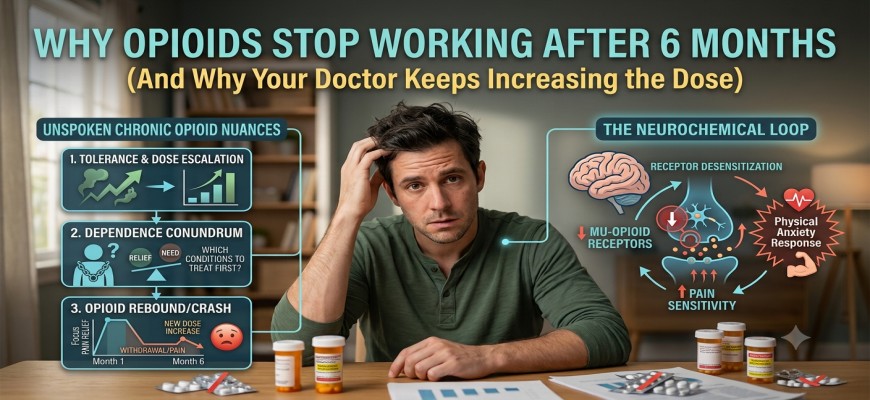
A critical pharmacist's guide to opioid tolerance, the neurochemical reality behind dose escalation, and why mainstream pain management often makes things worse.
Your doctor prescribed opioids for chronic pain. The first month was incredible. You could finally move without wincing. You slept better than you had in years. You felt like your life was getting back to normal.
Then month four hits. The pain is creeping back. It's not as bad as before the medication, but it's definitely returning. You call your doctor and mention it. They say: "We can increase the dose. Your body has adapted." So you go higher. For a few weeks, it works again. But by month seven, you're right back where you started—pain returning, function declining.
Now your doctor wants to increase again. You're concerned. You ask: "Isn't this dangerous?" Your doctor says tolerance is normal and that dose increases are the standard approach. But here's what they probably didn't tell you: the standard approach often doesn't work, and there's solid neuroscience explaining why.
After 21 years as a clinical pharmacist specializing in pain management, I've watched this cycle repeat with hundreds of patients. And I can tell you with certainty: what happens to your body on chronic opioids is far more complex than simple "tolerance." It's a cascade of neurological adaptations that dose escalation actually makes worse, not better.
This guide breaks down exactly what's happening to your brain and body on opioids, why the dose-escalation approach is neurochemically misguided, and what actually works for long-term pain management.
Most doctors explain opioid tolerance like this: "Your body gets used to the drug. You need more to feel the same effect." That's technically true, but it's incomplete. The actual neurochemistry is far more interesting—and explains why simply increasing the dose doesn't solve the problem.
Opioids (morphine, oxycodone, hydrocodone, fentanyl) work by binding to opioid receptors in the brain. These receptors are part of your body's natural pain-suppression system. When you activate them pharmacologically, pain signals get quieted.
But here's the crucial part: your brain doesn't like being told "pain is irrelevant" 24 hours a day. Pain is a vital warning system. Your brain's job is homeostasis—keeping everything balanced. When you chronically suppress pain signals via opioid receptors, your brain detects this as abnormal and compensates.
Your brain responds to chronic opioid exposure by:
This is your brain trying to restore equilibrium. It's a brilliant adaptation in acute pain settings. But in chronic opioid use, it becomes counterproductive.
Beyond receptor downregulation, your brain also recruits "opponent" systems—neural circuits that work against opioid effects to counterbalance them.
What this means: While opioids suppress pain and produce euphoria (if that's happening), your brain is simultaneously activating systems that promote pain perception and dysphoria. Over time, these opponent systems become stronger and more active.
Result: You need more opioid to override the opponent systems. This is true pharmacological tolerance—not weakness, not "drug-seeking," but genuine neurochemical adaptation.
| Time Period | Neurochemical Change | Clinical Manifestation | What's Happening |
|---|---|---|---|
| Days 1-7 | Minimal changes | Drug works great (peak efficacy) | Receptors are fresh; full response |
| Weeks 2-4 | Initial receptor downregulation begins | Effect still good but noticeably less than week 1 | Brain detects chronic signaling; begins compensation |
| Weeks 4-8 | Accelerated downregulation + opponent system activation | Effect declining noticeably (classic tolerance curve) | Receptor numbers dropping 30-40%; opponent systems ramping up |
| Months 2-6 | Plateau of downregulation + strong opponent systems | Tolerance nearly complete (new equilibrium reached) | Receptors at ~50% of baseline; opponent systems dominant |
| 6+ months | Stable low receptor density maintained | Tolerance is complete; dose increases have minimal effect | New "set point" established; further escalation ineffective |
Tolerance doesn't develop at the same rate for everyone. Some people plateau on the same dose for months. Others see tolerance within weeks. Here's what influences the speed:
Fast tolerance developers (tolerance within 2-4 weeks):
Slower tolerance developers (tolerance over 2-6 months):
Here's where things get really important: chronic opioid use doesn't just cause tolerance. It actually makes pain worse.
This phenomenon is called opioid-induced hyperalgesia (OIH). It's not a personality flaw or "the disease coming back." It's a direct neurochemical effect of chronic opioid exposure.
Remember those "opponent systems" your brain recruits to counterbalance opioid effects? They don't turn off when you take the drug. They're constantly active, sensitizing your nervous system to pain.
Result: You don't just have tolerance (needing more drug for the same effect). You have actual increased pain sensitivity. Your pain threshold drops. Things that didn't hurt before start hurting. Pain spreads to new locations.
The cruel irony: The drug that was supposed to relieve your pain ends up making you more pain-sensitive. And the standard medical response—increase the dose—actually worsens the hyperalgesia.
If you're experiencing these signs, increasing your opioid dose is the worst possible response. It will worsen hyperalgesia, not improve it.
This is the critical concept doctors often miss: once tolerance has developed and hyperalgesia has set in, increasing the opioid dose doesn't solve the underlying neurological problem. It just adds more drug to a system that's already adapted to compensate for it.
At 6 months on the same dose:
When you increase the dose:
The result: You're now on a higher dose, with worsening pain, increased side effects, and more physiological dependence. The problem is worse, not better.
If your opioid dose is increasing every 3-6 months and your pain control is getting worse, not better, increasing the dose further will not help. This is neurochemistry, not a character flaw or "the disease getting worse." The solution is not more opioids—it's a fundamentally different approach.
These terms are often confused, and the confusion leads to poor treatment decisions.
What it is: Your body adapts to the presence of opioids at a neurochemical level (receptor downregulation, opponent system activation). When you stop taking the drug, your brain is suddenly out of balance without the chronic opioid suppression.
Result: Withdrawal symptoms (sweating, body aches, insomnia, anxiety). These are unpleasant but not dangerous (not fatal).
Important: Physical dependence happens to everyone on chronic opioids, regardless of how responsibly they use the medication. It's inevitable neurochemistry, not moral weakness.
What it is: A behavioral condition characterized by compulsive use despite harm, continued use despite consequences, and prioritization of drug-seeking over other life activities.
Key difference: Addiction is not just physical dependence. Someone can be physically dependent without being addicted. Someone can be addicted without being physically dependent (psychological addiction exists).
If you're on chronic opioids, you will develop physical dependence. This is expected and normal, not a sign you're "becoming an addict." But increasing your dose doesn't reduce dependence—it increases it. You become more dependent while your pain control worsens.
| Risk Factor | Impact on Tolerance Speed | Mechanism |
|---|---|---|
| High baseline pain level | Tolerance x 2-3 faster | Brain already maximally pain-sensitized; opioids must overcome high baseline |
| High doses to start | Tolerance x 2 faster | Overwhelming receptor signaling triggers aggressive compensation |
| Age <40 | Tolerance x 1.5-2 faster | Younger brains adapt faster to chronic drug exposure |
| Prior opioid use | Tolerance much faster | Brain already has downregulated receptors; starts further behind |
| Genetic predisposition | Variable (up to 5x difference) | Some people's brains just adapt faster (genetic differences in receptor genes) |
| Chronic stress/trauma | Tolerance x 1.5 faster | Stress already dysregulates opioid system; magnifies response |
| Continuous dosing (no breaks) | Tolerance continuous | No opportunity for receptor recovery; adaptation constant |
| Extended-release formulations | Tolerance x 1.5 faster | Continuous drug exposure prevents any "off" periods |
The most effective approach is preventing tolerance in the first place, not fighting it after it develops.
The principle: Different opioids bind to opioid receptors slightly differently. By rotating between different opioids on a regular schedule (before tolerance develops fully), you allow receptors to partially recover and avoid maximal compensation.
Example rotation schedule:
Result: Tolerance redevelops more slowly. Pain control is maintained longer. You don't escalate doses as quickly.
Requires: Knowledgeable prescriber. Many doctors aren't trained in rotation strategies.
If rotation isn't feasible, planned brief breaks from opioids allow partial receptor recovery.
Example: 5-7 days off opioids every 8-12 weeks. This is unpleasant (withdrawal symptoms will occur), but it prevents the tolerance cycle from spiraling.
Alternative: "Dose-free weekends" where you take no opioids Saturday and Sunday. Less effective than longer breaks but allows some recovery.
Ketamine is an NMDA receptor antagonist—it works on a completely different neurochemical system than opioids.
Why it works: When combined with opioids, ketamine actually reverses opioid tolerance and hyperalgesia. It's been shown to reduce opioid requirements by 30-50% while improving pain control.
Dosing: Low-dose ketamine (0.5-1 mg/kg IV weekly or intranasal dosing). This is well below dissociative doses and has different pharmacology than recreational ketamine.
Important: Requires specialized clinics. Not widely available but increasingly recognized as evidence-based.
The most effective long-term approach combines multiple pain-management modalities. Opioids become one tool in a toolbox, not the only tool.
Components:
This approach keeps opioid doses low, prevents tolerance from escalating, and often provides better overall pain control than opioids alone.
If your doctor is willing to work with a rotation approach, here's how it works:
Bring this conversation to your appointment:
"I understand my pain management will require opioids long-term. I'm concerned about tolerance because I've read that doses escalate over time. I've learned that rotating between different opioids can prevent tolerance from developing as quickly. Would you be open to trying a rotation schedule before my tolerance becomes severe?"
What to expect: Knowledgeable pain management doctors will likely agree. Primary care doctors may be unfamiliar but willing to refer to a specialist.
Different opioids have different potencies. You need equianalgesic dosing (equivalent pain relief):
| Opioid | Equianalgesic Oral Dose | Example Dose Equivalence |
|---|---|---|
| Morphine | 30 mg (baseline) | 30 mg = reference dose |
| Oxycodone | 20 mg (1.5x more potent) | 20 mg oxycodone = 30 mg morphine |
| Hydromorphone | 7.5 mg (4x more potent) | 7.5 mg hydromorphone = 30 mg morphine |
| Codeine | 200 mg (much weaker) | 200 mg codeine = 30 mg morphine |
Your doctor will calculate equivalent doses so each switch provides the same pain relief but hits opioid receptors differently.
For many chronic pain conditions, non-opioid approaches provide equal or better pain control without the tolerance, dependence, and hyperalgesia risks.
What they do: Block calcium channels in the nervous system, reducing abnormal nerve pain signaling
Effective for: Neuropathic pain (nerve pain), fibromyalgia, post-herpetic neuralgia
Advantage: No tolerance develops; no dependence (though withdrawal can occur with abrupt discontinuation)
Typical dose: Gabapentin 300-600 mg three times daily; Pregabalin 150-600 mg daily in divided doses
What they do: SNRIs (serotonin-norepinephrine reuptake inhibitors) that modulate pain perception at the spinal cord and brain level
Effective for: Fibromyalgia, chronic pain, depression co-occurring with pain
Advantage: Addresses both pain and mood; no tolerance
Typical dose: Duloxetine 60 mg daily; Venlafaxine 150-225 mg daily
Lidocaine patches (Lidoderm): Apply directly to painful area. Numbs local nerves. No systemic absorption.
Capsaicin cream: Depletes substance P (pain neurotransmitter). Takes 3-4 weeks to work but is effective for localized pain.
Advantage: Minimal side effects; can use alongside systemic medications
Movement-based pain management is underutilized but highly effective.
If you're in the tolerance cycle and want to stop opioids, tapering must be done carefully to avoid severe withdrawal.
Important: Opioid withdrawal is extremely unpleasant but not life-threatening (unlike alcohol or benzodiazepine withdrawal). However, the misery can be significant enough that people restart opioids just to stop the withdrawal.
General principle: Reduce dose by 10-25% every 1-2 weeks. Slow tapers (over 8-12 weeks) produce less withdrawal than fast tapers (over 2-4 weeks).
Example: If currently on 60 mg oxycodone daily:
Medications that help:
Behavioral strategies:
No. Chronic high-dose opioids carry significant risks: overdose death, continued tolerance/hyperalgesia, worsening pain, increasing dependence. Withdrawal is miserable but temporary (1-2 weeks acute, 4-6 weeks mild symptoms). Long-term, withdrawal is safer than continued escalation. Discuss tapering options with your doctor rather than accepting perpetual dose increases.
Tolerance develops to cannabis too, though it's slower than opioids. Cannabis works through different receptors (CB1/CB2) so it can be combined with opioids or used as an alternative for some pain conditions. However, cannabis alone is less effective for severe pain than opioids. A combination approach (low-dose opioids + cannabis + non-opioid medications) is often better than either alone.
Partially. Opioid receptors do recover during off-periods, but recovery is incomplete and slow. A week off allows some (~20%) receptor recovery. A month off allows more (~40-50%) recovery. However, taking a month off every few months is impractical for chronic pain. Rotation strategies work better because you're switching drugs rather than completely stopping them.
Both. Your original pain condition is real. But chronic opioids add a layer of hyperalgesia (increased pain sensitivity) on top. So you're experiencing both the underlying condition AND drug-induced sensitization. This is why multimodal pain management (not just opioid increases) works better—it addresses both components.
No. Physical dependence is inevitable on chronic opioids and just means your body has adapted. Addiction is a behavioral disorder involving compulsive use despite harm. Someone can be dependent without being addicted. However, dependence does make quitting physically uncomfortable, which can feel like being "trapped" on the medication. This is why tolerance management and alternative pain approaches matter—they reduce dependence development.
Most medical schools don't teach detailed pharmacology of tolerance management. Doctors are trained in the standard approach: start opioids, increase as needed. Rotation strategies and multimodal pain management require more time, more knowledge, and often referrals to specialists. It's easier (but less effective) to simply increase doses. Seek pain management specialists who specifically have training in tolerance management and alternative approaches.
Opioid tolerance is real neurochemistry, not weakness or drug-seeking. It develops predictably, usually within 2-6 months. Dose escalation doesn't solve it—it worsens it by increasing hyperalgesia (pain sensitivity) and dependence without improving pain control. The solution is prevention (rotation strategies, medication breaks) or multimodal management (combining multiple pain approaches). If your pain control is worsening despite increasing doses, increasing opioids further will not help. It's time for a different approach.
The pain management system has often failed chronic pain patients by treating opioid escalation as the only option. This guide exists to help you understand what's actually happening neurochemically and to advocate for evidence-based alternatives.
Your pain is real. The tolerance is real. But the solution isn't perpetual dose increases. It's understanding your brain's adaptation, working with informed prescribers, and pursuing multimodal pain management that actually works long-term.

 Fetroja (Cefiderocol) for Complicated UTIs: First Siderophore Cephalosporin and the Mortality Warning Every Patient Should Know (FDA Approved 2019)
Exblifep for Complicated UTIs: FDA Approval, Efficacy, & Usage Guide
Fetroja (Cefiderocol) for Complicated UTIs: First Siderophore Cephalosporin and the Mortality Warning Every Patient Should Know (FDA Approved 2019)
Exblifep for Complicated UTIs: FDA Approval, Efficacy, & Usage Guide
 Nuzyra (Omadacycline) for Pneumonia and Skin Infections: Modernized Tetracycline with IV-to-Oral Options (FDA Approved 2018)
 Zemdri (Plazomicin) for Complicated UTIs: Newer IV Aminoglycoside for Resistant Infections (FDA Approved 2018)