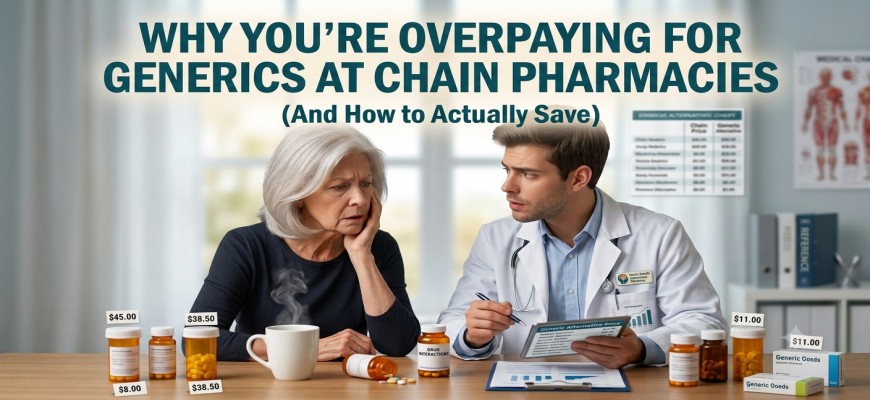
Why You're Overpaying for Generics at Chain Pharmacies (And How to Actually Save)
You walk into CVS with your generic prescription and pay $89. Your neighbor goes to Walgreens for the exact same medication and pays $34. Same drug, same dosage, same active ingredient — but a 61% price difference. This isn't an accident, and you're not being paranoid. Chain pharmacies use sophisticated pricing algorithms specifically designed to extract maximum revenue from people who don't know to ask questions.
After 18 years filling prescriptions at major chains, I've watched this pricing game destroy people's budgets and, worse, watched patients skip doses or not fill scripts entirely because they couldn't afford what the pharmacy quoted. This guide reveals exactly how the markup game works — and the eight strategies that actually work to cut what you pay in half or more.
Here's what most people believe: generic medicines have a standardized cost. The FDA approves the drug, sets a price, and every pharmacy charges roughly the same amount. Wrong. Dead wrong.
Generic drug pricing is completely unregulated in the United States. Unlike brand-name drugs (which have patent protections), generics compete in an open market where every pharmacy can charge whatever they want. This freedom creates insane price variations — often 300-400% differences for the exact same tablet at different pharmacies in the same city.
Why This Matters: You could take the same prescription to three pharmacies and receive three completely different quotes. This isn't pricing competition — it's pricing extraction targeting people who don't know to ask.
Chain pharmacies don't use a simple formula like "cost + 20%." They use dynamic pricing — algorithms that adjust prices based on:
The result: the same generic antibiotic might cost $15 at a rural pharmacy, $45 at an urban CVS, and $28 at the same chain's location two miles away. The markup isn't about covering pharmacy costs — it's about charging what the system thinks you'll pay.
I can walk you through exactly what happened the last time you got a quote that shocked you.
You present your prescription to the pharmacist. They enter it into their system. Within seconds, the software:
This happens invisibly. You see a single number quoted at the counter. What you don't see is that the algorithm considered dozens of variables and deliberately chose a price higher than what a cash customer at Walmart would pay for the same drug.
Pharmacist's Admission: I've worked at three major chains. Every single one used this system. I watched customers walk away from prescriptions they needed because the quoted price was 5-10x what they'd find elsewhere. The pharmacy knew this — and quoted the higher number anyway, because most people don't shop around.
The algorithm works like this: Charge the maximum price that customer-segment data suggests you can charge without losing the sale. It's not malicious — it's profit optimization. But it's also predictable, which means you can exploit it.
| Customer Profile | What the Algorithm Does | Price Quoted |
|---|---|---|
| High deductible insurance, frequent fills | Assumes you have budget pressure but will pay for essentials | $50-80 |
| First-time customer, uses insurance | Assumes you're unfamiliar with pricing variations | $60-90 |
| Cash customer with no insurance | Assumes you're price-sensitive but has "cash pay" rates | $20-40 |
| Regular customer, always fills here | Assumes loyalty = willingness to overpay | $45-75 |
| Customer paying with GoodRx code | Assumes you know pricing game, quotes competitive rate | $15-30 |
Notice the pattern? The algorithm punishes people who don't know to comparison shop. The moment you signal you're comparison shopping (by using GoodRx, asking for cash prices, or asking "what's your best price?"), prices drop dramatically.
Here's where chains make their biggest profits. If you have a high-deductible plan, the pharmacy's system knows:
What happens next? The pharmacy quotes you the insurance-negotiated price (designed to look legitimate) even though you can't actually use insurance. You end up paying $65 for a drug that costs $8 cash at a discount pharmacy.
Then, when your deductible is met and you refill, the insurance-negotiated price is suddenly $12 because your insurance actually kicks in. You've essentially subsidized the pharmacy's pricing game.
Pro Tip: If you have a high deductible, always ask: "What's your cash price?" before letting them run it through insurance. Often, paying cash is 50-80% cheaper than your insurance's negotiated rate during deductible season.
GoodRx and similar discount platforms work by exposing pharmacy pricing algorithms to price competition. When you enter a drug on GoodRx, you see real prices from real pharmacies in your area. This transparency is deadly to the markup game.
Here's why pharmacies hate it: they can't use their algorithm to extract maximum pricing if you have a competing offer. The moment you show a GoodRx coupon code at checkout, the system is forced to match or beat that price.
Real example: A customer came in with a GoodRx code for metformin 500mg, 90-day supply. CVS's quoted price was $87. GoodRx code: $12. Same pharmacy, same drug, same customer. The moment we entered the coupon code, the system adjusted to $12.
GoodRx costs nothing and takes 90 seconds. It's the single most effective tool you have against pharmacy markup.
Pharmaceutical manufacturers run programs that give away free or deeply discounted medications directly to patients. These programs exist specifically to help people who can't afford their drugs. Yet 90% of the people who qualify never use them because pharmacies don't advertise them.
Here's how to find them:
Some examples of savings through these programs:
These programs aren't advertised because pharmacies make money charging you full price. You have to ask for them specifically.
Let's look at a real scenario. A 30-day supply of lisinopril 10mg (common blood pressure medication):
| Pharmacy Source | Price (Cash/No Insurance) | Price (With Insurance) |
|---|---|---|
| CVS (chain default quote) | $52 | $45 |
| CVS (with GoodRx code) | $8 | $8 |
| Walgreens (chain default) | $48 | $42 |
| Walmart Pharmacy (cash) | $4 | $4 |
| Amazon Pharmacy (Prime member) | $6 | $6 |
| Manufacturer Assistance Program | Free (if eligible) | Free (if eligible) |
Same drug. The difference between CVS's default quote ($52) and Walmart ($4) is $48 per fill. Over a year, that's $576 you're overpaying for a single medication. Many people take 3-5 regular prescriptions.
Most people don't know you can negotiate with pharmacies. You absolutely can — and most pharmacies will match or beat competitor pricing if you ask.
Here's the exact script that works:
"I found this medication at [competitor] for [lower price]. Can you match that? If not, I'll need to transfer my prescription."
That's it. The pharmacy system is designed to retain customers. Most will immediately adjust the price. I've watched pharmacists override prices for customers who simply asked.
Even better: show them your GoodRx coupon before they quote a price. "I have a coupon code here — what's your best price with this?" Forces the system to quote competitively from the start.
Check GoodRx first. If the GoodRx price is lower than your insurance copay, use the coupon. Many people don't realize this is allowed — it's completely legal to use a discount code instead of insurance.
If you haven't met your deductible yet, insurance won't help. The pharmacy's quoted price is just an algorithm guess. Ask specifically: "What's the cash price?" Often 50-80% cheaper.
Walmart and Amazon have made pharmacy price transparency their competitive advantage. For common medications (lisinopril, metformin, atorvastatin), these are consistently $4-8 for 30-day supplies. Lock your regular meds there.
If you take weight-loss medication, newer biologics, or any drug over $200/month, search RxAssist.org. Manufacturers often offer better rates than any pharmacy.
For medications you take regularly, 90-day supplies at mail order pharmacies often cost less than three 30-day fills. Check GoodRx for mail order pricing too.
Chain pharmacies hate losing prescriptions. The transfer process takes 10 minutes and forces your old pharmacy to match or beat competitor pricing. Use this leverage.
AARP membership ($12-16/year) includes pharmacy discounts that rival GoodRx on many drugs. Some people find better deals through AARP than GoodRx — always check both.
Doctors get free samples from pharmaceutical reps. For new prescriptions, ask if samples are available. This saves you the first fill cost while you evaluate if the medication works for you.
Completely legal. GoodRx is a legitimate discount program. You can use any discount coupon instead of your insurance copay if it's cheaper. The only restriction: you can't bill insurance AND use a discount code simultaneously.
They don't lose money. Pharmacies make money on volume and on insurance negotiations. When you use GoodRx, they still profit — it's just less than their algorithm-optimized price. They prefer a customer who gets a small margin over a customer who doesn't fill the prescription at all.
No, you pick one. But you should check all three and use whichever is cheapest. GoodRx vs Insurance vs Manufacturer assistance — the math changes for every drug and every patient.
Legitimate online pharmacies (Amazon Pharmacy, verified NABP pharmacies, major chains' mail order) are safe. Unverified sellers are scams. Always check for NABP Verified Pharmacy seal if using an unfamiliar online source. We recommend verified online pharmacies with proper licensing.
Transfer your prescription. This is your leverage. Call the competitor, ask them to transfer it, and mention you're leaving because of price. Most chains will immediately call your doctor's office to get your current prescriptions and will price-match to get your business.
Brand-name drugs go up. Generic prices actually fluctuate based on supply, competition, and demand. This is why shopping around matters so much — the same generic might be $15 this month and $30 next month at the same pharmacy.
No. Generic prices vary wildly by location and supplier, but the medication itself is identical. A $4 generic lisinopril from Walmart is 100% the same drug as a $52 version from CVS. The only difference is markup.
Chain pharmacies rely on customers not knowing they can shop around. The pricing algorithm is designed to charge you the maximum you might accept without asking. But the moment you ask, compare, or show a discount code, that algorithm has to compete. You have more power than you think — you just have to use it. Your prescription costs what you accept it costs, not what the pharmacy quotes. Challenge the quote.
Disclosure & Disclaimer: This article is provided for general educational purposes and reflects common pharmacy pricing practices across the industry. Individual prices vary by location, insurance plan, and timing. This article does not constitute medical or financial advice. Always consult with your healthcare provider or pharmacist about your specific medications and pricing options. The examples and price comparisons in this article are illustrative and may not reflect current pricing at all locations.
 Fetroja (Cefiderocol) for Complicated UTIs: First Siderophore Cephalosporin and the Mortality Warning Every Patient Should Know (FDA Approved 2019)
Exblifep for Complicated UTIs: FDA Approval, Efficacy, & Usage Guide
Fetroja (Cefiderocol) for Complicated UTIs: First Siderophore Cephalosporin and the Mortality Warning Every Patient Should Know (FDA Approved 2019)
Exblifep for Complicated UTIs: FDA Approval, Efficacy, & Usage Guide
 Nuzyra (Omadacycline) for Pneumonia and Skin Infections: Modernized Tetracycline with IV-to-Oral Options (FDA Approved 2018)
 Zemdri (Plazomicin) for Complicated UTIs: Newer IV Aminoglycoside for Resistant Infections (FDA Approved 2018)