
<p>The FDA Just Added Its Strongest Warning to a Popular IV Iron Treatment Millions of Women Get Routinely — What the New Injectafer Boxed Warning Means for You</p>
<div class="masthead">
<h1>The FDA Just Added Its Strongest Warning to a Popular IV Iron Treatment<br />Millions of Women Get Routinely</h1>
<p>A pharmacist's guide to the new September 2026 FDA boxed warning on Injectafer (ferric carboxymaltose), the widely used IV iron infusion — what symptomatic hypophosphatemia actually is, who's most at risk, and what questions to ask before your next infusion.</p>
<div class="masthead-meta">? Updated September 2026 · ? Pharmacist-Reviewed · ? Evidence-Based · ?? 19 min read</div>
</div>
<div class="container">
<div class="article-intro">
<p>If you've ever been told your iron levels were "too low for pills to fix quickly enough," there's a good chance you were offered an IV iron infusion — and a strong chance that infusion was Injectafer (ferric carboxymaltose), one of the most widely used intravenous iron products in the United States. It's fast, convenient, often requiring just one or two visits instead of months of daily pills, and it's used routinely for iron deficiency anemia in women with heavy periods, people with inflammatory bowel disease, chronic kidney disease patients, and people with heart failure.</p>
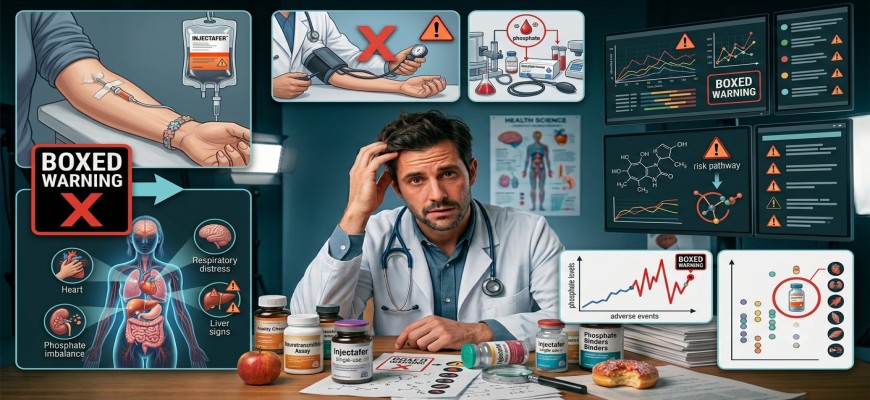
<p>On September 1, 2026, the FDA added a boxed warning — its most serious and prominent safety warning category — to Injectafer's label, specifically addressing the risk of severe, symptomatic low phosphate levels (hypophosphatemia). This isn't a brand-new discovery; regulators have been tightening this exact warning gradually since 2020. What changed is that despite those earlier updates, the FDA found the problem kept showing up in real-world reports, and phosphate testing meant to catch it was happening far less often than it should have been. This guide breaks down what this warning actually means, why phosphate matters so much, who's at highest risk, and the specific questions worth asking before your next infusion.</p>
</div>
<div class="toc">
<h3>? Quick Navigation</h3>
<ol>
<li><a href="#whats-injectafer">What Is Injectafer, and Why Is It So Widely Used?</a></li>
<li><a href="#whats-a-boxed-warning">What a "Boxed Warning" Actually Means (And Why This One Is Different)</a></li>
<li><a href="#the-timeline">The Timeline: How This Warning Gradually Escalated Since 2020</a></li>
<li><a href="#why-now">Why the FDA Escalated to a Boxed Warning Now</a></li>
<li><a href="#what-is-hypophosphatemia">What Is Hypophosphatemia, and Why Does Phosphate Matter?</a></li>
<li><a href="#how-it-happens">How IV Iron Actually Causes This</a></li>
<li><a href="#who-is-at-risk">Who's Most at Risk</a></li>
<li><a href="#symptoms">Symptoms to Watch For, and the Long-Term Complications</a></li>
<li><a href="#monitoring">What Proper Monitoring Should Actually Look Like</a></li>
<li><a href="#alternatives">Alternatives and Options Worth Discussing With Your Doctor</a></li>
<li><a href="#questions-to-ask">Questions to Ask Before Your Next Infusion</a></li>
<li><a href="#when-to-act">When to Seek Medical Attention</a></li>
<li><a href="#faqs">FAQs: Your Biggest Questions Answered</a></li>
</ol>
</div>
<h2 id="whats-injectafer">What Is Injectafer, and Why Is It So Widely Used?</h2>
<p>Injectafer (ferric carboxymaltose injection) is a prescription intravenous iron replacement medication, originally approved by the FDA in 2013. It's indicated for treating iron deficiency anemia in adult and pediatric patients aged 1 and older who haven't tolerated or responded adequately to oral iron, in adults with non-dialysis-dependent chronic kidney disease, and for iron deficiency in adults with heart failure (New York Heart Association class II/III) to improve exercise capacity.</p>
<p>Its popularity comes down to a genuine clinical advantage: it can deliver a large, clinically meaningful dose of iron in just one or two infusions, compared to the months of daily oral iron supplementation often needed to correct significant deficiency — supplementation that many patients also tolerate poorly, given oral iron's well-known tendency to cause GI side effects like constipation and nausea.</p>
<div class="callout critical"><strong>?? Critical Point:</strong> Iron deficiency anemia is extremely common, particularly among women with heavy menstrual periods, pregnant individuals, people with inflammatory bowel disease or other GI conditions affecting iron absorption, and people with chronic kidney disease or heart failure. Because Injectafer is used so routinely across such a broad patient population, a safety signal affecting it has an unusually wide potential reach.</div>
<h2 id="whats-a-boxed-warning">What a "Boxed Warning" Actually Means (And Why This One Is Different)</h2>
<p>A boxed warning — sometimes called a "black box warning" — is the FDA's most serious and prominent category of drug safety warning, reserved for risks that are serious enough to require the strongest possible visibility on a medication's label. It's not a routine label update; it represents the agency's judgment that prescribers and patients need this specific risk placed front and center in every clinical decision involving the drug.</p>
<p>What makes this particular case notable is that it isn't the FDA's first attempt to address this exact risk. This is an escalation, not the discovery of an entirely new problem — and that escalation history matters, because it tells you the earlier warnings weren't fully solving the issue in real-world practice.</p>
<h2 id="the-timeline">The Timeline: How This Warning Gradually Escalated Since 2020</h2>
<div class="dosage-block">
<div class="dosage-block-header">? THE REGULATORY ESCALATION TIMELINE</div>
<h4>2019-2020: The First Formal Warning</h4>
<p>The FDA determined that Injectafer could cause serious symptomatic hypophosphatemia, and in February 2020 approved labeling revisions adding a warning about this risk to the drug's label.</p>
<h4>2023: Monitoring Recommendations Added</h4>
<p>The warning was revised to recommend serum phosphate level monitoring specifically in patients at elevated risk, and in any patient receiving a repeat treatment course within three months. This update also added osteomalacia (bone softening) and fractures as potential long-term complications, and identified inflammatory bowel disease as an additional risk factor.</p>
<h4>2025: Additional Risk Factors Identified</h4>
<p>The warning was further revised to include additional recognized risk factors for developing hypophosphatemia after treatment.</p>
<h4>August-September 2026: Boxed Warning Added</h4>
<p>Following a citizen petition and the FDA's own review of adverse event reports, published case data, and real-world laboratory monitoring data, the agency approved a full boxed warning — its highest warning tier — for symptomatic hypophosphatemia associated with Injectafer.</p>
</div>
<p>This step-by-step escalation over six years is itself an important part of the story: each prior update was a genuine, good-faith attempt to address the risk with a lower-tier warning, and each time, real-world data showed the problem persisting at a level the agency judged required a stronger response.</p>
<h2 id="why-now">Why the FDA Escalated to a Boxed Warning Now</h2>
<p>The specific evidence behind this escalation is worth understanding in detail, because it illustrates exactly why the earlier warnings weren't sufficient on their own.</p>
<h3>The Numbers Behind the Decision</h3>
<p>In its 2026 review, the FDA examined multiple data sources, including its Adverse Event Reporting System, and identified 134 reports and published cases of serious, symptomatic hypophosphatemia associated with ferric carboxymaltose between July 1, 2022 and June 30, 2025. Some of these cases were described as severe, prolonged, difficult to treat, or associated with serious outcomes.</p>
<h3>The Monitoring Gap</h3>
<p>Perhaps the most significant finding driving this decision: the FDA found that phosphate testing was happening far less often than expected, even though the prior labeling already recommended monitoring for patients at increased risk. In other words, the safeguard the agency had already put in place — "monitor phosphate levels in at-risk patients" — wasn't being consistently followed in real-world clinical practice.</p>
<div class="callout warning"><strong>?? Why This Matters:</strong> A boxed warning is, in part, a tool for changing clinical behavior at scale. When a lower-tier warning with a specific monitoring recommendation doesn't reliably translate into that monitoring actually happening, escalating to the FDA's most visible warning category is a direct response to that real-world gap — not simply a formality.</div>
<h3>The Citizen Petition</h3>
<p>This specific action followed a citizen petition granted by the FDA on August 13, 2026, submitted by a physician advocating on behalf of patients with hereditary hemorrhagic telangiectasia (HHT) — a condition that causes chronic nosebleeds and GI bleeding, making iron deficiency and repeated IV iron treatment a common, recurring necessity for many patients in that community. Their case highlighted how patients requiring repeated infusions over months or years face a compounding version of this exact risk.</p>
<h2 id="what-is-hypophosphatemia">What Is Hypophosphatemia, and Why Does Phosphate Matter?</h2>
<p>Phosphate is a mineral essential to several core body functions that don't get much everyday attention until something goes wrong with them.</p>
<div class="dosage-block">
<div class="dosage-block-header">? WHAT PHOSPHATE ACTUALLY DOES IN YOUR BODY</div>
<h4>Bone Structure and Strength</h4>
<p>Phosphate, alongside calcium, is a core structural component of bone. Chronically low levels can weaken bone over time, contributing to a softening condition called osteomalacia and increasing fracture risk.</p>
<h4>Cellular Energy Production</h4>
<p>Phosphate is a critical component of ATP, the molecule your cells use as their basic energy currency — meaningfully low phosphate can directly impair how efficiently your cells produce and use energy, which helps explain why fatigue and muscle weakness are hallmark symptoms.</p>
<h4>Muscle and Nerve Function</h4>
<p>Adequate phosphate levels are necessary for normal muscle contraction and nerve signaling, which is why significant deficiency can produce muscle weakness or pain.</p>
</div>
<p>Hypophosphatemia simply means blood phosphate levels have dropped below normal. Mild, transient dips can be relatively inconsequential, but the FDA's concern here is specifically with <em>symptomatic</em> hypophosphatemia — cases severe or prolonged enough to produce real clinical symptoms and, in some documented cases, lasting complications.</p>
<h2 id="how-it-happens">How IV Iron Actually Causes This</h2>
<p>The mechanism connecting IV iron to low phosphate involves a hormone called FGF23 (fibroblast growth factor 23), which plays a central role in regulating how much phosphate the kidneys retain versus excrete.</p>
<p>Certain IV iron formulations, including ferric carboxymaltose, appear to trigger an increase in active FGF23, which in turn signals the kidneys to excrete more phosphate than normal into the urine. In most patients, this effect is mild and temporary. In a meaningful subset of patients, particularly those with specific risk factors covered below, the effect can be pronounced and prolonged enough to cause clinically significant, symptomatic hypophosphatemia — and in some cases, this has been documented to persist for weeks to months after a single infusion.</p>
<div class="callout"><strong>? Key Insight:</strong> This isn't a contamination issue, a dosing error, or a manufacturing problem — it's a recognized, mechanism-based pharmacological effect of this specific class of IV iron formulation, occurring at a low but real rate that the FDA has now determined warrants its strongest warning label.</div>
<h2 id="who-is-at-risk">Who's Most at Risk</h2>
<div class="table-wrapper">
<table>
<thead>
<tr><th>Risk Factor</th><th>Why It Raises Risk</th></tr>
</thead>
<tbody>
<tr><td><strong>Repeat treatment courses within a short interval</strong></td><td>Receiving another infusion within roughly three months of a prior one, before phosphate has had time to fully normalize, compounds the effect</td></tr>
<tr><td><strong>Inflammatory bowel disease</strong></td><td>Specifically identified as a risk factor in prior label updates, likely related to how these conditions affect overall mineral and nutrient regulation</td></tr>
<tr><td><strong>Pre-existing low or borderline phosphate levels</strong></td><td>Less physiological buffer before dropping into a clinically significant range</td></tr>
<tr><td><strong>Malnutrition or malabsorption conditions</strong></td><td>Reduced baseline phosphate intake or absorption compounds the kidney losses triggered by treatment</td></tr>
<tr><td><strong>Vitamin D deficiency</strong></td><td>Vitamin D plays a role in phosphate regulation and absorption, and deficiency can compound the risk</td></tr>
<tr><td><strong>Older age</strong></td><td>Associated with increased risk in some of the data reviewed by the FDA</td></tr>
</tbody>
</table>
</div>
<div class="callout warning"><strong>?? An Important Nuance:</strong> Having one or more of these risk factors doesn't mean IV iron treatment should automatically be avoided — for many patients, the anemia being treated carries its own serious risks, and IV iron remains an appropriate, often necessary choice. What it does mean is that phosphate monitoring becomes more clearly warranted, and that's precisely the gap this new boxed warning is meant to close.</div>
<h2 id="symptoms">Symptoms to Watch For, and the Long-Term Complications</h2>
<p>Because hypophosphatemia's early symptoms overlap significantly with the fatigue and weakness that iron deficiency anemia itself causes, it can be genuinely difficult to distinguish "my anemia hasn't fully resolved yet" from "my phosphate has dropped too low" without an actual blood test.</p>
<div class="callout critical"><strong>? SYMPTOMS OF SYMPTOMATIC HYPOPHOSPHATEMIA TO REPORT TO YOUR DOCTOR:</strong>
<ul>
<li>Fatigue that doesn't improve, or worsens, after your iron infusion</li>
<li>Muscle weakness or muscle pain</li>
<li>Bone or joint pain</li>
<li>Any new bone fracture, especially without significant trauma</li>
</ul>
</div>
<p>Left unaddressed, prolonged or severe hypophosphatemia can progress to more serious complications, including osteomalacia (a bone-softening condition distinct from osteoporosis) and an increased risk of fractures — both specifically flagged in the FDA's updated warning as potential long-term consequences.</p>
<h2 id="monitoring">What Proper Monitoring Should Actually Look Like</h2>
<p>Current FDA guidance, now reinforced by the boxed warning, calls for specific monitoring practices that patients can reasonably expect and ask about directly.</p>
<div class="dosage-block">
<div class="dosage-block-header">? WHAT THE UPDATED LABEL RECOMMENDS</div>
<h4>Serum Phosphate Testing for At-Risk Patients</h4>
<p>Patients with recognized risk factors for chronic low phosphate should have serum phosphate levels monitored, rather than assuming absence of obvious symptoms means levels are normal.</p>
<h4>Monitoring for Repeat Treatment Within Three Months</h4>
<p>Anyone receiving a repeat course of Injectafer within three months of a previous one should have phosphate levels checked, given the compounding risk described above.</p>
<h4>Treating Hypophosphatemia When It's Found</h4>
<p>If low phosphate is identified, the current guidance calls for treating it as medically indicated, which may include phosphate supplementation depending on severity.</p>
<h4>Considering Discontinuation for Severe or Persistent Cases</h4>
<p>For severe or persistent hypophosphatemia, the updated guidance indicates that permanent discontinuation of the medication should be considered.</p>
</div>
<div class="callout critical"><strong>?? Critical Point:</strong> The FDA's own review found that this recommended monitoring wasn't consistently happening even before this boxed warning was added. That's precisely why proactively asking about it, rather than assuming it's automatically being done, is a meaningful and reasonable step for any patient receiving this treatment.</div>
<h2 id="alternatives">Alternatives and Options Worth Discussing With Your Doctor</h2>
<p>This warning isn't a reason to panic or to avoid IV iron treatment altogether — for many patients with significant iron deficiency, the risks of remaining untreated (including the serious consequences of severe anemia itself) outweigh this risk when it's properly monitored. But it is a reasonable prompt to have a more informed conversation about options.</p>
<div class="comparison-grid">
<div class="comparison-card">
<h4>Oral Iron Supplementation</h4>
<p>Generally doesn't carry this specific hypophosphatemia risk, but is slower to correct significant deficiency and is frequently limited by GI side effects (constipation, nausea) that lead many patients to discontinue it before treatment is complete.</p>
</div>
<div class="comparison-card">
<h4>Other IV Iron Formulations</h4>
<p>Not all IV iron products carry an identical hypophosphatemia risk profile — this is a meaningful, individualized question to raise with your prescriber, since alternative formulations may be a reasonable option depending on your specific situation and risk factors.</p>
</div>
</div>
<p>The right choice depends heavily on the severity of your anemia, how quickly correction is clinically needed, your specific risk factors for hypophosphatemia, and your personal tolerance of oral iron — all reasons this is a conversation to have directly with your prescriber rather than a decision to make from a blog post.</p>
<h2 id="questions-to-ask">Questions to Ask Before Your Next Infusion</h2>
<div class="dosage-block">
<div class="dosage-block-header">? A PRACTICAL CHECKLIST FOR YOUR NEXT APPOINTMENT</div>
<h4>1. "Do I have any of the recognized risk factors for hypophosphatemia?"</h4>
<p>Ask specifically about inflammatory bowel disease, prior low phosphate levels, malnutrition, vitamin D deficiency, or a recent repeat infusion within the last three months.</p>
<h4>2. "Will my phosphate levels be checked before and after this infusion?"</h4>
<p>Given the FDA's finding that this monitoring wasn't consistently happening, it's reasonable to confirm directly rather than assume.</p>
<h4>3. "What symptoms should I watch for afterward, and when should I call?"</h4>
<p>Make sure you leave the appointment knowing specifically what fatigue, weakness, or bone pain would warrant a call versus what's expected as normal recovery.</p>
<h4>4. "Is there an alternative iron formulation that might carry a lower risk for my specific situation?"</h4>
<p>Particularly relevant if you have identified risk factors or anticipate needing repeated treatment courses over time.</p>
<h4>5. "If I've had previous infusions, should my phosphate be checked now, even retrospectively?"</h4>
<p>If you've had Injectafer before and were never specifically monitored for this, it's reasonable to ask whether a current check makes sense, especially if you have any of the symptoms described above.</p>
</div>
<h2 id="when-to-act">When to Seek Medical Attention</h2>
<div class="callout critical"><strong>? CONTACT YOUR DOCTOR IF, AFTER AN INJECTAFER INFUSION, YOU EXPERIENCE:</strong>
<ul>
<li>Fatigue or weakness that doesn't improve, or that worsens, despite your anemia being treated</li>
<li>New or worsening muscle pain or weakness</li>
<li>New bone or joint pain</li>
<li>A fracture that occurs without significant trauma</li>
</ul>
</div>
<div class="callout warning"><strong>?? ALSO WORTH RAISING AT YOUR NEXT APPOINTMENT IF:</strong>
<ul>
<li>You've received Injectafer before and were never specifically monitored for phosphate levels</li>
<li>You're due for a repeat infusion within three months of your last one</li>
<li>You have inflammatory bowel disease, malnutrition, vitamin D deficiency, or any other recognized risk factor for this condition</li>
</ul>
</div>
<h2 id="faqs">FAQs: Your Biggest Questions Answered</h2>
<div class="faq-section">
<div class="faq-item">
<div class="faq-question">Does this boxed warning mean I should stop or refuse Injectafer treatment? +</div>
<div class="faq-answer">
<p>Not automatically. For many patients with significant iron deficiency anemia, IV iron treatment remains an appropriate and often necessary choice, and the risks of leaving severe anemia untreated can be serious in their own right. The purpose of this warning is to ensure proper monitoring and risk-factor awareness, not to broadly discourage use of the medication — this is a conversation to have with your prescriber based on your individual situation.</p>
</div>
</div>
<div class="faq-item">
<div class="faq-question">How common is severe hypophosphatemia with this medication? +</div>
<div class="faq-answer">
<p>The FDA's review identified 134 reports and published cases of serious, symptomatic hypophosphatemia over a three-year period nationally, out of what is a very widely used medication administered to a large patient population — meaning it's a real but relatively uncommon complication in absolute terms, though the agency judged the severity and monitoring gap significant enough to warrant its strongest warning category.</p>
</div>
</div>
<div class="faq-item">
<div class="faq-question">Is this the first time the FDA has warned about this risk? +</div>
<div class="faq-answer">
<p>No — the FDA first added a warning about this risk to Injectafer's label in 2020, then strengthened it further in 2023 and again in 2025 before this September 2026 boxed warning. This is best understood as a gradual regulatory escalation based on accumulating real-world evidence, not a sudden, previously unknown discovery.</p>
</div>
</div>
<div class="faq-item">
<div class="faq-question">Will my phosphate levels definitely be checked before my next infusion? +</div>
<div class="faq-answer">
<p>Not automatically — the FDA's own review found that recommended phosphate monitoring wasn't consistently happening even before this boxed warning was added. This is exactly why proactively asking your provider about it, rather than assuming it will happen by default, is a reasonable and worthwhile step.</p>
</div>
</div>
<div class="faq-item">
<div class="faq-question">Can low phosphate from IV iron be treated once it's found? +</div>
<div class="faq-answer">
<p>Yes, hypophosphatemia identified through monitoring can be treated as medically indicated, which may include phosphate supplementation depending on severity. For severe or persistent cases, current guidance also indicates that permanently discontinuing the medication should be considered.</p>
</div>
</div>
<div class="faq-item">
<div class="faq-question">Are there IV iron formulations without this specific risk? +</div>
<div class="faq-answer">
<p>Different IV iron formulations have different risk profiles for this specific effect, related to how strongly they trigger the FGF23 hormonal pathway described above. This is a meaningful and reasonable question to raise directly with your prescriber if you have risk factors or concerns, though the right choice depends on your individual clinical situation.</p>
</div>
</div>
<div class="faq-item">
<div class="faq-question">I've had Injectafer infusions before this warning came out — should I be worried? +</div>
<div class="faq-answer">
<p>Having had prior infusions isn't automatically cause for alarm, particularly if you haven't experienced any of the symptoms described above. That said, if you have any of the recognized risk factors, are due for another infusion, or have noticed unexplained fatigue, weakness, or bone pain, it's a reasonable and worthwhile step to ask your doctor about checking your phosphate levels now.</p>
</div>
</div>
<div class="faq-item">
<div class="faq-question">Why did it take from 2020 to 2026 for this to become a boxed warning? +</div>
<div class="faq-answer">
<p>Regulatory escalation typically follows an evidence-accumulation process: an initial warning is added, then real-world data (adverse event reports, published case data, and monitoring compliance) is reviewed over time to determine whether the existing warning is adequately addressing the risk. In this case, the FDA's 2026 review found the problem persisting despite earlier updates, and specifically found that recommended monitoring wasn't happening consistently — which is what prompted the escalation to this strongest warning category.</p>
</div>
</div>
</div>
<div class="disclaimer"><strong>?? MEDICAL DISCLAIMER</strong>
<p>This article is for educational purposes only and does not constitute medical advice. It summarizes a September 2026 FDA drug safety communication and related regulatory history, and does not diagnose or rule out any individual's condition or risk level. Do not stop, refuse, or change any prescribed medication based on this article alone. If you have questions about Injectafer or any IV iron treatment, including your personal risk factors and appropriate monitoring, discuss them directly with your prescriber or pharmacist. This content reflects FDA communications and clinical understanding current as of September 2026, and prescribing information may be further updated as new information emerges.</p>
</div>
<div class="article-footer">
<h3>About MyOnlineMedShop</h3>
<p>MyOnlineMedShop is committed to providing evidence-based pharmaceutical information to help patients and healthcare providers make informed decisions about medications. This article synthesizes the FDA's September 1, 2026 Drug Safety Communication regarding ferric carboxymaltose injection (Injectafer), related regulatory history dating to 2020, and current FDA-approved prescribing information.</p>
<p><strong>Last updated:</strong> September 2026 | <strong>Next review:</strong> December 2026</p>
</div>
</div>



 The FDA Just Added Its Strongest Warning to a Popular IV Iron Treatment Millions of Women Get Routinely — What the New Injectafer Boxed Warning Means for You (2026)
Scientists Just Found a Hidden Cause of High Blood Pressure That Your Doctor's Office Can't Detect — What Nighttime Hormone Surges Are Doing to Your Heart (2026)
Scientists Just Found a Hidden Cause of High Blood Pressure That Your Doctor's Office Can't Detect — What Nighttime Hormone Surges Are Doing to Your Heart (2026)
Libido Gummies and "Hormone-Balancing" Powders Are 2026's Hottest Wellness Trend — Here's What's Actually in Them (And Why No One's Regulating It)
The FDA Just Added Its Strongest Warning to a Popular IV Iron Treatment Millions of Women Get Routinely — What the New Injectafer Boxed Warning Means for You (2026)
Scientists Just Found a Hidden Cause of High Blood Pressure That Your Doctor's Office Can't Detect — What Nighttime Hormone Surges Are Doing to Your Heart (2026)
Scientists Just Found a Hidden Cause of High Blood Pressure That Your Doctor's Office Can't Detect — What Nighttime Hormone Surges Are Doing to Your Heart (2026)
Libido Gummies and "Hormone-Balancing" Powders Are 2026's Hottest Wellness Trend — Here's What's Actually in Them (And Why No One's Regulating It)