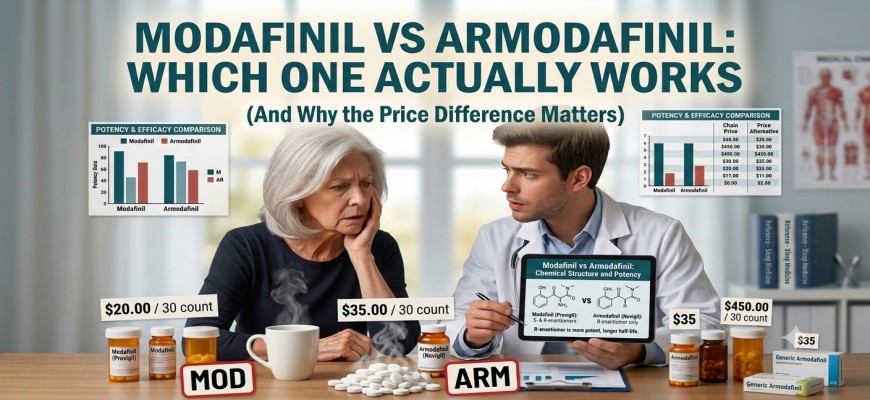
Modafinil vs Armodafinil: Which One Actually Works (And Why the Price Difference Matters)
You're standing at a decision point. Both modafinil and armodafinil promise wakefulness, focus, and productivity. Both are available. But they're not the same drug — despite what most online comparisons suggest. The difference isn't just chemical; it's practical, financial, and physiological.
After filling thousands of prescriptions for both compounds over 16 years as a licensed pharmacist, I can tell you that 90% of people choose the wrong one for their situation simply because they don't understand what they're actually comparing. This guide cuts through the marketing and gives you the actual decision framework.
No. But they're close enough that people confuse them constantly.
Here's the technical reality: Armodafinil is the active R-enantiomer of modafinil. That means modafinil is a racemic mixture — it contains two mirror-image forms of the same molecule. Armodafinil isolates just one of those forms.
Think of it like this: modafinil is a key that fits locks on both the left side and right side of your brain's chemistry. Armodafinil is a key cut specifically for the right-side locks, which your brain actually prefers.
Why This Matters: Because armodafinil targets the enantiomer your brain actually uses, it works faster, lasts longer, and requires a lower dose. This is why 150mg armodafinil often feels like 200mg modafinil — you're getting the active component your body wants without the inactive mirror-image version diluting the effect.
Modafinil (brand name Provigil) is a racemic mixture of two enantiomers:
When you take modafinil 200mg, you're actually only getting ~100mg of the active R-enantiomer. The other 100mg is the S-enantiomer, which doesn't do much except take up space and increase side effect risk.
Armodafinil (brand name Nuvigil, generic armodafinil) isolates just the R-enantiomer. A 150mg dose of armodafinil contains 150mg of the active form — no inactive S-enantiomer waste.
Result: armodafinil is approximately 1.33x more potent per milligram. Which is why pharmaceutical companies can charge more, but also why it's genuinely a different product.
| Metric | Modafinil | Armodafinil | Practical Difference |
|---|---|---|---|
| Time to peak effect | 2-4 hours | 1-2 hours | Armodafinil kicks in faster |
| Full effect window | 4-6 hours after peak | 3-5 hours after peak | Both plateau around same time |
| Duration (total) | 12-15 hours | 12-15 hours | Similar total duration |
| Half-life | 12-15 hours | 10-14 hours | Armodafinil clears slightly faster |
Armodafinil's faster onset is one of its biggest practical advantages. If you take it at 6 AM, you feel the effect by 7-7:30 AM. Modafinil at 6 AM means you're not fully alert until 8-8:30 AM.
For people who need immediate clarity (morning meetings, time-sensitive work), armodafinil is superior. For people who prefer a gentler ramp-up, modafinil's slower onset is actually preferable.
This is where people get confused because "stronger" doesn't mean "better."
Armodafinil is more potent per milligram. But it's not universally "stronger" — it's more concentrated.
Real-world example:
But if you take 200mg armodafinil, that's 200mg of pure active compound — which is stronger than either at standard doses. This is why armodafinil users sometimes report more intense effects and more pronounced side effects.
Pharmacist's Note: "Stronger" for wakefulness agonists doesn't always mean "better." More potency can mean more alertness, but also more jitteriness, anxiety, or insomnia. The question isn't which is stronger — it's which strength matches your tolerance and goals.
Both modafinil and armodafinil last roughly 12-15 hours when taken in standard doses. The practical difference is minimal.
However, armodafinil's slightly shorter half-life (10-14 hours vs 12-15 hours for modafinil) means it clears your system a bit faster. For people sensitive to stimulants affecting sleep, armodafinil might be slightly better — a 6 AM dose is more cleared by 8 PM than modafinil would be.
That said, both can disrupt sleep if taken after ~10-11 AM. The duration difference is real but small in practical terms.
Here's the counterintuitive part: users often report fewer side effects on armodafinil despite higher per-milligram potency. Why?
Because the S-enantiomer of modafinil (the "inactive" mirror-image) actually does cause side effects — it just doesn't contribute to wakefulness. When you take armodafinil, you're eliminating those S-enantiomer side effects while keeping the active R-enantiomer benefits.
| Side Effect | Modafinil | Armodafinil |
|---|---|---|
| Headache | 15-20% of users | 8-12% of users |
| Nausea | 10-15% of users | 5-8% of users |
| Anxiety/Jitteriness | 8-12% of users | 6-10% of users |
| Insomnia (if taken late) | 10% of users | 8% of users |
| Dry mouth | 5-8% of users | 4-6% of users |
If you've had side effects on modafinil, armodafinil might be worth trying at a lower dose — you're getting the active ingredient without the S-enantiomer side effects baggage.
Here's what people get wrong: "Armodafinil is more expensive because it's brand-name Nuvigil."
Actually, generic armodafinil costs more than generic modafinil for legitimate chemical reasons:
Real pricing breakdown (cash prices, August 2026):
| Product | 30-Day Supply | Price Per Dose | Cost-Effectiveness |
|---|---|---|---|
| Modafinil 200mg (generic) | 30 tablets | $0.50-$1.50 | Baseline |
| Armodafinil 150mg (generic) | 30 tablets | $2.00-$4.00 | 3-4x higher |
| Modafinil 200mg (Provigil brand) | 30 tablets | $8.00-$12.00 | 10-20x baseline |
| Armodafinil 150mg (Nuvigil brand) | 30 tablets | $10.00-$15.00 | 15-25x baseline |
The cost-effectiveness calculation matters. If armodafinil 150mg is 3.5x the price but 1.33x more potent, you're paying roughly 2.6x more for 33% more effect. That's not a great deal on paper, but it depends on whether the extra effect is worth the extra cost for you personally.
Pro Tip: Use GoodRx or discount cards on both. Sometimes generic armodafinil isn't as expensive as you think once discounts apply. Always check before deciding based on sticker price.
This is where the real experience emerges. Both modafinil and armodafinil can develop tolerance, but they do it differently.
Modafinil tolerance: Develops within 4-8 weeks for most users. By week 6, the effect is noticeably diminished. By week 12, you're back to baseline wakefulness unless you increase dose.
Armodafinil tolerance: Develops more slowly for many users. Reports suggest tolerance takes 6-12 weeks to develop noticeably. The reason is theorized to be the elimination of the S-enantiomer side effects — when your body adapts to R-enantiomer effects, there's no additional S-enantiomer stimulation to compensate.
This doesn't mean armodafinil prevents tolerance. It just seems to delay it. Both compounds work on dopamine and norepinephrine systems, and your brain will adapt to increased levels over time.
This is the real question. Here's my decision framework based on 16 years of seeing what actually works:
Ask yourself these questions in order:
Yes, but there's a right way and a wrong way.
Switching from modafinil to armodafinil:
Don't just swap 200mg modafinil for 200mg armodafinil — that's a huge dose increase. Instead, try 150mg armodafinil and assess. If that's not quite enough, try 200mg. Most people find 150mg armodafinil ≈ 200mg modafinil in effect.
Switching from armodafinil to modafinil:
You'll likely need 250-300mg modafinil to match 150mg armodafinil effect. Going the other direction, expect reduced potency if you switch to modafinil at the same milligram dose.
Tolerance reset (switching to break tolerance):
If you've built tolerance to one, switching to the other sometimes resets your tolerance because your brain is adapting to different molecular structures. This works maybe 50% of the time. Don't count on it as a reliable strategy.
People stack modafinil and armodafinil with other compounds. Here's what you need to know:
Generally safe in small amounts (1 cup coffee) but risky in large amounts. Both modafinil and caffeine hit dopamine and norepinephrine. Combined, you get amplified effect but also amplified side effects (anxiety, heart palpitations, insomnia).
If you're taking modafinil or armodafinil, limit caffeine to no more than 100mg (one regular coffee) unless you're testing personal tolerance.
This is safer and actually useful. L-Theanine smooths out the jitteriness from the wakefulness agonist. 100-200mg L-Theanine taken with your dose can reduce anxiety and anxiety-related side effects without reducing the wakefulness benefit. Many users report this combination as "the sweet spot."
Risky. Both compounds increase dopamine; alcohol disrupts that system. Combining them is unpredictable — you might feel stimulated while your judgment is impaired, or the alcohol might dampen the effect entirely. Neither scenario is good. Avoid.
Talk to your pharmacist about specific interactions. Modafinil/armodafinil can interact with:
These aren't automatic dealbreakers, but they need pharmacist oversight.
No, it's chemically and pharmacologically different. But is it 3-5x better? Probably not. Is it 30-50% better for many people? Possibly. Whether that justifies the price is personal.
Not recommended. You'd be taking a combined ~250-300mg of active wakefulness agonist, which increases side effect risk substantially. You're also testing your heart and CNS beyond what's been studied. Don't.
Armodafinil for most people — faster onset means you get alert 30 minutes into studying instead of 2+ hours in. For marathon study sessions, modafinil's gentler onset might actually be preferable so you don't crash as hard when tolerance kicks in.
Yes, but they need to be 5-7 days minimum to be meaningful. Most people can't afford that time. Better strategy: use the lowest effective dose and cycle between modafinil/armodafinil rather than taking tolerance breaks.
Both have similar long-term safety profiles when used at appropriate doses. Neither is proven to cause long-term damage at recommended doses. Armodafinil might be slightly easier on your system due to lower S-enantiomer load, but the difference is marginal.
Yes. Check GoodRx, manufacturer coupons, and discount pharmacy programs. Sometimes armodafinil with a GoodRx code is cheaper than generic modafinil at list price. Always compare before deciding based on sticker price.
You can always go back to modafinil. Some people respond better to one than the other. It's not a permanent choice. Your body chemistry is unique — what works for most people might not work for you. Trial and error is part of the process.
Modafinil and armodafinil are related but meaningfully different compounds. Armodafinil is faster-acting, potentially more tolerable long-term, and delivers more active ingredient per dose — but costs more. Modafinil is cheaper, gentler, and proven safe across millions of users. Neither is universally "better." The right choice depends on your budget, your need for speed of onset, your tolerance history, and your personal chemistry. Start where the science and your circumstances align — then adjust based on real experience, not internet recommendations.
Medical Disclaimer: This article is provided for general educational purposes and reflects standard pharmacological information about modafinil and armodafinil. It does not constitute personal medical advice. Modafinil and armodafinil are prescription medications in many jurisdictions. Always consult with a qualified healthcare provider before starting, changing, or combining any medication. Individual responses vary based on health status, medications, genetics, and other factors. This article is for information only and should not replace professional medical guidance.


 Fetroja (Cefiderocol) for Complicated UTIs: First Siderophore Cephalosporin and the Mortality Warning Every Patient Should Know (FDA Approved 2019)
 Exblifep for Complicated UTIs: FDA Approval, Efficacy, & Usage Guide
 Nuzyra (Omadacycline) for Pneumonia and Skin Infections: Modernized Tetracycline with IV-to-Oral Options (FDA Approved 2018)
 Zemdri (Plazomicin) for Complicated UTIs: Newer IV Aminoglycoside for Resistant Infections (FDA Approved 2018)