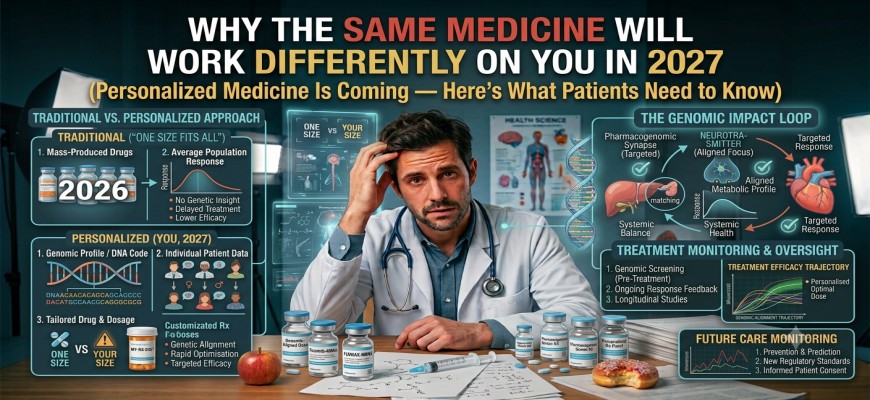
Why the Same Medicine Will Work Differently on You in 2027
Personalized Medicine Is Coming — Here's What Patients Need to Know
Imagine going to a doctor in 2027, being diagnosed with high blood pressure, and instead of being handed the same prescription that millions of other people with the same condition receive, your doctor checks a quick genetic profile and says: "Actually, that standard medication won't work well for you — your liver processes it too quickly. Here's the one that will."
That is not science fiction. It is happening now in pockets of medicine, and it is about to become the expectation rather than the exception. The shift is called personalized medicine — and it will change the relationship between patients and their prescriptions in ways that most people have not been told about yet.
This guide explains what personalized medicine actually means for ordinary patients, what is already available today, what is coming in the next two to three years, and the honest questions you should be asking your pharmacist and doctor before that wave arrives.
- What Personalized Medicine Actually Means
- Why 2027 Is the Turning Point
- Your Genes and Your Medicine
- What Is Already Available Today
- What Is Coming in the Next Two to Three Years
- Your Gut, Your Genes, and Your Prescription
- How AI Is Changing Prescribing
- The Honest Concerns About Personalized Medicine
- Myths and Misconceptions
- What Patients Can Do Right Now
- Questions to Ask Your Doctor or Pharmacist
- Frequently Asked Questions
- The Bottom Line
Sources: NIH National Human Genome Research Institute; Dr. Matthew Lynch health trends analysis 2026; FDA drug approval records; Longevity.media market analysis.
What Personalized Medicine Actually Means
The term gets used a lot right now, often loosely. So it is worth being precise about what personalized medicine — also called precision medicine — actually involves.
Standard medicine works like this: a doctor observes a condition, matches it to a diagnosis, and prescribes the treatment most likely to help the largest number of people with that diagnosis. It is population-level thinking applied to an individual patient. Most of the time, it works well enough. But "most of the time" still leaves a significant portion of patients who get limited benefit, unexpected side effects, or both.
Personalized medicine asks a different question: given everything we know about this specific person — their genetics, their metabolism, their gut bacteria, their existing conditions, their other medications — which treatment is most likely to work best for them specifically?
The NIH's National Human Genome Research Institute defines precision medicine as "an emerging approach for disease treatment and prevention that takes into account individual variability in genes, environment, and lifestyle for each person." The important word there is variability. People are biologically different from each other in ways that directly affect how medicines work in their bodies — and medicine is now developing the tools to actually use that information at scale.
Why 2027 Is the Turning Point
Personalized medicine is not new as a concept. What is new is the combination of three things arriving at the same time: affordable genetic sequencing, artificial intelligence capable of analyzing complex biological data, and a regulatory environment that is actively approving precision treatments faster than at any previous point in history.
The cost of DNA sequencing collapsed
In 2001, sequencing a single human genome cost roughly $100 million. By 2025, it cost under $200. That collapse in cost is what changed everything. When genetic profiling becomes cheap enough to run before writing a prescription rather than only in a research lab, it stops being experimental and starts becoming clinical.
Regulators are moving faster than most patients realize
The FDA approved more than 16 personalized treatments for rare diseases in 2023 alone — more than double the approvals from the year before. Precision oncology, where a tumour's specific genetic mutations guide which drug is chosen, is already standard of care in many cancer types. That model is now moving outward into cardiology, neurology, psychiatry, and chronic disease management.
AI made sense of data that humans couldn't
The human genome contains over 3 billion base pairs. No physician can hold that complexity in their head while writing a prescription. AI systems trained on millions of patient datasets can identify patterns — which genetic variants predict which drug responses, which combinations of biomarkers signal which risks — that would be invisible to unaided clinical judgment. This is not replacing doctors. It is giving doctors a far more precise instrument than they have ever had before.
Your Genes and Your Medicine
The branch of personalized medicine most immediately relevant to everyday prescriptions is called pharmacogenomics — the study of how your genes affect your response to drugs.
Here is what most patients do not know: the liver contains a family of enzymes called cytochrome P450 (CYP) enzymes that break down the majority of commonly prescribed medicines. The genes that code for these enzymes vary between people. Some people's enzymes work fast, some work slowly, and some don't work in a particular way at all.
This variation is not rare or unusual. It is normal human biological diversity. And it has enormous practical consequences.
The four metabolizer types
| Metabolizer Type | What It Means | Effect on Medicine | Medicines Most Affected |
|---|---|---|---|
| Poor Metabolizer | The enzyme works very slowly or not at all | Medicine builds up to higher-than-expected levels; increased side effect risk | Certain antidepressants, codeine, some blood pressure medicines, tamoxifen |
| Intermediate Metabolizer | The enzyme works slower than average | Moderately higher drug levels; may need dose adjustment | Similar to poor metabolizers, to a lesser degree |
| Normal (Extensive) Metabolizer | The enzyme works as the drug was designed for | Standard dosing typically applies | All — this is the population most prescriptions are calibrated for |
| Ultrarapid Metabolizer | The enzyme works much faster than average | Medicine clears the body before it reaches effective levels; treatment may fail | Antidepressants, opioid painkillers, some antipsychotics |
This is why two people with the same diagnosis can take the same antidepressant at the same dose and have completely different experiences. One builds up an excess that causes intolerable side effects. Another clears it so quickly that it never works. A third responds exactly as the prescriber intended. Their genotype — not their willpower, not their lifestyle choices — is a significant part of the explanation.
It goes beyond metabolism
Pharmacogenomics also covers how genes affect drug targets — the receptors, channels, and proteins that medicines bind to. Some people carry variants that make a receptor more or less responsive to a drug, independent of how quickly their body processes it. This is why genetic factors can affect not just the dose needed but whether a particular medicine is likely to work at all for a given individual.
What Is Already Available Today
Personalized medicine is not entirely a future promise. Significant applications already exist in clinical practice, and patients who know about them can ask for them now.
Oncology: where it started
Cancer treatment has led the way. Tumour profiling — sequencing the DNA of a tumour to identify which specific mutations are driving its growth — is now standard for many cancer types. This information guides which targeted therapies are prescribed, rather than applying the same chemotherapy protocol to every patient with the same cancer name. Two people with "lung cancer" may have molecularly distinct tumours that respond to completely different drugs.
Pharmacogenomic testing for everyday prescriptions
Beyond oncology, pharmacogenomic testing is commercially available now for:
- Antidepressants and antipsychotics — tests can identify which patients are likely to have poor or ultrarapid metabolism of commonly prescribed SSRIs, helping guide which medicine and dose is most appropriate
- Warfarin (blood thinner) — genetic variants in CYP2C9 and VKORC1 significantly affect both the dose needed and the bleeding risk; the FDA drug label includes pharmacogenomic information
- Clopidogrel (antiplatelet) — a significant proportion of patients are poor metabolizers of this heart medication, reducing its effectiveness; this is now part of cardiology prescribing considerations
- Statins — some genetic variants increase the risk of muscle side effects (myopathy) at standard statin doses
- Certain pain medicines — including codeine and tramadol, as noted above
Biomarker-guided prescribing
Beyond genetics, doctors are increasingly using measurable biological markers — biomarkers — to guide treatment decisions. HER2 status in breast cancer, PD-L1 expression in lung cancer, and BRCA mutations in ovarian cancer are examples that are now embedded in standard treatment guidelines. The same principle — test first, then treat — is expanding into diabetes, heart disease, and autoimmune conditions.
What Is Coming in the Next Two to Three Years
The changes already underway in specialist medicine are about to arrive in the areas of healthcare most patients interact with regularly: primary care, mental health treatment, and chronic disease management.
The end of medication trial-and-error for depression
Currently, finding the right antidepressant for a given patient often involves months of trial-and-error — trying one medicine, waiting six to eight weeks to assess response, switching if it doesn't work, waiting again. This process is frustrating, sometimes dangerous, and based on guesswork that genetic information could significantly reduce. Pharmacogenomic-guided antidepressant prescribing is already in clinical trials and beginning to enter guidelines. Within two to three years, it is expected to become a standard consideration in psychiatry for patients who do not respond to initial treatment.
Precision dosing for blood thinners and heart medicines
Warfarin dosing is one of the most challenging aspects of anticoagulation management — the therapeutic window is narrow, and both underdosing and overdosing carry serious risks. Genetic testing for CYP2C9 and VKORC1 variants can help predict the right starting dose more accurately than the current standard approach. This is already embedded in the FDA's drug label and is expected to become routine clinical practice in the coming years as testing becomes cheaper and faster.
Pharmacogenomic panels at the point of prescribing
Several health systems and direct-to-consumer services now offer broad pharmacogenomic panels — single tests that profile a patient's metabolism across dozens of clinically relevant genes. As these panels drop in cost and integrate with electronic health records, the expectation is that a patient's genetic drug-response profile will be available to their GP at the point of prescribing, in the same way their allergy history is available now.
Gene therapy moving from experimental to approved
For patients with certain rare genetic conditions, gene therapy — treatments that correct or replace faulty genes — is moving from clinical trials into approved treatments. CRISPR-based therapies received landmark approvals in 2023 and 2024. While these treatments are not relevant to most patients today, they represent the leading edge of a medicine that is increasingly designed around biological individuality rather than population averages.
Your Gut, Your Genes, and Your Prescription
One of the less-discussed but genuinely emerging areas of personalized medicine involves the gut microbiome — the trillions of bacteria, fungi, and other microorganisms living in the digestive system.
Research is accumulating to suggest that the microbiome can influence how medicines are absorbed and processed, and that differences in microbiome composition between individuals may contribute to differences in drug response. This is still an active area of research rather than established clinical practice, but it represents an additional layer of biological individuality that future prescribing may need to account for.
What is already established is that the microbiome can be disrupted by certain medicines — most notably antibiotics — and that this disruption can have downstream effects on health that vary significantly between individuals. Understanding a patient's microbiome baseline may eventually be part of predicting their response to treatment, particularly for conditions like inflammatory bowel disease, metabolic syndrome, and some mental health conditions where the gut-brain axis is increasingly implicated.
How AI Is Changing Prescribing
Artificial intelligence is the infrastructure layer that makes personalized medicine scalable. Without it, the biological complexity involved would be practically unusable at a clinical level.
Pattern recognition at a scale humans cannot match
AI systems trained on large datasets of patient outcomes can identify which combinations of genetic variants, biomarkers, lifestyle factors, and existing conditions predict which treatment responses. A clinician seeing individual patients cannot hold millions of examples in mind simultaneously. An AI system trained on those millions of examples can surface relevant patterns in seconds.
Drug interaction checking at a deeper level
Current drug interaction checking in pharmacies and electronic prescribing systems is helpful but blunt — it flags known interactions based on established pharmacology. AI-powered systems are being developed that can model interactions at a patient-specific level, accounting for individual metabolism rates, genetic variants, and the combined effect of multiple medicines simultaneously. This is particularly relevant for older patients managing five or more medicines, where the interaction complexity quickly exceeds what any current checking system can reliably evaluate.
Predicting side effects before they happen
One of the more significant clinical applications of AI in prescribing is adverse event prediction — identifying which patients are at higher risk of specific side effects before they experience them, based on their individual profile rather than population-level rates. This is already being piloted in cancer treatment and is expected to expand into other therapeutic areas.
The Honest Concerns About Personalized Medicine
A trustworthy guide to personalized medicine has to include the honest concerns alongside the genuine promise. There are several.
Accessibility and cost
Advanced genomic testing, AI-guided diagnostics, and precision therapies remain expensive — particularly for patients in lower-income settings or countries with limited healthcare infrastructure. Without deliberate policy decisions to make these tools broadly available, personalized medicine risks becoming personalized medicine for the already-advantaged. This is a legitimate ethical concern that researchers, regulators, and health systems are actively debating.
Overconfidence in preliminary findings
A physician interviewed by Forbes in early 2026 put it plainly: "I'm struck by the real overconfidence in experimental diagnostics and therapies. People often read a post online and confuse signals with outcomes, or mice studies with what can happen in humans." The pace of commercial products claiming to be personalized medicine has outrun the pace of rigorous clinical evidence in some areas. Patients need to distinguish between personalized medicine that is grounded in peer-reviewed evidence and personalized medicine that is marketing language attached to an unvalidated consumer product.
Data privacy
Genetic data is uniquely sensitive. Unlike a password, it cannot be changed, and it carries information not just about the individual but about their biological relatives. How genetic information collected for medical purposes is stored, shared, and protected is a concern that patients are right to take seriously, and one that regulators in multiple countries are actively working to address.
Not every medicine has a precision alternative yet
For all the genuine progress, the honest reality is that the majority of everyday prescriptions — for blood pressure, for common infections, for pain management, for many chronic conditions — do not yet have precision alternatives that most patients can access. The transition will be gradual, uneven across specialties, and faster in some healthcare settings than others.
Myths and Misconceptions About Personalized Medicine
Fact: For the vast majority of patients, personalized medicine means choosing from existing approved medicines based on a better understanding of individual biology — not manufacturing a bespoke drug. True individualized biologics exist for rare diseases but remain exceptional.
Fact: An unexpected treatment response can reflect individual biological variation that was not knowable at the time of prescribing with current tools. Personalized medicine is about improving prediction, not assigning blame.
Fact: Pharmacogenomic testing is one input among many. It can narrow down options and flag likely issues, but prescribing still requires clinical judgment, patient history, and shared decision-making.
Fact: While oncology has led the way, pharmacogenomic applications now exist for psychiatry, cardiology, pain management, and infectious disease, with more specialties following.
Fact: Consumer ancestry and health trait tests are not the same as clinical pharmacogenomic testing. The specific variants analysed, the clinical validation behind the results, and the regulatory oversight are entirely different. Using consumer genetic results to guide prescription decisions without clinical review is not appropriate.
Fact: Personalized medicine can reduce the frequency of avoidable side effects by better matching treatment to individual biology. It will not eliminate side effects entirely — medicines act on complex biological systems, and some effects are inherent to the mechanism of action rather than to individual mismatch.
Fact: Genetics is one significant factor. Others — including age, organ function, other medicines, diet, the microbiome, and disease state — also shape drug response. Personalized medicine accounts for multiple variables, not genetics alone.
What Patients Can Do Right Now
You do not need to wait for personalized medicine to arrive fully formed before taking steps that put you in a better position.
- Keep a complete, up-to-date list of every medicine and supplement you take — including doses and timing — and bring it to every appointment
- Tell every prescriber and pharmacist about all other treatments you receive, even from different healthcare settings
- If you have had an unexpected reaction to a medicine — whether it didn't work or caused unusual side effects — document it and discuss it with your pharmacist or prescriber rather than assuming it was random
- Ask whether pharmacogenomic testing is available and relevant for any medicine you are prescribed that involves a narrow therapeutic window or a history of variable patient response
- Be cautious about commercial personalized health products — supplements, nutrigenomics tests, or wellness panels — that are not backed by peer-reviewed clinical evidence and not overseen by a qualified healthcare professional
- If a medicine has consistently not worked for you despite adequate adherence, ask specifically whether individual genetic factors could be contributing and whether testing would be informative
- Stay informed. Patients who understand the direction medicine is heading are better positioned to have useful conversations with their healthcare team
Questions to Ask Your Doctor or Pharmacist
These are genuine, practical questions that the shift toward personalized medicine makes increasingly relevant for ordinary patient appointments:
- Could genetic factors be affecting how my body processes this medicine?
- Is there pharmacogenomic testing available that would be relevant to any of my current prescriptions?
- Are there alternatives to this medicine that might suit my individual biology better?
- Is my unexpected response to this medicine something that could be explained by individual variation rather than the diagnosis being wrong?
- As personalized prescribing becomes more available, what would a genetic profile mean for my specific treatment plan?
- Are there any biomarkers you would recommend testing before starting this new treatment?
- How long should I expect this medicine to take to show an effect — and what does it mean if it doesn't?
Your pharmacist at MyOnlineMedShop is a good starting point for many of these questions, particularly those about how specific medicines are processed and what individual variation in response might look like for your prescriptions.
Frequently Asked Questions
What is personalized medicine in simple terms?
Personalized medicine means tailoring medical treatment to the individual characteristics of each patient — particularly their genetic makeup — rather than prescribing the same dose of the same drug to everyone with the same diagnosis. It uses information about your genes, lifestyle, and environment to decide which treatment is most likely to work best for you specifically.
Will personalized medicine replace my current prescriptions?
Not immediately, and not all at once. Personalized medicine is being introduced gradually, starting in areas like cancer treatment, cardiology, and psychiatry. For most patients, current prescriptions will remain unchanged in the short term. What will change is that future prescribing decisions may be guided by additional genetic or biomarker information rather than a one-size-fits-all approach.
Do I need genetic testing to benefit from personalized medicine?
Not necessarily. Some elements of personalized medicine — such as adjusting doses based on kidney function, age, or known drug interactions — don't require genetic testing at all. Pharmacogenomic testing is becoming more relevant for specific medicines and conditions. Your doctor or pharmacist can advise whether testing would be useful for your situation.
Is personalized medicine available now or is it still in the future?
It's both. Personalized medicine already exists in oncology, where tumour profiling guides cancer treatment choices. Pharmacogenomic testing is available now for certain antidepressants, blood thinners, and other medicines. What's changing is how widely available and affordable these approaches are becoming, with broader integration into everyday prescribing expected through 2027 and beyond.
What should I ask my doctor about personalized medicine?
Useful questions include: Could genetic testing help predict how I'll respond to this medicine? Is there a pharmacogenomic profile available for any of my current prescriptions? Are there treatments where my genetic makeup might affect the dose or the choice of drug? Your pharmacist is also a good first point of contact for questions about how your biology might interact with your current medicines.
Can I use a consumer DNA test to guide my medication choices?
No. Consumer ancestry and health trait tests are not equivalent to clinical pharmacogenomic tests. The specific variants they analyse, the clinical validation behind their results, and the regulatory oversight governing them are entirely different from medical-grade testing. Using consumer genetic results to make prescription decisions without clinical review is not appropriate and could be misleading.
Is personalized medicine only for wealthy or well-insured patients?
Currently, access to advanced personalized medicine tools is unequal. Cost and availability vary significantly between healthcare systems, countries, and insurance arrangements. This is one of the most significant equity concerns in the field, and it is actively being discussed in research, policy, and regulatory circles. The goal is broader access as costs fall and tools become more integrated into standard care.
How is AI involved in personalized medicine?
AI helps analyse the enormous complexity of genetic, biological, and clinical data that personalized medicine generates. It identifies patterns that predict which treatments are most likely to work for which patients, supports drug interaction checking at a more individual level, and assists with adverse event prediction. AI is a tool that supports clinical decision-making rather than replacing it.
The Bottom Line
Medicine has always known that people are different from each other. What is changing now is that it is developing the tools — genetic sequencing, AI analysis, biomarker testing — to act on that knowledge at a clinical level rather than relying on population averages as the default.
The same medicine will increasingly work differently on different people — not because that is new, but because medicine is finally in a position to identify why, predict when, and adjust before a patient spends months on a treatment that was never well-suited to them.
For patients, the most useful thing to take from this is not anxiety about a changing system but curiosity. If a medicine is not working as expected, or has produced unexpected effects, there may now be a more specific explanation than there was a decade ago — and there may be tools to find it. Asking about those tools, understanding what is available now versus what is coming, and staying informed about the direction medicine is heading are all genuinely useful things patients can do today.
Personalized medicine is not going to arrive overnight. But its direction is clear. And patients who understand where it is going will be better prepared when it arrives at their door.