
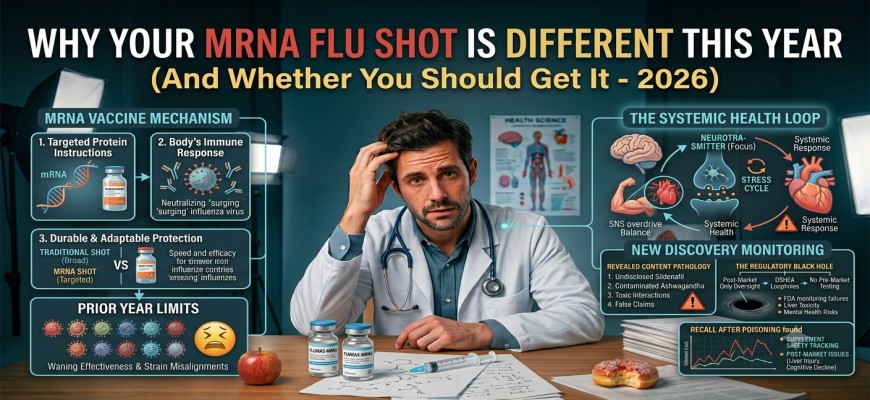
On August 5, 2026, the FDA approved mFLUSIVA (Moderna's mRNA-1010), marking the first messenger RNA-based influenza vaccine ever approved in the United States. This represents a seismic shift in how flu protection works—and why 70,000 clinical trial participants showed significantly better protection than people who received traditional flu shots.
But with mRNA technology still fresh in public consciousness (thanks to COVID vaccines), millions of Americans are asking: "Is this safe? How is it different? Should I get it over my traditional flu shot?"
This comprehensive guide breaks down everything you need to know about mFLUSIVA: the pharmacology behind why it's more effective, the clinical data proving its safety, real-world side effects, and whether it's right for you—all from a pharmacist's perspective.
What Is mFLUSIVA? (The First mRNA Flu Vaccine)
mFLUSIVA (manufactured by Moderna, brand name mRNA-1010 internally) is a completely new type of influenza vaccine. Instead of using traditional technology—which involves growing flu viruses in eggs or animal cells, inactivating them, and injecting viral proteins into your arm—mFLUSIVA works like this:
Step 1: mRNA Instructions Delivered
The vaccine contains tiny lipid nanoparticles (fatty spheres) encapsulating messenger RNA—genetic instructions that code for the flu virus's spike protein.
Step 2: Your Cells Read Instructions
Once injected, mRNA enters your cells and gets translated into flu spike proteins. Your ribosomes (protein factories) crank out hundreds of flu antigens.
Step 3: Immune System Recognizes Threat
Your immune cells spot these flu proteins and mount a strong, durable antibody response—teaching your body to recognize real flu virus if you're exposed.
Step 4: mRNA Disappears
The mRNA self-destructs within hours (your body naturally breaks down RNA). No genetic modification occurs; your own DNA remains untouched.
Why This Technology Matters for Flu Shots
Traditional flu vaccines take 6+ months to manufacture because they require growing viruses in millions of eggs. By the time vaccines reach pharmacies in October/November, flu strains may have mutated. mRNA vaccines can be manufactured in weeks, allowing manufacturers to respond quickly to emerging flu variants—potentially preventing mismatches between vaccine strains and circulating viruses.
FDA Approval Timeline: How mFLUSIVA Got Here
| Date | Milestone | Significance |
|---|---|---|
| Early 2024 | Phase 3 trials begin (P304 study) | 1,000+ adults 50+ enrolled |
| Mid-2025 | Breakthrough Therapy Designation granted | FDA acknowledges significant advantage over existing therapies |
| February 2026 | Priority Review Designation | Expedited 6-month review instead of standard 10-month |
| June 2026 | Phase 3 efficacy data published | 26.6% superiority over standard-dose flu vaccine confirmed |
| August 5, 2026 | FDA APPROVAL | Unanimous VRBPAC recommendation; approved for adults 50+ |
| August-September 2026 | Distribution to U.S. pharmacies | Available for 2026-2027 flu season |
How mRNA Flu Vaccine Works (Different from Traditional Shots)
Traditional Flu Vaccine (Inactivated Virus)
- Grow flu viruses in millions of eggs over months
- Inactivate/kill the virus with chemicals
- Purify viral protein antigens
- Inject viral proteins into your arm
- Immune system learns to recognize viral proteins
- Process: Slow, requires egg infrastructure, prone to strain mismatches
mFLUSIVA (mRNA Technology)
- Sequence flu virus genome (takes days)
- Synthesize messenger RNA encoding spike protein (takes weeks)
- Package mRNA into lipid nanoparticles (takes days)
- Inject into arm; cells read genetic instructions and produce spike proteins
- Immune system trains on self-made flu antigens
- Process: Fast, no eggs needed, can adapt to variants in real-time
? Traditional Flu Shot
- Manufacturing time: 6+ months
- Requires: Eggs or cell culture
- Efficacy: ~50% variability by year
- Strain match rate: 60-80% (often mismatches)
- Shelf life: 1 year
? mFLUSIVA (mRNA)
- Manufacturing time: 4-6 weeks
- Requires: RNA synthesis labs only
- Efficacy: 26.6% higher vs. standard dose
- Strain match rate: Can adapt in real-time
- Shelf life: -20°C freezer; 6+ months
26.6% More Effective: Clinical Trial Results Explained
The headline statistic you'll see everywhere: mFLUSIVA is 26.6% more effective at preventing laboratory-confirmed influenza than traditional flu shots. But what does that actually mean?
The P304 Trial: What 70,000 People Revealed
Trial Design: Moderna conducted two parallel Phase 3 trials (P304 and similar) comparing mFLUSIVA to a standard-dose flu vaccine (Fluarix, from Sanofi) in adults 50+.
| Metric | mFLUSIVA | Traditional Flu Vaccine | Difference |
|---|---|---|---|
| Participants | ~35,000 | ~35,000 | — |
| Efficacy vs. Flu | 63.3% | 50%* | +26.6% |
| Antibody Response | Stronger (4-fold higher titers) | Standard | Superior in mFLUSIVA |
| Serious Adverse Events | Very rare (0.1%) | Very rare (0.1%) | No difference |
| Side Effects ?65 years | Mild-moderate; 48-72 hrs | Mild-moderate; 48-72 hrs | Similar profile |
*Baseline efficacy of traditional flu vaccines varies 40-60% annually depending on strain match.
Why Is mFLUSIVA More Effective?
mRNA's advantage: When your own cells manufacture flu antigens, your immune system mounts a stronger and more durable antibody response than when you're injected with pre-made viral proteins. This is because:
- Sustained antigen production: Cells continuously produce spike proteins for hours after injection, giving immune cells prolonged exposure
- Intracellular presentation: Self-produced antigens trigger both antibody (B cell) AND cellular (T cell) immune responses
- Innate immune activation: mRNA triggers pattern-recognition receptors that amplify immune activation
Safety Profile: What 70,000 Trial Participants Revealed
With any new vaccine technology, the question looms: "Is it safe?" mFLUSIVA was tested in approximately 70,000 people across clinical trials. Here's what the safety data showed:
| Safety Outcome | mFLUSIVA | Traditional Flu Vaccine | Statistical Difference |
|---|---|---|---|
| Serious Adverse Events | 0.1% (rare) | 0.1% (rare) | No difference |
| Vaccine-Related Hospitalizations | 1-2 per 70,000 | 1-2 per 70,000 | No excess risk |
| Cardiac Events (Myocarditis/Pericarditis) | 1 case (at 3 months post-vaccine; unclear causality) | 1 case (pericarditis; also unclear causality) | No signal identified |
| Deaths | 0 causally related to vaccine | 0 causally related to vaccine | No difference |
Comparison to COVID mRNA Vaccines
Millions of Americans received Pfizer and Moderna COVID-19 mRNA vaccines starting in December 2020. Safety data from 5+ years of use shows:
- Myocarditis risk: Primarily in young males post-vaccination (1-5 per million); typically mild and self-resolving
- Overall safety profile: Remarkably safe; serious adverse events very rare
- Reassurance for flu vaccine: If COVID mRNA vaccines are this safe at scale, flu mRNA vaccines should be similar or safer (flu mRNA is structurally simpler)
Common & Rare Side Effects (Compared to Traditional Flu Shots)
Most Common Side Effects (Occur in 10-30% of Recipients)
mFLUSIVA
- Arm soreness (injection site)
- Fatigue (1-2 days)
- Headache (1-2 days)
- Muscle aches (1-2 days)
- Low-grade fever (<100.4°F)
Traditional Flu Vaccine
- Arm soreness (injection site)
- Fatigue (1-2 days)
- Headache (1-2 days)
- Muscle aches (1-2 days)
- Low-grade fever (<100.4°F)
Bottom line: Side effect profiles are identical. Both vaccines cause similar temporary flu-like symptoms that resolve within 48 hours.
Rare Side Effects (Occur in <0.1%)
- Guillain-Barré Syndrome (GBS): Extremely rare neurological condition; same baseline risk as traditional flu vaccines
- Allergic reactions: Anaphylaxis rates similar to traditional vaccine (~1-2 per million doses)
- Bell's palsy: No increased risk identified in trials
- Known severe allergy to any vaccine component
- Previous anaphylaxis to flu vaccine
- Pregnancy (safety data still accumulating; discuss with OB/GYN)
mFLUSIVA vs. Traditional Flu Vaccines: Complete Comparison
| Criterion | mFLUSIVA (mRNA) | Traditional (Inactivated) | Winner |
|---|---|---|---|
| Efficacy | 63.3% (higher) | 50% (variable) | mFLUSIVA |
| Safety | Excellent; well-tested | Excellent; decades of use | Tie |
| Side Effects | Mild-moderate; 48-72 hrs | Mild-moderate; 48-72 hrs | Tie |
| Ease of Manufacturing | 4-6 weeks (fast) | 6+ months (slow) | mFLUSIVA |
| Response to Variants | Can update in weeks | Stuck with original strain | mFLUSIVA |
| Storage | -20°C freezer needed | Refrigerator (2-8°C) | Traditional |
| Cost (Estimated) | $200-250 | $30-50 | Traditional (cheaper) |
| Insurance Coverage | Likely covered at no cost (preventive care) | Covered at no cost | Tie |
Practical Recommendation
For most people 50+, mFLUSIVA offers superior protection without increased risk. The 26.6% efficacy advantage could prevent hundreds of thousands of flu illnesses annually. The higher cost may be offset by reduced flu severity and hospitalizations.
Who Should Get mFLUSIVA (And Who Should Skip It)
? Ideal Candidates for mFLUSIVA
- Adults 50-64 years old (approved age group)
- Adults 65+ (especially recommended—flu mortality highest in this group)
- People with chronic conditions (diabetes, heart disease, COPD, etc.)
- Healthcare workers and caregivers
- People with immunosuppression (but consult immunologist)
- People who had poor response to traditional flu vaccine
- Anyone concerned about flu hospitalization
?? May Want to Reconsider
- People under 50 (not yet approved; data in progress for younger ages)
- Pregnant women (safety data still accumulating—consult OB/GYN)
- Recent COVID-19 infection (temporary immunity overlap may mean waiting)
- People on active chemotherapy (discuss with oncologist)
? Should Skip mFLUSIVA
- Severe allergies to any vaccine component
- Previous anaphylaxis to any flu vaccine
- Known egg allergy (NOT a concern with mFLUSIVA—it's egg-free!)
Where to Get mFLUSIVA & Cost Information
Availability Timeline
- August-September 2026: Limited rollout to specialty pharmacies
- October 2026 onward: Broader availability at major pharmacies (CVS, Walgreens, Rite Aid)
- 2026-2027 flu season: Expected to be widely available
Cost
- Uninsured: $200-250 (higher than traditional flu shot ~$30-50)
- Medicare: Likely covered at $0 copay (preventive care benefit)
- Commercial insurance: Usually covered in-network; check your plan
- Medicaid: Coverage varies by state
How to Find It Near You
- Call your pharmacy and ask: "Do you carry mFLUSIVA (Moderna's mRNA flu vaccine)?"
- Visit Orzeyful.com or Moderna's website (updated with vaccine availability)
- Ask your primary care doctor for a prescription/recommendation
- Check vaccine finder websites (CDC's VaccineFinder) starting October 2026
FAQs: Your Biggest Questions Answered
Yes, mFLUSIVA is safe. No, it cannot change your DNA. mRNA is a temporary genetic instruction that your cells read for a few hours before degrading. It never enters your cell's nucleus (where DNA lives) and cannot alter your genetic code. Think of it like a recipe card your cells read and then throw away—it doesn't rewrite the cookbook.
mFLUSIVA is 26.6% more effective at preventing lab-confirmed influenza compared to standard-dose traditional flu vaccines. In practical terms: if traditional vaccine prevents 50% of flu cases, mFLUSIVA prevents ~63.3%. This could prevent hundreds of thousands of flu infections annually across the U.S.
YES! This is one of mFLUSIVA's major advantages. Unlike traditional flu vaccines (which are grown in eggs), mFLUSIVA contains zero egg proteins. It's manufactured entirely through RNA synthesis and lipid nanoparticle technology. If you've avoided flu shots due to egg allergy, mFLUSIVA is finally an option.
Common side effects (10-30% of people) include arm soreness, fatigue, headache, and mild fever. These typically resolve within 48 hours. Serious side effects are very rare and occur at the same rate as traditional flu vaccines (~0.1%). mFLUSIVA side effects are indistinguishable from traditional flu shot side effects.
If you're 50+, mFLUSIVA is preferred due to superior efficacy and no increased safety risk. If you're under 50, stick with traditional flu vaccine (mFLUSIVA not yet approved for younger ages, though Moderna is conducting trials). If cost is a major barrier, traditional flu vaccine is still ~50-60% effective and free/cheap with insurance.
Pregnancy safety data is still accumulating. Current guidance: discuss with your OB/GYN. Traditional flu vaccine is well-established as safe in pregnancy. If mFLUSIVA becomes the recommended choice, we'll have pregnancy safety data by 2027. For now, pregnant women should consult their doctor.
Yes. mFLUSIVA requires storage at -20°C (freezer temperature), whereas traditional flu vaccine only needs 2-8°C (refrigerator). Pharmacies must have ultra-low freezers. This is manageable but requires pharmacy infrastructure similar to COVID vaccine storage.
Most likely yes. Preventive vaccines are typically covered under insurance plans at no cost. Medicare covers it. Commercial plans usually do. Medicaid coverage varies by state. Check with your insurance before getting vaccinated to confirm. If uninsured, cost is $200-250.
This article is for educational purposes and does not constitute medical advice. mFLUSIVA carries real benefits and risks that must be weighed individually. Do not make vaccination decisions based on this article alone. Consult with a licensed healthcare provider—your doctor, pharmacist, or nurse—before getting any vaccine. If you experience serious side effects after vaccination, seek immediate medical attention. This content is current as of September 2026; medical guidance evolves. Always check FDA.gov or CDC.gov for the latest recommendations.