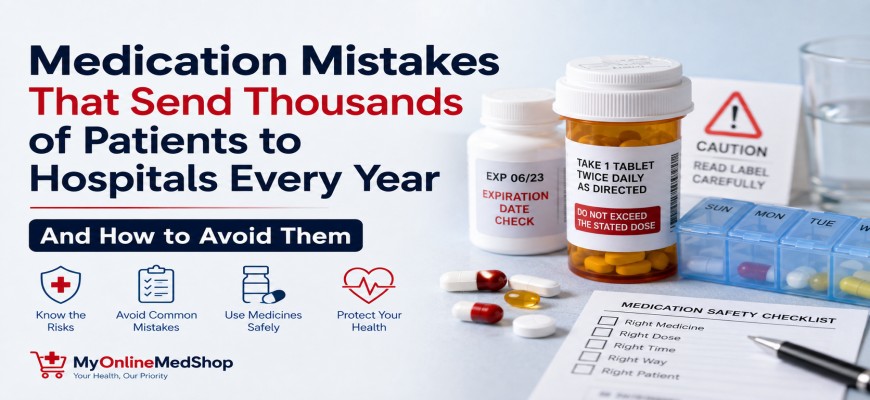
25 Medication Mistakes That Send Thousands to the Hospital (And How to Avoid Them)
Medication Mistakes That Send Thousands of Patients to Hospitals Every Year (And How to Avoid Them)
Written by the MyOnlineMedShop Health Content Team, reviewed for pharmacist accuracy · Updated August 2026 · 19 min read
A patient takes the same pill twice because they forgot they'd already taken it. A parent measures children's fever medicine with a kitchen spoon instead of the dosing syringe in the box. A grandmother stops her blood pressure tablets because she "feels fine," and three weeks later her blood pressure spikes hard enough to land her in the emergency room. None of these people did anything reckless. They made an ordinary, human mistake with a medicine bottle — and that is exactly why medication errors are one of the most common, and most preventable, causes of hospital visits in the world.
The World Health Organization estimates that medication errors cost health systems around US$42 billion every year worldwide, and that they account for roughly half of all preventable harm in medical care. In the United States, government injury-surveillance data collected from hospital emergency departments shows an estimated 4 emergency visits for adverse drug events per 1,000 people every year, and about 27% of those visits end in hospital admission. Older adults are hit hardest: they make up around a third of these ER visits and have the highest chance of being admitted once they arrive.
This guide exists to close the gap between "I know I should be careful with medicine" and actually knowing where the danger hides. We built it with pharmacists, using guidance from the FDA, CDC, WHO, NIH, NHS, and the Institute for Safe Medication Practices (ISMP), and organized it the way a pharmacist would explain it to you at the counter — plainly, without scare tactics, and with a clear next step for every mistake.
Why Medication Mistakes Are So Common
Medicine safety looks simple from the outside: take the right pill, at the right time, in the right amount. In practice, a single patient managing three or four prescriptions is running a small logistics operation with no formal training, often while feeling unwell, tired, or distracted. Pharmacists see the same root causes again and again:
- Look-alike, sound-alike medicines. Hydroxyzine and hydralazine. Clonidine and Klonopin. Names that differ by one or two letters cause real, repeated confusion — even among trained staff.
- Multiple prescribers who don't see each other's notes. A cardiologist, a GP, and a specialist can each prescribe something reasonable on its own that becomes risky in combination.
- Confusing units and abbreviations. "mg" versus "mcg" is a thousand-fold difference. "QD" (once daily) can be misread as "QID" (four times daily) in handwriting.
- Health literacy and language barriers. Medical shorthand on a label ("PRN," "stat," "bid") is not intuitive if nobody has explained it.
- Fatigue, stress, and busy routines. Most home medication errors are not about not knowing — they're about a rushed morning, a skipped breakfast, or a bag packed in a hurry before travel.
- Polypharmacy. The WHO's Global Patient Safety Challenge specifically flags patients on five or more medicines as high risk, because every additional medicine multiplies the number of possible interactions.
$42BEstimated annual global cost of medication errors — WHO
~4 per 1,000People in the US visiting the ER each year for an adverse drug event — CDC
27%Of those ER visits result in hospital admission — CDC
~35%Of adverse-drug-event ER visits are in adults 65+, who also have the highest admission rate — CDC
Sources: World Health Organization, "Medication Without Harm — Global Patient Safety Challenge" (2017); Shehab et al., CDC National Electronic Injury Surveillance System–Cooperative Adverse Drug Event Surveillance Project data, published in JAMA.
? Suggested graphic: "Where Medication Errors Happen" infographic — see Image Prompt #1 in the supporting materials file.
Did you know?
A WHO estimate suggests the average hospital experiences a medication error roughly once every 23 hours — not because staff are careless, but because a busy system with many handoffs creates many small openings for mistakes. The same logic applies at home: the more moving parts in your routine, the more a simple checklist protects you.
The 25 Medication Mistakes That Send Patients to the Hospital
Each mistake below follows the same structure: what actually happens, why it happens, a realistic example, who is most at risk, the warning signs to watch for, how to prevent it, and exactly what to do if it's already happened.
1. Taking Someone Else's Prescription Medicine
- What happens
- A patient borrows a family member's leftover antibiotic, painkiller, or sleep aid instead of seeing a prescriber.
- Why it happens
- The symptoms look similar to what the other person had, and getting an appointment feels slower than reaching for a half-used bottle in the cabinet.
- Real-world example
- A person with a sinus infection takes a spouse's leftover amoxicillin. The dose is wrong for their weight and the infection is actually viral, so the antibiotic does nothing except disrupt their gut bacteria and contribute to antibiotic resistance.
- Who is at risk
- Households where prescriptions are shared casually, and anyone trying to avoid a clinic visit or its cost.
- Warning signs
- No improvement after a few days, new rash, stomach upset, or worsening symptoms.
- How to prevent it
- Keep every prescription labeled with the patient's name and never offer or accept a "spare" prescription medicine. Use telehealth for a fast, low-cost opinion instead.
- What to do if it happens
- Stop the medicine, call a pharmacist or doctor to describe exactly what was taken and how much, and seek care if symptoms worsen or an allergic reaction develops.
2. Doubling a Dose After a Missed One
- What happens
- A patient realizes mid-afternoon that they forgot the morning dose, so they take two pills at once to "catch up."
- Why it happens
- It feels logical — if one dose is good, two should just fix the gap. But most medicines are dosed to maintain a steady level in the blood, not to be caught up in a lump.
- Real-world example
- Doubling a blood pressure medicine after a missed dose can cause dizziness and fainting from a sudden blood pressure drop, occasionally leading to a fall or an ER visit.
- Who is at risk
- Anyone on a fixed daily schedule, especially blood pressure, diabetes, blood thinner, and thyroid medicines.
- Warning signs
- Dizziness, unusual fatigue, low blood sugar symptoms (shakiness, sweating), or an irregular heartbeat.
- How to prevent it
- Read the label's specific missed-dose instructions, or ask your pharmacist for a one-line rule for each of your medicines ahead of time, before you need it.
- What to do if it happens
- Call a pharmacist or poison control immediately rather than waiting to see what happens — the right response depends entirely on which medicine was doubled.
3. Skipping Doses Without a Plan
- What happens
- A dose is missed and simply skipped with no clear rule for what to do next, creating gaps in medicines that need steady blood levels.
- Why it happens
- Busy mornings, travel, or simply forgetting — most people miss doses occasionally, but repeated gaps are different from a one-off.
- Real-world example
- Missing several days of a blood thinner around a busy work trip can allow a blood clot to form in someone with atrial fibrillation.
- Who is at risk
- People on complex regimens, shift workers, and anyone without a reminder system.
- Warning signs
- Return of the original symptoms the medicine was treating — chest discomfort, swelling, high readings on a home monitor.
- How to prevent it
- Use a weekly pill organizer, a phone alarm, or pair the dose with an existing habit like brushing your teeth.
- What to do if it happens
- Check the medicine's specific missed-dose guidance and mention a pattern of missed doses at your next appointment rather than hiding it.
4. Doubling Up on the Same Active Ingredient
- What happens
- A patient takes a prescription pain reliever and an over-the-counter cold medicine that both contain acetaminophen, without realizing it.
- Why it happens
- Brand names hide ingredients. "Extra strength," "PM," and "cold and flu" versions of familiar products often contain acetaminophen even though it isn't in large print.
- Real-world example
- Acetaminophen overdose from combination products is one of the leading causes of acute liver injury reported to poison control centers, precisely because it is so easy to unknowingly exceed the daily limit.
- Who is at risk
- Anyone combining a prescription painkiller with an OTC cold, flu, or sleep product, and people managing chronic pain with multiple products.
- Warning signs
- Nausea, loss of appetite, yellowing skin or eyes, dark urine — these can appear days after the overdose, not immediately.
- How to prevent it
- Check the "active ingredients" panel on every product, not just the brand name, and ask a pharmacist before combining any two pain or cold medicines.
- What to do if it happens
- Call poison control right away, even without symptoms — acetaminophen toxicity is treatable early but dangerous once the liver is already damaged.
5. Not Telling Every Prescriber About Every Medicine
- What happens
- A patient sees a new specialist and doesn't mention a supplement, an OTC medicine, or a prescription from another doctor.
- Why it happens
- Patients often don't think of vitamins, herbal products, or "just an occasional" medicine as something worth mentioning.
- Real-world example
- A patient on warfarin starts a new prescription without disclosing it to their anticoagulation clinic, and the combination pushes their blood-clotting levels dangerously low, causing unexpected bleeding.
- Who is at risk
- Patients with multiple specialists, anyone on blood thinners, and people who see prescribers who don't share the same electronic record.
- Warning signs
- Unusual bruising, bleeding gums, unexpected drowsiness, or a new symptom starting shortly after a prescription change.
- How to prevent it
- Keep one master medication list — including supplements — and bring it, or a photo of it, to every appointment.
- What to do if it happens
- Call the prescribing office to flag the gap as soon as it's noticed, and fill all prescriptions at one pharmacy so the pharmacist can screen for interactions automatically.
6. Mixing Alcohol With Medication
- What happens
- A patient drinks alcohol while taking a medicine that interacts with it, intensifying sedation, liver stress, or blood pressure changes.
- Why it happens
- Social drinking doesn't feel like a medical decision, so the interaction warning on the bottle gets overlooked.
- Real-world example
- Combining alcohol with benzodiazepines or opioid painkillers can suppress breathing to a dangerous degree, a combination frequently involved in accidental overdose deaths.
- Who is at risk
- Anyone on sedatives, opioids, certain antidepressants, muscle relaxants, or metronidazole (which causes a severe reaction with alcohol).
- Warning signs
- Extreme drowsiness, slowed or shallow breathing, confusion, or difficulty waking someone up.
- How to prevent it
- Ask your pharmacist directly, "Can I drink alcohol with this?" every time you start a new medicine.
- What to do if it happens
- If someone is very hard to wake or breathing slowly after mixing alcohol and medication, call emergency services immediately — this is not a "sleep it off" situation.
7. Ignoring Food-Drug Interactions
- What happens
- A medicine's effect is blocked, intensified, or made unsafe by something eaten around the same time.
- Why it happens
- Food interaction warnings are often printed in small text on an insert that gets thrown away with the box.
- Real-world example
- Grapefruit juice interferes with the enzyme that breaks down several statins and blood pressure medicines, effectively increasing the dose reaching the bloodstream and raising the risk of side effects.
- Who is at risk
- Anyone on statins, certain blood pressure medicines, thyroid medicine (which needs to be taken away from calcium and iron), and warfarin, which is sensitive to vitamin K intake.
- Warning signs
- Unusual muscle pain (statins), new palpitations, or unexpected changes in a routine blood test like INR for warfarin users.
- How to prevent it
- Ask "is there anything I should avoid eating or drinking with this?" at pickup, and keep warfarin users' vitamin K intake consistent rather than avoiding greens altogether.
- What to do if it happens
- Report new symptoms to your pharmacist or prescriber and mention exactly what you ate or drank and when.
8. Stopping a Medicine Suddenly
- What happens
- A patient feels better, feels fine, or dislikes a side effect and stops a medicine without checking whether it needs to be tapered.
- Why it happens
- If a medicine is treating something silent, like blood pressure or cholesterol, it's easy to assume it's no longer needed once symptoms are gone.
- Real-world example
- Suddenly stopping a beta-blocker can cause a rebound spike in heart rate and blood pressure; suddenly stopping certain antidepressants can trigger dizziness, irritability, and flu-like withdrawal symptoms; suddenly stopping oral steroids after long use can cause a life-threatening adrenal crisis.
- Who is at risk
- Anyone on steroids, beta-blockers, antidepressants, benzodiazepines, or anti-seizure medicine for more than a few weeks.
- Warning signs
- Rebound of the original condition, unusual fatigue, tremor, sweating, or in steroid withdrawal: severe fatigue, low blood pressure, and nausea.
- How to prevent it
- Always ask "can I stop this safely, or does it need to be tapered?" before stopping anything, even if a side effect is bothering you — call first, stop second.
- What to do if it happens
- Contact the prescriber promptly; most tapering issues can be corrected quickly once caught, but adrenal crisis from steroid withdrawal is a medical emergency.
9. Splitting or Crushing Tablets That Shouldn't Be Split
- What happens
- A patient cuts a tablet in half to save money or make it easier to swallow, not realizing the tablet is extended-release or enteric-coated.
- Why it happens
- Most tablets look the same to the eye — there's no obvious visual difference between an immediate-release and an extended-release version.
- Real-world example
- Crushing an extended-release opioid or blood pressure tablet releases the entire day's dose at once instead of over 12–24 hours, which can cause a dangerous spike in effect.
- Who is at risk
- Anyone who splits or crushes tablets for cost, swallowing difficulty, or feeding-tube administration without checking first.
- Warning signs
- Sudden intensified side effects shortly after a dose that previously felt mild and steady.
- How to prevent it
- Ask the pharmacist whether a tablet is safe to split — look for "ER," "XR," "CR," "SR," or "LA" in the name, which usually signal a controlled-release formulation that must stay whole.
- What to do if it happens
- Call a pharmacist or poison control if a controlled-release tablet was accidentally split or crushed, and monitor closely for intensified effects.
10. Using the Wrong Measuring Device for Liquid Medicine
- What happens
- A kitchen teaspoon or tablespoon is used instead of the oral syringe, dosing cup, or dropper that came with the medicine.
- Why it happens
- Kitchen spoons are convenient and familiar, but they vary widely in actual volume — a "teaspoon" from a drawer can hold anywhere from 3 to 7 mL.
- Real-world example
- This is one of the most frequently cited causes of pediatric liquid medicine overdose, since a child's safe dosing range is much narrower than an adult's.
- Who is at risk
- Parents and caregivers giving liquid medicine to children, and adults measuring their own liquid prescriptions.
- Warning signs
- Excess drowsiness, vomiting, or unusual behavior after a dose in a child; for adults, side effects appearing more intense than described.
- How to prevent it
- Always use the syringe, cup, or dropper included with the medicine, and ask the pharmacy for a replacement if it's lost — never estimate with kitchen tools.
- What to do if it happens
- Call poison control with the exact medicine name, concentration, and estimated amount given.
11. Taking Expired Medicine
- What happens
- A patient uses a medicine well past its printed expiration date, assuming it's still just as effective and safe.
- Why it happens
- Many medicines don't look or smell different after expiring, so there's no obvious signal to throw them away.
- Real-world example
- Expired epinephrine auto-injectors and expired insulin can lose potency exactly when they're needed most — during a severe allergic reaction or a diabetic emergency.
- Who is at risk
- Anyone with a stocked home medicine cabinet, and people relying on emergency medicines like epinephrine or nitroglycerin that are used rarely.
- Warning signs
- Reduced effectiveness — a rescue inhaler that doesn't relieve symptoms as quickly, or a fever that doesn't respond to a dose that used to work.
- How to prevent it
- Check expiration dates twice a year and set a reminder to replace emergency medicines like EpiPens and rescue inhalers before they expire, not after.
- What to do if it happens
- Discard expired medicine through a pharmacy take-back program and replace it promptly, especially for anything used in an emergency.
12. Storing Medicine in the Wrong Place
- What happens
- Medicines are kept in a steamy bathroom cabinet, a hot car, or direct sunlight, all of which degrade them faster than their printed expiration date assumes.
- Why it happens
- The bathroom cabinet is the traditional "medicine cabinet," even though heat and humidity are exactly what most medicines need to avoid.
- Real-world example
- Insulin left in a hot car for even a short period can lose effectiveness permanently, leading to unexpectedly high blood sugar despite normal-looking doses.
- Who is at risk
- Anyone storing medicine in a bathroom, car, or near a window, and travelers who leave medicine in checked luggage or a hot vehicle.
- Warning signs
- Tablets that look chalky, crumbly, or discolored; liquids that look cloudy or separated when they shouldn't.
- How to prevent it
- Store most medicines in a cool, dry, dark place — a bedroom drawer or a kitchen cabinet away from the stove works better than a bathroom.
- What to do if it happens
- If a temperature-sensitive medicine like insulin was exposed to extreme heat or cold, don't use it — call the pharmacy to check if it's still safe or needs replacing.
13. Confusing Look-Alike or Sound-Alike Medicines
- What happens
- Two different medicines with similar names or similar-looking packaging get swapped, especially when refilling a pillbox from multiple bottles.
- Why it happens
- Pharmaceutical naming conventions often produce short, similar-sounding names, and generic packaging can look nearly identical across manufacturers.
- Real-world example
- ISMP maintains an official list of confused drug name pairs — like hydroxyzine (an allergy medicine) and hydralazine (a blood pressure medicine) — precisely because mix-ups between them have caused real harm.
- Who is at risk
- Anyone managing several medicines at once, particularly when refilling a weekly organizer from multiple bottles at the same time.
- Warning signs
- A pill that looks different from usual, or an effect that doesn't match what the medicine is supposed to do.
- How to prevent it
- Fill a pillbox one bottle at a time, not all bottles open on the counter together, and check the label — not just the pill's appearance — every time.
- What to do if it happens
- Call your pharmacist to confirm what was actually taken, and keep the original bottle for reference when reporting it.
14. Not Finishing a Prescribed Antibiotic Course
- What happens
- A patient feels better after a few days and stops the antibiotic early, saving the rest "just in case."
- Why it happens
- Symptom relief often comes before the infection is fully cleared, so stopping early feels reasonable in the moment.
- Real-world example
- Incomplete antibiotic courses are a major driver of antibiotic-resistant infections, and can also let a partially treated infection flare back up, sometimes worse than before.
- Who is at risk
- Anyone treating a bacterial infection, especially with courses longer than five days.
- Warning signs
- Return of fever, pain, or the original infection symptoms within a week or two of stopping early.
- How to prevent it
- Finish the full course exactly as prescribed unless your prescriber specifically tells you to stop, and never save leftover antibiotics for later use.
- What to do if it happens
- Call the prescriber if symptoms return, and dispose of leftover antibiotics rather than storing them.
15. Self-Adjusting Insulin or Other High-Risk Medicines
- What happens
- A patient changes their own insulin, blood thinner, or seizure medicine dose based on how they feel, without checking with their care team.
- Why it happens
- These are exactly the medicines where day-to-day symptoms tempt self-adjustment the most — high blood sugar readings, feeling "too calm," or a rough night's sleep.
- Real-world example
- Increasing an insulin dose without guidance after a single high reading can cause a dangerous low blood sugar episode a few hours later, especially if the extra insulin overlaps with the next scheduled dose.
- Who is at risk
- Patients managing insulin, warfarin, or anti-seizure medicines at home, especially soon after a dose change.
- Warning signs
- Shakiness, sweating, confusion (low blood sugar); unusual bruising or bleeding (blood thinners); new or worsening seizures.
- How to prevent it
- Keep a log of readings and symptoms and bring it to appointments so dose changes are made with full information, not guesswork.
- What to do if it happens
- Treat the immediate symptom per your care plan (for example, fast-acting sugar for a low), then call your care team before making another adjustment.
16. Giving Children the Wrong Dose or Formulation
- What happens
- A child is given an adult tablet, an adult-strength liquid concentration, or a dose based on age instead of weight.
- Why it happens
- Children's doses are calculated by weight, not age, and many liquid medicines come in more than one concentration — a detail easy to miss under a brand name that looks familiar.
- Real-world example
- Infant and children's acetaminophen or ibuprofen products have historically come in different concentrations; using the wrong one, or the wrong dosing chart, can lead to significant overdose.
- Who is at risk
- Infants and young children, especially when a caregiver other than the usual parent is giving the medicine.
- Warning signs
- Unusual drowsiness, vomiting, refusal to eat, or a fever that isn't responding as expected.
- How to prevent it
- Always dose by current weight using the chart on the package or from the pediatrician, and double-check the concentration printed on the bottle every time, even if you've used "the same medicine" before.
- What to do if it happens
- Call poison control immediately with the child's weight, the medicine's concentration, and the amount given.
17. Polypharmacy Without a Coordinated Medication List
- What happens
- An older adult accumulates five, ten, or more medicines from different prescribers over the years, with no single person tracking the full list.
- Why it happens
- Each new medicine is added to treat a new problem, but old medicines are rarely reviewed or removed, and prescribers don't always see each other's prescriptions.
- Real-world example
- An older patient on ten medications may be taking two different drugs for the same purpose, prescribed years apart by different doctors, doubling the effect and the side-effect risk without anyone intending it.
- Who is at risk
- Adults 65 and older, and anyone with multiple chronic conditions managed by different specialists.
- Warning signs
- New confusion, falls, appetite changes, or fatigue that appear gradually rather than suddenly — easy to mistake for "just getting older."
- How to prevent it
- Request an annual "brown bag" medication review with a pharmacist, bringing every bottle, and ask specifically, "is anything on this list no longer needed?"
- What to do if it happens
- Schedule a medication reconciliation appointment rather than stopping anything abruptly on your own.
18. Combining OTC Cold Products With Prescription Medicines That Overlap
- What happens
- A patient already taking a prescription antihistamine, decongestant, or blood pressure medicine adds an OTC cold and flu product containing the same class of ingredient.
- Why it happens
- OTC products are viewed as "not real medicine," so their interaction potential is underestimated.
- Real-world example
- Combining a decongestant like pseudoephedrine with certain blood pressure medicines can push blood pressure and heart rate higher than either medicine alone would.
- Who is at risk
- People with high blood pressure, glaucoma, or an enlarged prostate reaching for cold and flu products without checking labels.
- Warning signs
- Palpitations, headache, or a noticeably higher home blood pressure reading after starting an OTC product.
- How to prevent it
- Ask the pharmacist to recommend an OTC product that's compatible with your existing prescriptions rather than picking one off the shelf.
- What to do if it happens
- Stop the OTC product and contact your pharmacist if you notice new cardiovascular symptoms.
19. Herbal Supplement Interactions
- What happens
- A "natural" supplement is combined with a prescription medicine without recognizing that herbal products can be pharmacologically active too.
- Why it happens
- Supplements are sold without the same interaction warnings printed on prescription labels, creating a false sense that "natural" means "risk-free."
- Real-world example
- St. John's Wort accelerates the breakdown of many medicines, including some birth control pills and antidepressants, reducing their effectiveness; ginkgo biloba and high-dose fish oil can add to the bleeding risk of blood thinners.
- Who is at risk
- Anyone taking blood thinners, antidepressants, birth control, or immunosuppressants alongside herbal supplements.
- Warning signs
- A medicine that suddenly seems less effective, or unexpected bleeding or bruising after starting a new supplement.
- How to prevent it
- List every supplement on your medication list and ask your pharmacist specifically about interactions before starting one.
- What to do if it happens
- Report the supplement to your prescriber rather than quietly discontinuing your prescription medicine.
20. Traveling Without a Medicine Plan
- What happens
- Medicines are packed in checked luggage, left in a hot car during a road trip, or run out mid-trip with no plan for a refill in an unfamiliar location.
- Why it happens
- Travel planning tends to focus on itinerary and packing, with medicine treated as an afterthought.
- Real-world example
- Checked luggage that gets lost or delayed can separate a traveler from insulin or heart medicine for days, and time-zone changes can throw off a strict medicine schedule without a clear adjustment plan.
- Who is at risk
- Anyone on a time-sensitive medicine schedule, insulin users, and travelers crossing multiple time zones.
- Warning signs
- Missed or doubled doses caused by time-zone confusion, or a medicine that's been exposed to extreme temperatures.
- How to prevent it
- Always pack medicine in carry-on luggage, bring several days of buffer supply, and carry a printed prescription list for security checks and emergencies.
- What to do if it happens
- Contact a local pharmacy at your destination — many can fill an emergency refill with your prescription details, and travel insurance may help with lost medicine replacement.
21. No Pill Organizer or Consistent Schedule System
- What happens
- Medicines are kept in their original bottles with no system to track what's been taken each day, leading to missed or repeated doses.
- Why it happens
- A single medicine is easy to track by memory; three or more quickly becomes unmanageable without a visual system.
- Real-world example
- A patient can't remember whether they took their morning medicine and, unsure, decides to take it again "just in case" — exactly the situation a labeled organizer prevents.
- Who is at risk
- Anyone taking three or more medicines daily, and caregivers managing medicine for someone else.
- Warning signs
- Uncertainty about whether a dose was taken, or finding pills left over at the end of the week that should have been used.
- How to prevent it
- Use a weekly or monthly pill organizer with clearly labeled compartments, refilled at the same time each week, ideally while checking against the original bottles.
- What to do if it happens
- If you're genuinely unsure whether a dose was taken, don't guess — call the pharmacist for guidance specific to that medicine.
22. Misreading the Label or Medical Abbreviations
- What happens
- A patient misunderstands shorthand like "qid," "prn," or confuses "mg" with "mcg," leading to a dose or frequency error.
- Why it happens
- Medical abbreviations are written for clinical staff, not patients, and rarely come with a plain-English translation.
- Real-world example
- Levothyroxine is dosed in micrograms (mcg); confusing this with milligrams (mg) would represent a thousand-fold dosing error.
- Who is at risk
- Anyone unfamiliar with medical shorthand, and patients managing medicines dosed in very small units like mcg.
- Warning signs
- A dose or frequency that seems unusually high or low compared to what was discussed at pickup.
- How to prevent it
- Ask the pharmacist to say the instructions out loud in plain language before leaving the counter, and write the plain-English version on the bottle yourself.
- What to do if it happens
- Call the pharmacy to confirm the correct dose before taking another one if anything about the label is unclear.
23. Incorrect Injection or Inhaler Technique
- What happens
- An insulin injection, EpiPen, or inhaler is used with the wrong technique, reducing the amount of medicine that actually reaches the bloodstream or lungs.
- Why it happens
- Technique is usually demonstrated once at pickup and easily drifts over months or years without anyone checking in again.
- Real-world example
- Poor inhaler technique — not coordinating the breath with the puff, or not shaking a metered-dose inhaler — can mean a patient is receiving only a fraction of their prescribed asthma dose despite "using it every day."
- Who is at risk
- Anyone using insulin pens, inhalers, or auto-injectors, especially those who haven't had their technique reviewed recently.
- Warning signs
- A rescue inhaler that doesn't seem to help, or blood sugar that doesn't respond to insulin as expected.
- How to prevent it
- Ask your pharmacist or nurse to watch you demonstrate your technique at least once a year, not just at the first prescription.
- What to do if it happens
- Request a technique review, and don't assume the medicine itself has stopped working before ruling out technique.
24. Driving or Operating Machinery on Sedating Medication
- What happens
- A patient drives shortly after starting or increasing a medicine that causes drowsiness, slowed reaction time, or dizziness.
- Why it happens
- The sedating effect is often strongest in the first days of a new medicine or dose, before the patient has learned how it affects them personally.
- Real-world example
- Certain antihistamines, muscle relaxants, sleep aids, and opioid painkillers can impair driving as much as alcohol, even when the patient doesn't feel visibly "impaired."
- Who is at risk
- Anyone starting a new sedating medicine, and older adults, who tend to be more sensitive to these effects.
- Warning signs
- Noticeable drowsiness, delayed reactions, or a "foggy" feeling within the first hours of a dose.
- How to prevent it
- Avoid driving for the first day or two of any new sedating medicine, and ask directly whether a medicine carries a driving warning.
- What to do if it happens
- Pull over and stop driving at the first sign of drowsiness, and discuss the dose or timing with your prescriber rather than pushing through it.
25. Buying Medicine From Unverified Online Sources
- What happens
- A patient orders prescription medicine from a website with no pharmacist, no prescription requirement, and no way to verify what's actually in the package.
- Why it happens
- Unverified sites are often cheaper and skip the step of requiring a valid prescription, which feels convenient in the moment.
- Real-world example
- The FDA has repeatedly warned that medicines from unverified online pharmacies can be counterfeit, contaminated, wrongly dosed, or contain entirely different active ingredients than advertised.
- Who is at risk
- Anyone buying medicine online without checking for pharmacist access, a requirement for a valid prescription, and a verifiable physical pharmacy license.
- Warning signs
- A medicine that looks, tastes, or works differently than the same medicine has in the past.
- How to prevent it
- Only order from a licensed online pharmacy that requires a valid prescription, lists a real pharmacist for questions, and provides verifiable contact information.
- What to do if it happens
- Stop using the product, report it to the FDA's MedWatch program, and get your prescription filled through a verified pharmacy instead.
?? Suggested graphic: "25 Medication Mistakes at a Glance" summary grid — see Image Prompt #2 in the supporting materials file.
Medicine Storage Mistakes — and the Storage Conditions That Actually Matter
Most medicine labels say "store at room temperature," but few patients know what that actually means, or which medicines are the exception. Here's a quick reference.
| Medicine Type | Correct Storage | Common Mistake | Why It Matters |
|---|
| Standard tablets/capsules | 59–77°F (15–25°C), dry, away from light | Bathroom cabinet (humidity), car glovebox (heat) | Humidity and heat speed up chemical breakdown of the active ingredient |
| Insulin (in use) | Room temperature, away from direct heat/sun, used within the labeled in-use period | Left in a hot car or direct sun | Heat permanently denatures the protein, reducing effectiveness even if it still looks normal |
| Insulin (unopened/spare) | Refrigerated 36–46°F (2–8°C), never frozen | Stored in freezer or door shelf with temperature swings | Freezing destroys insulin; door shelves fluctuate more than the main compartment |
| Liquid antibiotics (reconstituted) | Often refrigerated; check the label — many expire in 10–14 days | Left on the counter or kept past the short expiry window | Reconstituted suspensions degrade fast and lose potency well before the printed "shelf" expiry |
| Eye drops | Room temperature or as labeled; discard per opened-bottle timeline (often 28 days) | Used for months after opening | Preservatives lose effectiveness over time, raising contamination risk |
| Nitroglycerin tablets | Original glass container, away from light and moisture | Transferred to a pillbox or pocket container | Nitroglycerin degrades quickly when exposed to air and light, reducing emergency effectiveness |
| Epinephrine auto-injector | Room temperature, protected from light; never refrigerate or leave in a hot car | Kept in a car glovebox for "convenience" | Extreme heat or cold degrades the epinephrine before an anaphylaxis emergency |
Pro tip
Keep medicine in its original, labeled container whenever possible. If you use a pillbox, keep a printed list nearby of what's in each compartment — in an emergency, first responders need to know exactly what you're taking.
Medication Errors in Children
Children aren't just smaller adults — their bodies process medicine differently, and dosing mistakes in this age group are disproportionately common. The core issues: dosing by weight instead of age, confusing concentrations between infant and children's formulas, and child-resistant caps being left off after use.
- Always weigh before you dose. A dosing chart based on age assumes an "average" child; an actual child's weight can be very different.
- Check concentration every time. Don't assume "the children's medicine" is always the same strength — read the mg per mL on the bottle you have in hand.
- Use only the provided dosing device. Kitchen spoons vary too much in volume to be safe for a child's narrow dosing range.
- Store up and away, locked if possible. Accidental ingestion by a young child exploring a cabinet is one of the most common reasons for a pediatric poison control call.
- Never call medicine "candy." This common trick to encourage a reluctant child to take medicine increases the odds they'll seek it out on their own later.
Medication Errors in Older Adults
CDC surveillance data shows adults 65 and older account for a disproportionate share of medication-related ER visits and hospital admissions — not because they are careless, but because they typically manage more medicines, from more prescribers, alongside age-related changes in vision, memory, and kidney or liver function that change how medicines are processed.
- Request an annual medication review. A pharmacist "brown bag review" — bringing every bottle in for a full check — routinely finds duplicate or unnecessary medicines.
- Watch for the "prescribing cascade." Sometimes a new medicine is prescribed to treat a side effect of an existing one, rather than adjusting the original medicine. Ask if that's happening.
- Use large-print labels and organizers. Many pharmacies offer large-print labeling on request — ask if reading small text is a struggle.
- Loop in a caregiver. A second set of eyes catches missed doses and mix-ups earlier.
- Be extra cautious with sedating medicines. Falls linked to sedating medicines are a leading cause of injury-related hospital visits in this age group.
Interaction Quick-Reference Tables
Alcohol Interaction Table
| Medicine Class | Effect With Alcohol | Severity |
|---|
| Benzodiazepines / sleep aids | Severe sedation, slowed breathing | High |
| Opioid painkillers | Dangerously slowed breathing, overdose risk | High |
| Metronidazole (antibiotic) | Severe nausea, flushing, vomiting (disulfiram-like reaction) | High |
| Acetaminophen (in high doses) | Increased liver stress | Moderate–High |
| Antidepressants (many types) | Increased drowsiness, impaired coordination | Moderate |
| Blood pressure medicines | Exaggerated blood-pressure drop, dizziness | Moderate |
Common Food-Drug Interactions
| Medicine | Interacting Food/Drink | What Happens |
|---|
| Statins (some types) | Grapefruit / grapefruit juice | Higher blood levels of the drug, raising side-effect risk |
| Warfarin | Leafy greens high in vitamin K | Reduced blood-thinning effect if intake suddenly increases |
| Levothyroxine (thyroid) | Calcium, iron, coffee close to dosing time | Reduced absorption of the medicine |
| MAOI antidepressants | Aged cheese, cured meats, some wines | Dangerous spike in blood pressure |
| Tetracycline antibiotics | Dairy products | Reduced absorption of the antibiotic |
Checklists, Templates, and Planners You Can Use Today
Medication Safety Score Checklist
Answer honestly, then count your checked boxes: 8–10 means your routine is well-protected; 5–7 means a few gaps are worth closing; under 5 means it's worth a pharmacist consultation this week.
- I have one written or photographed list of every medicine and supplement I take
- I know which of my medicines cannot be stopped suddenly
- I use a pill organizer or remi



 Libido Gummies and "Hormone-Balancing" Powders Are 2026's Hottest Wellness Trend — Here's What's Actually in Them (And Why No One's Regulating It)