
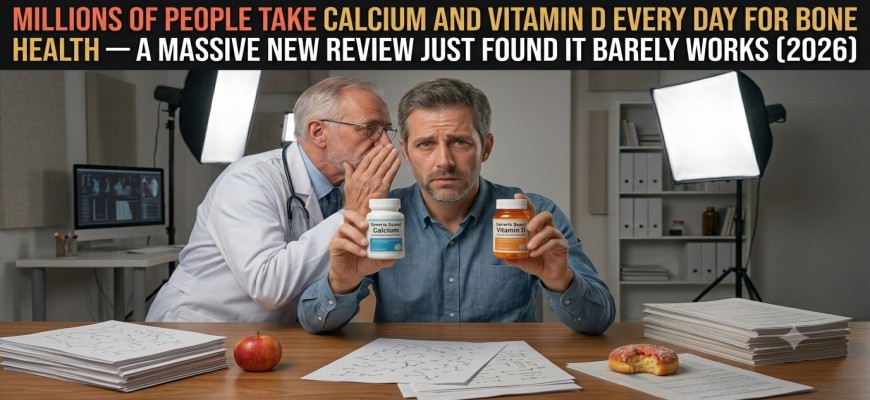
Millions of People Take Calcium and Vitamin D Every Day for Bone Health — A Massive New Review Just Found It Barely Works
A pharmacist's guide to the largest review ever conducted on calcium and vitamin D supplements — what 69 clinical trials and nearly 154,000 adults actually showed, who might still benefit, and what the evidence says actually protects aging bones.
For decades, "take your calcium and vitamin D" has been near-universal advice for aging bones — recommended by doctors, printed on supplement labels, and repeated so consistently that questioning it has felt almost unnecessary. It's one of the most widely followed pieces of preventive health advice in the country, particularly among older adults and postmenopausal women.
A landmark review published in The BMJ, and receiving renewed attention this month, has now delivered a genuinely uncomfortable verdict: for most older adults, calcium supplements, vitamin D supplements, or the two combined provide little to no clinically meaningful protection against fractures or falls. This is not a single small study — it's the largest systematic review of its kind ever conducted, pooling data from 69 randomized controlled trials and 153,902 adults. This guide breaks down exactly what the researchers did differently from earlier reviews, what they found, who the findings do and don't apply to, why the guidance hasn't caught up yet, and what actually has stronger evidence behind it for protecting bones as you age.
A team of Canadian researchers, led by Olivier Massé, set out to resolve years of inconsistent findings on this exact question by conducting the most comprehensive review of the evidence to date. They analyzed 69 randomized controlled trials involving a combined 153,902 adults, examining the effects of calcium supplements alone, vitamin D supplements alone, and the two taken together, each compared against placebo or no treatment, on the outcomes that actually matter to patients: fractures and falls.
The trials varied in quality, and the researchers formally assessed each one's risk of bias and overall certainty of evidence using established, standardized methodology, allowing them to weigh stronger studies more heavily in their conclusions.
| Intervention | Evidence Base | Effect on Fracture Risk |
|---|---|---|
| Calcium supplements alone | Moderate-certainty evidence from 11 trials; 9,067 participants | Little to no effect |
| Vitamin D supplements alone | High-certainty evidence from 36 trials; 92,045 participants | Little to no effect |
| Calcium and vitamin D combined | High-certainty evidence from 15 trials; 51,126 participants | Little to no effect |
The same pattern held for more specific outcomes as well: calcium, vitamin D, or the combination showed little to no meaningful effect on hip fractures specifically, or on the risk of falling, across the pooled data. Notably, the researchers found this pattern remained broadly consistent regardless of a person's age, sex, prior fracture history, prior fall history, or how much calcium they were already getting through diet — meaning the lack of meaningful benefit wasn't confined to a narrow subgroup.
Calcium and vitamin D's reputation for bone protection didn't come from nowhere — earlier research did generally support some benefit, which is exactly why the recommendation became so widespread in the first place. This new review didn't ignore that prior evidence; it re-analyzed the overall picture using a stricter and more clinically honest standard.
The single most important methodological choice in this review was deciding, in advance, what size of effect would actually count as clinically meaningful to a patient — rather than simply asking whether any effect, however small, was statistically different from zero. This distinction matters enormously in medicine, because a large enough study can detect a tiny, real, but practically irrelevant effect as "statistically significant," while a smaller but more clinically important effect can be missed in an underpowered study. By anchoring their conclusions to a threshold that reflects actual clinical relevance, the researchers produced a result more directly useful for real-world patient care than many previous reviews.
One of the clearest explanations for why earlier research seemed more encouraging comes down to a well-known but frequently overlooked statistical distinction: the difference between relative risk and absolute risk.
Both descriptions of the exact same data are technically accurate. But relative risk reductions, reported alone, are well known to make small absolute effects look considerably more impressive than they actually are in practice — a pattern that has shaped the framing of health headlines and even some clinical guidance for years. This new review's use of clinically meaningful absolute thresholds is precisely what allowed it to cut through that framing and arrive at a more sobering, but more clinically honest, conclusion.
It's important to be precise about the population this review actually studied, because the findings don't necessarily extend to everyone equally.
Most older adults living independently in the community, without a diagnosed bone-specific disease, who are not currently on prescription osteoporosis medication — the population that makes up the bulk of routine, preventive calcium and vitamin D use.
People with diagnosed osteoporosis, confirmed vitamin D deficiency, certain other specific bone or metabolic disorders, or those already taking prescription osteoporosis medications — groups the review did not specifically evaluate and where supplementation may still play a legitimate, evidence-supported role as part of a broader treatment plan.
One of the more striking aspects of this story is that the evidence and the official guidance patients receive are currently not well aligned, and understanding why helps explain why your own doctor may not have brought this up yet.
The U.S. Preventive Services Task Force, an influential body that shapes preventive care recommendations nationally, issued a draft recommendation in December 2024 against routine calcium and vitamin D supplementation specifically for fall and fracture prevention in community-dwelling adults — a direct reversal of its own 2018 recommendation, which had conditionally supported low-dose supplementation for this purpose. That draft recommendation has not yet been finalized, meaning the older, more permissive 2018 guidance technically remains in effect while the update works its way through the review process.
Patients are currently caught in a genuine gap between what the best available evidence increasingly shows and what official guidelines, still catching up, formally recommend. This kind of lag between emerging evidence and finalized guideline updates isn't unusual in medicine — but it does mean patients may need to raise this topic proactively with their own provider rather than assuming it will come up automatically at a routine visit.
Despite this accumulating evidence, this review's authors note that vitamin D supplementation, with or without calcium, continues to be widely recommended by healthcare providers, professional guidelines, and regulatory agencies for bone health — and prescriptions for these supplements have actually risen considerably in recent years, moving in the opposite direction from where the evidence increasingly points.
Clinical practice, reasonably, tends to be conservative about reversing decades-old, deeply ingrained recommendations until the evidence is exceptionally strong and official guideline bodies have formally updated their positions — a cautious approach that has real benefits but also creates exactly this kind of lag.
Because calcium and vitamin D have historically been viewed as low-risk, inexpensive, and easy to recommend, there's been less clinical urgency to actively discourage their use compared to, say, a medication with more obvious side effects — even as evidence of meaningful benefit has weakened.
For patients with an unclear individual risk profile, or those the physician suspects may have an underlying vitamin D deficiency that hasn't been formally tested, continuing to recommend supplementation as a low-cost, generally low-risk option can still feel like a reasonable default in the absence of individualized testing — even if it isn't specifically supported for pure fracture or fall prevention in the general older adult population.
Part of why this new evidence matters isn't just that these supplements may not help as much as believed — it's that they aren't entirely without downsides, particularly at higher doses or with long-term use.
| Supplement | Potential Concern With Excess or Long-Term Use |
|---|---|
| Calcium | Some research has raised questions about a possible association between high-dose calcium supplementation and cardiovascular risk, an area that remains actively debated and studied; also commonly linked to constipation and, in excess, kidney stone risk |
| Vitamin D | Excess vitamin D can lead to elevated blood calcium levels (hypercalcemia), with symptoms including nausea, weakness, and in severe cases, kidney problems, though this is generally associated with doses well above typical recommended amounts |
Perhaps the most practically useful part of this story is what the researchers, and an accompanying editorial published alongside the review, pointed to instead as more promising strategies.
Structured balance exercises are specifically highlighted as a more promising approach to reducing fall risk in older adults than routine supplementation, by directly addressing the physical mechanism — loss of balance — that leads to many falls in the first place.
Regular resistance training helps maintain muscle mass and strength, which supports stability, coordination, and the physical resilience needed to recover from a stumble before it becomes a fall.
Structured programs that combine several elements at once — balance and strength training, home safety assessment, vision checks, and medication review — are specifically pointed to as a more comprehensive and evidence-supported approach than a single daily supplement.
As covered in prior coverage of medication stacking and polypharmacy, certain medications (sedatives, some blood pressure medications, and others) can directly increase fall risk — reviewing and adjusting these with a doctor or pharmacist is a concrete, evidence-relevant step.
Simple environmental changes — adequate lighting, removing loose rugs, adding grab bars in bathrooms — address a very direct, mechanical cause of falls that no supplement can address.
Even in light of this evidence, stopping supplementation is a decision worth making collaboratively with your provider, particularly if you have any underlying condition that might make an individual exception to these general findings.
Bring this review directly to your next appointment and ask whether you're a generally healthy, independently living older adult without diagnosed osteoporosis or confirmed deficiency — or whether you fall into one of the groups where supplementation may still have a stronger evidence-based rationale.
If bone health or vitamin D status is a genuine concern, ask whether actual testing (such as a vitamin D blood level or a bone density scan) would give a more individualized, useful picture than continuing supplementation by default without ever having been tested.
Regardless of what you decide about supplements, consider asking your doctor about a referral to a balance or strength training program, or a home safety assessment, given the stronger evidence base behind these approaches.
Ask your pharmacist or doctor to specifically review your medications for any that might be increasing your fall risk, an actionable step directly supported by this review's implicit call for a more comprehensive approach to fall prevention.
Don't stop abruptly without talking to your doctor first, particularly if you have a diagnosed bone condition or other reason for taking them beyond general prevention. This review is strong evidence against routine, preventive use in most healthy, independently living older adults, but individual circumstances can still make continued supplementation reasonable — this is a conversation to have with your provider, not a decision to make unilaterally.
Not necessarily — this review specifically did not evaluate people with diagnosed osteoporosis or those taking prescription osteoporosis medications, and the findings may not apply to that population. Calcium and vitamin D can still play a legitimate supporting role as part of an overall osteoporosis treatment plan, which is a different clinical situation from routine preventive use in the general older adult population.
Part of the explanation is methodological: earlier research and public health messaging often reported findings using relative risk reductions, which can make a small real effect look more clinically significant than it actually is in absolute terms. This new review specifically used pre-agreed, clinically meaningful absolute thresholds rather than relying on relative risk framing, which is part of why it reached a more sobering conclusion.
Vitamin D plays roles in several other areas of physiology beyond bone health, and this specific review focused narrowly on fracture and fall prevention outcomes rather than evaluating every possible function of the vitamin. A confirmed vitamin D deficiency, identified through actual blood testing, may still warrant treatment for reasons beyond what this particular review assessed.
Official guidance, including the U.S. Preventive Services Task Force's own draft recommendation against routine supplementation for this purpose, has not yet been formally finalized, leaving many clinicians working from older, still-technically-in-effect guidelines. This is a reasonable topic to raise proactively at your next appointment rather than waiting for it to come up automatically.
The researchers and an accompanying editorial specifically pointed to balance training, resistance exercise, and comprehensive multi-component fall-prevention programs as more promising approaches than routine supplementation. Asking your doctor about a referral to a structured balance or strength program, along with a home safety assessment and a review of medications that might increase fall risk, are concrete, evidence-aligned next steps.
At typical recommended doses, calcium supplements are generally considered reasonably safe for most people, though some research has raised ongoing questions about a possible association between high-dose supplementation and cardiovascular risk, an area still being actively studied and debated. This new review's findings don't establish that calcium is dangerous — they establish that, for most older adults, its benefit for fracture and fall prevention specifically appears smaller than previously believed, which changes the overall risk-benefit calculation for routine use.
This review specifically focused on fracture and fall prevention in older adults, since that's the population for whom these outcomes are most clinically relevant and for whom this supplementation is most commonly and routinely recommended. It doesn't directly address calcium and vitamin D's role in younger adults' bone development or other areas of health.
This article is for educational purposes only and does not constitute medical advice. It summarizes findings from a 2026 systematic review and meta-analysis published in The BMJ, and does not diagnose or rule out any individual's condition or personal risk profile. Do not start, stop, or change any supplement regimen based on this article alone, particularly if you have a diagnosed bone condition, confirmed vitamin D deficiency, or are taking prescription osteoporosis medication. Discuss your personal calcium and vitamin D needs, and appropriate fall-prevention strategies, with your doctor or pharmacist. This content reflects research findings and clinical guidance current as of September 2026, and official recommendations may be updated as the evidence continues to develop.

 Millions of People Take Calcium and Vitamin D Every Day for Bone Health, A Massive New Review Just Found It Barely Works (2026)
The "Menopause Cocktail" Taking Over TikTok — Why Millions of Women Are Mixing Allegra and Pepcid Daily, and What Doctors Want You to Know First (2026)
Why the Same Medicine Will Work Differently on You in 2027 (Personalized Medicine Is Coming — Here's What Patients Need to Know)
Why Your mRNA Flu Shot Is Different This Year (And Whether You Should Get It)
Millions of People Take Calcium and Vitamin D Every Day for Bone Health, A Massive New Review Just Found It Barely Works (2026)
The "Menopause Cocktail" Taking Over TikTok — Why Millions of Women Are Mixing Allegra and Pepcid Daily, and What Doctors Want You to Know First (2026)
Why the Same Medicine Will Work Differently on You in 2027 (Personalized Medicine Is Coming — Here's What Patients Need to Know)
Why Your mRNA Flu Shot Is Different This Year (And Whether You Should Get It)