
The "Menopause Cocktail" Taking Over TikTok — Why Millions of Women Are Mixing Allegra and Pepcid Daily, and What Doctors Want You to Know First
A pharmacist's guide to the viral antihistamine-plus-acid-reducer combination being shared as a menopause fix — the real theory behind it, what's actually been proven, who should be cautious, and what evidence-based menopause care actually looks like.
It's become one of the most-shared menopause tips on TikTok this year: take a daily over-the-counter antihistamine like fexofenadine (Allegra) or cetirizine (Zyrtec), paired with famotidine (Pepcid), an over-the-counter H2 acid reducer usually reached for after a spicy meal. Creators describe it as the "menopause cocktail," crediting it with easing hot flashes, brain fog, anxiety, and sleep disruption — and framing it as a simple, cheap, drug-store workaround for symptoms that can otherwise feel dismissed or under-treated.
The theory behind it is more sophisticated than most viral health trends, which is part of why it's spread so effectively: it borrows a real physiological mechanism — the relationship between estrogen, mast cells, and histamine — and applies it in a way that sounds clinically plausible. The problem is that "plausible mechanism" and "proven treatment, safe for daily long-term use in this specific population" are two very different things, and the gap between them hasn't been widely explained in the videos sharing this trend. This guide breaks down the actual science behind the theory, what's been studied and what hasn't, who should be genuinely cautious about this combination, and what treatments for menopause symptoms actually do have strong evidence behind them.
Despite the playful name, there's no alcohol involved. The trend refers to combining two categories of over-the-counter medication, taken daily:
Proponents claim this combination reduces hot flashes, night sweats, brain fog, anxiety, itching, and sleep disturbances associated with perimenopause and menopause, by addressing what they describe as excess histamine activity triggered by hormonal changes. Content promoting this combination has accumulated a large and rapidly growing following, often framed as a low-cost, doctor-visit-free alternative for symptoms many women feel have been minimized or dismissed in traditional medical settings.
Unlike some viral wellness trends built on entirely invented physiology, this one draws on a genuine and actively studied area of endocrinology and immunology.
Mast cells are immune cells that release histamine and other inflammatory mediators, most familiarly in the context of allergic reactions. Research has established that estrogen can influence mast cell activity and histamine release, and that declining and fluctuating estrogen levels during perimenopause and menopause may affect this relationship in ways that are still being actively studied.
Histamine is well known to cause flushing, itching, and blood vessel dilation, and elevated histamine activity has been linked in some research to effects on thinking, memory, and concentration. Because these effects overlap noticeably with commonly reported menopause symptoms — hot flashes (flushing), brain fog, and disrupted sleep — the theory that reducing histamine activity might ease these symptoms has genuine surface plausibility.
A biologically plausible mechanism is a reasonable basis for a research hypothesis — it is not, on its own, evidence that a specific intervention works, especially at a specific dose, in a specific population, over a specific duration. Many biologically plausible ideas in medicine turn out not to hold up once actually tested in controlled trials, and many others turn out to help only a specific subset of people for reasons that aren't yet fully understood.
| Claim | Evidence Status |
|---|---|
| Estrogen influences mast cell activity and histamine release | Reasonably well-supported by existing research |
| Histamine can cause flushing, itching, and cognitive effects | Well-established, general pharmacology, not specific to menopause |
| Menopausal hormone changes may affect histamine regulation in some way | An active, ongoing area of research; plausible but not yet fully mapped |
| Taking a daily H1 antihistamine plus H2 blocker meaningfully reduces menopause symptoms | Not established by large-scale controlled clinical trials; based primarily on anecdotal and social-media-driven reports |
| This specific combination is safe for daily, long-term, unsupervised use in perimenopausal and postmenopausal women | Not specifically studied for this population and this exact use case |
Both medications in this combination are real, functional drugs with genuine pharmacological activity — not inert wellness products — which is part of why they deserve more careful consideration than a supplement gummy might.
Approved use: Allergic rhinitis, hives, itching
Mechanism: Blocks histamine H1 receptors, reducing allergy-type symptoms
Common side effects: Drowsiness (more common with cetirizine than fexofenadine), dry mouth, headache
Not studied for: Long-term daily use specifically to treat menopause symptoms
Approved use: Heartburn, acid reflux, peptic ulcer disease
Mechanism: Blocks histamine H2 receptors in the stomach, reducing acid production; H2 receptors also exist elsewhere in the body
Common side effects: Headache, dizziness, constipation or diarrhea
Not studied for: Long-term daily use specifically to treat menopause symptoms
Both drugs are generally considered to have a reasonably favorable short-term safety profile for their approved uses, which is likely part of why this combination feels low-risk to people trying it — but "reasonably safe for occasional, approved use" is a different safety question than "safe for indefinite daily use, for an entirely different purpose, without medical supervision."
Even generally well-tolerated over-the-counter medications carry real considerations when taken daily, long-term, and outside their studied use case.
Both hot flashes and cognitive changes can have causes other than menopause — thyroid dysfunction, cardiovascular issues, anxiety disorders, and other conditions can produce overlapping symptoms. Self-treating with this combination without a proper evaluation risks attributing symptoms to menopause when something else may be at play, covered further below.
Chronic acid suppression from regular H2 blocker use can, over the long term, affect absorption of certain nutrients (including vitamin B12) and may have implications for gut bacterial balance — effects generally more studied in the context of long-term proton pump inhibitor use, but worth considering with any chronic acid-suppressing regimen.
Daily antihistamine use can, in some individuals, lead to reduced effectiveness over time or contribute to rebound symptoms if stopped abruptly, particularly relevant for anyone also using antihistamines for actual seasonal allergies.
Because this combination hasn't been studied specifically for menopause symptom management, there's no established, evidence-based dosing protocol — people are largely following whatever dose and timing has circulated informally online, rather than a regimen validated by actual research.
| Group | Why Extra Caution Is Warranted |
|---|---|
| Anyone on multiple other medications | Both drugs carry real interaction potential, covered below, that's easy to overlook when a combination is perceived as "just OTC allergy and heartburn medicine" |
| Anyone with kidney disease | Famotidine is cleared by the kidneys, and dosing may need adjustment in reduced kidney function; unsupervised chronic use bypasses this consideration |
| Anyone with a heart rhythm condition | Some antihistamines carry cardiac rhythm considerations, particularly relevant in combination with other medications affecting heart rhythm |
| Anyone who hasn't had recent bloodwork or a menopause-related evaluation | Self-treating without baseline evaluation makes it harder to distinguish menopause symptoms from other treatable conditions |
| Anyone with a history of significant depression or anxiety | Antihistamines can affect mood and cognition in some individuals, and self-directed daily use without monitoring removes a natural checkpoint for noticing this |
| Drug in the "Cocktail" | Interacts With | Effect |
|---|---|---|
| Famotidine (Pepcid) | Certain medications requiring stomach acid for absorption | Reduced absorption and effectiveness of the other medication |
| Famotidine (Pepcid) | Medications also cleared by the kidneys | Potential for altered clearance, particularly relevant with reduced kidney function |
| Cetirizine / Fexofenadine | Other sedating medications (sleep aids, certain antidepressants, alcohol) | Additive drowsiness, more pronounced with cetirizine than fexofenadine |
| Cetirizine / Fexofenadine | Certain antacids containing aluminum or magnesium | Can reduce fexofenadine absorption if taken too close together |
One of the more clinically significant concerns with self-treating menopause symptoms through this combination isn't really about the drugs' direct side effects — it's about what a self-directed approach might delay identifying.
Hot flashes, fatigue, brain fog, and mood changes are genuinely characteristic of perimenopause and menopause — but they can also be symptoms of thyroid dysfunction, anemia, sleep disorders, cardiovascular issues, and anxiety or depressive disorders, among other conditions. Attributing these symptoms confidently to menopause and self-treating accordingly, without ruling out other explanations, risks missing a different underlying cause.
A visit specifically addressing menopause symptoms is also an opportunity to discuss bone density, cardiovascular risk changes associated with menopause, and evidence-based treatment options — a conversation that's skipped entirely when symptoms are managed quietly at home with an over-the-counter combination.
Many women report feeling that menopause symptoms are minimized, dismissed, or inadequately addressed in standard medical visits, particularly given documented historical underinvestment in menopause-specific research and training. A trend offering an accessible, no-appointment-required option taps directly into that legitimate frustration.
Because the histamine-estrogen connection is genuinely real science rather than invented pseudoscience, the trend carries more credibility than a typical wellness fad — making it harder to dismiss outright, even though the specific treatment protocol built on top of that science remains unproven.
Community-driven testimonials from people describing genuine relief create a powerful sense of validation, particularly for a population that may have felt unheard in more traditional medical settings — a psychological dynamic worth acknowledging with real empathy, even while encouraging appropriate caution.
For many appropriately selected candidates, menopausal hormone therapy remains the most effective treatment for hot flashes and several other menopause symptoms, with a substantial evidence base, though it isn't appropriate for everyone and requires an individualized discussion of risks and benefits with a knowledgeable provider.
Several non-hormonal prescription medications, including certain antidepressant classes and newer specifically-approved non-hormonal treatments for hot flashes, have real clinical trial evidence behind them for symptom relief.
CBT has evidence supporting its use specifically for menopause-related sleep disruption, mood symptoms, and even the subjective experience of hot flashes.
Regular exercise, adequate sleep hygiene, and management of known hot-flash triggers (such as alcohol and spicy foods in sensitive individuals) have reasonable evidence for modestly improving symptom burden.
Seeking out a provider with specific training or interest in menopause care — a growing and increasingly recognized specialty area — can make a meaningful difference in getting a thorough, individualized evaluation rather than a rushed, generic response.
Before self-treating, get baseline bloodwork and a clinical evaluation to help rule out other explanations for your symptoms and establish a clear picture of where you are in the menopause transition.
Rather than trying it quietly on your own, ask your provider directly what they think about this specific combination for your specific situation and medication list — this is exactly the kind of question a good clinician should be able to engage with thoughtfully rather than dismissively.
If you decide to try this combination, tell your pharmacist so it can be checked against your full medication list for interactions, exactly as you would with any other regular medication.
Rather than treating this as an indefinite daily regimen, set a specific window (discussed with your provider) to reassess whether it's actually helping and whether continuing makes sense.
Don't treat prescription or evidence-based options as a fallback only after this trend fails — bring them into the conversation from the start, since they have a stronger track record specifically for menopause symptom relief.
For most healthy adults without other risk factors, occasional use of these individually well-tolerated over-the-counter medications is unlikely to cause serious harm in the short term. The larger concerns outlined in this article are about daily, long-term, unsupervised use for an unproven purpose, potential interactions with other medications, and the risk of masking symptoms that deserve proper medical evaluation — not that either drug is acutely dangerous on its own at normal doses.
The underlying connection between estrogen, mast cells, and histamine is a genuine and actively studied area of research, which is part of why this trend has more surface credibility than many other viral health trends. What hasn't been established is that this specific self-directed combination, at these doses, reliably and safely treats menopause symptoms — that's a separate, unproven claim built on top of real underlying science.
Yes — this is exactly the kind of trend worth bringing directly to a provider rather than trying quietly on your own, both so they can check it against your full medication list and health history, and so you can get their honest clinical opinion on whether it's a reasonable option for you specifically.
Several explanations are possible without requiring the full theory to be definitively proven: a genuine, if not yet formally studied, effect in some individuals; a placebo response, which is a well-documented and real phenomenon; or symptom improvement coinciding with the natural fluctuation of menopause symptoms over time, unrelated to the intervention. Personal anecdotes, even sincere ones, don't substitute for controlled trial evidence when evaluating whether a treatment reliably works.
This should be discussed directly with your prescriber, since combining any additional regimen with hormone therapy deserves individualized review rather than a general answer. There's no established research specifically evaluating this combination alongside hormone therapy.
Famotidine and proton pump inhibitors work through different mechanisms and have somewhat different long-term risk profiles, with H2 blockers like famotidine generally considered to have a different, though not necessarily risk-free, long-term safety picture compared to PPIs. Regardless of which acid-reducing medication is used, any daily long-term use for a purpose outside its approved indication is worth discussing with a doctor.
Ask specifically for a menopause symptom review, relevant bloodwork to rule out other causes of your symptoms (such as thyroid function), and a discussion of the full range of treatment options, including hormone therapy and non-hormonal prescription options, rather than only being offered general lifestyle advice.
The frustration behind this trend's popularity reflects a real and well-documented gap in menopause-specific medical training and care historically, and that frustration is valid. The goal of this article isn't to dismiss that experience, but to encourage bringing it into a real clinical conversation — ideally with a menopause-informed provider — rather than navigating it entirely alone.
This article is for educational purposes only and does not constitute medical advice. It does not diagnose or rule out any health condition, and general statements about medication safety may not apply to your individual health situation or medication list. Do not start, stop, or change any medication regimen based on this article alone. Consult a licensed healthcare provider — ideally one experienced in menopause care — before starting any new symptom management approach, including over-the-counter combinations, especially if you take other medications or have an existing heart, kidney, or other chronic condition. This content reflects general pharmacological and endocrinological understanding current as of September 2026.


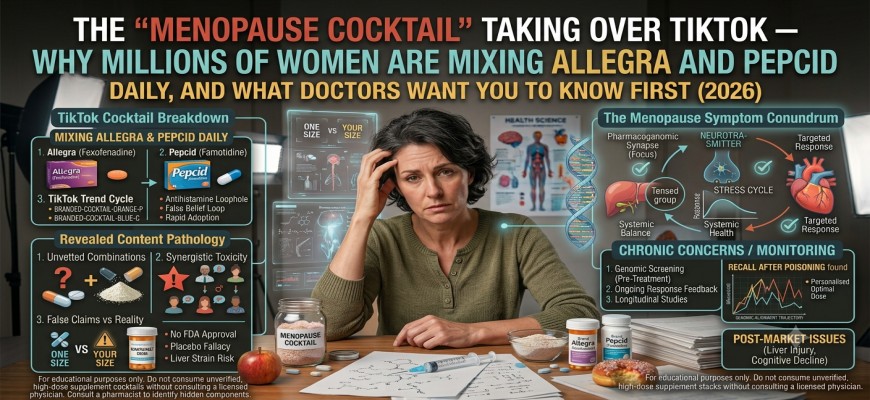 The "Menopause Cocktail" Taking Over TikTok — Why Millions of Women Are Mixing Allegra and Pepcid Daily, and What Doctors Want You to Know First (2026)
Why the Same Medicine Will Work Differently on You in 2027 (Personalized Medicine Is Coming — Here's What Patients Need to Know)
Why Your mRNA Flu Shot Is Different This Year (And Whether You Should Get It)
Scientists Just Found a Hidden Cause of High Blood Pressure That Your Doctor's Office Can't Detect — What Nighttime Hormone Surges Are Doing to Your Heart (2026)
The "Menopause Cocktail" Taking Over TikTok — Why Millions of Women Are Mixing Allegra and Pepcid Daily, and What Doctors Want You to Know First (2026)
Why the Same Medicine Will Work Differently on You in 2027 (Personalized Medicine Is Coming — Here's What Patients Need to Know)
Why Your mRNA Flu Shot Is Different This Year (And Whether You Should Get It)
Scientists Just Found a Hidden Cause of High Blood Pressure That Your Doctor's Office Can't Detect — What Nighttime Hormone Surges Are Doing to Your Heart (2026)