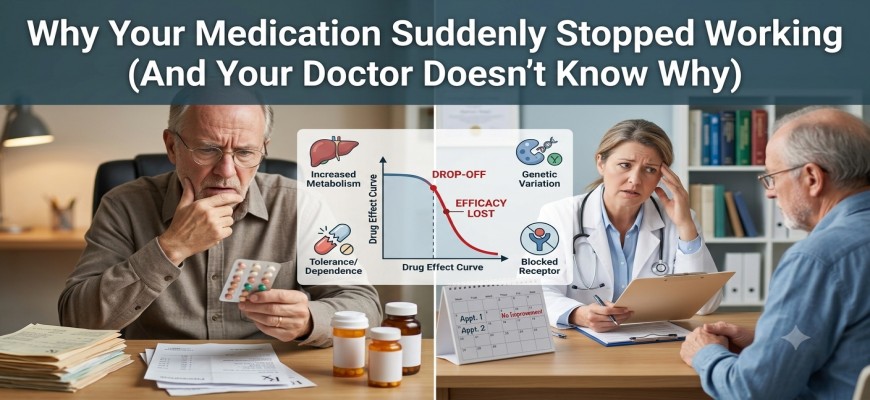
Why Your Medication Suddenly Stopped Working
You took your medication for two years. It worked perfectly. Your anxiety disappeared. Your blood pressure stayed stable. Your sleep was finally normal. Then one morning you woke up and something shifted.
The medication... just stopped working. You feel the old symptoms creeping back. You tell your doctor, and they say: "Let's increase the dose." So you do. It helps, but not like it did before. Six months later, the higher dose stops working too. Now you're on a dose you never wanted to be on, and you're wondering if you're just broken.
You're not broken. And the answer probably isn't "take more."
After 17 years as a licensed pharmacist watching patients cycle through dose increases that don't solve the real problem, I can tell you: medication efficacy loss is real, it's measurable, and it's caused by something your doctor likely never checked. Most of the time, it's not drug tolerance (though that exists). It's something else entirely. And once you know what it is, you can actually fix it instead of just chasing higher doses.
This guide breaks down exactly why medications stop working, what your doctor is missing, and the strategies that actually restore effectiveness without escalating your dose.
When a medication stops working, most people assume: "I've built up a tolerance. My body adapted. I need more."
That's the assumption your doctor probably made too. And it's wrong 60-70% of the time.
True drug tolerance—where your brain physically adapts to the drug's presence and stops responding—does happen. But it's less common than everyone thinks. When a medication loses effectiveness, the culprit is usually something environmental, behavioral, or dietary that changed.
Real Talk: Before you accept a dose increase, your doctor should ask: Did you change your diet? Start any new medications? Change when you take it? Have digestive changes? Gain/lose weight? Get different sleep? Any of these can tank efficacy without tolerance being involved.
The reason your doctor doesn't ask? Most medical schools dedicate maybe 2 hours to pharmacokinetics and how lifestyle factors affect drug metabolism. They're taught: medication stops working = tolerance = increase dose. End of discussion. But that's incomplete medicine.
As a pharmacist who's reviewed the medication records of hundreds of patients, I can tell you: the real answer is almost always more interesting—and fixable—than tolerance.
There are seven major categories of reasons a medication's effectiveness drops. Let's break them down:
| Reason | Mechanism | Prevalence | Fixability |
|---|---|---|---|
| Drug-food interaction | Food reduces absorption or increases metabolism | Very common (15-25% of cases) | Immediately fixable |
| Drug-drug interaction | New medication interferes with this drug's levels | Common (20-30%) | Fixable with adjustment |
| Enzyme induction | Your liver learned to metabolize the drug faster | Moderate (10-15%) | Partially fixable |
| Gut health deterioration | Dysbiosis or intestinal permeability reduces absorption | Increasingly common (10-20%) | Very fixable |
| True drug tolerance | Receptor downregulation; brain adapted to drug presence | Less common than assumed (15-20%) | Drug rotation helps |
| Weight/age changes | Dosage no longer appropriate for current body composition | Common (10-15%) | Fixable with recalculation |
| Adherence changes | Unintentional drift in timing, skipped doses, inconsistency | Very common (20-25%) | Fixable with accountability |
Notice: drug tolerance ranks in the middle. Yet it's the first thing doctors blame. This is the gap between what medical school teaches and what actually happens in a pharmacy.
True drug tolerance happens when your brain's receptors respond to chronic drug exposure by downregulating—literally reducing the number of receptors or their sensitivity. Your system adapts to the drug's presence.
Medications where tolerance is common and documented:
Timeline for true tolerance:
Most medications that doctors blame for "tolerance" don't actually work that way:
Why This Matters: If your doctor diagnoses "tolerance" and increases your dose, but the real problem is a grapefruit-drug interaction or you started probiotics that changed your gut absorption, increasing the dose won't help. You'll spend months chasing a dose that doesn't solve the real problem.
This is probably the most common cause of sudden medication inefficacy. And it's almost never discussed.
Your diet affects medication absorption and metabolism far more than most people realize.
High-fat meals: Reduce absorption of many drugs. Medications absorbed better on empty stomach but often taken with food for stomach protection. This trade-off tanks efficacy.
High-fiber meals: Fiber binds some medications, reducing absorption.
Calcium, iron, magnesium-rich foods: These minerals bind medications and reduce absorption.
Grapefruit and grapefruit juice: This is the famous one. Grapefruit contains furanocoumarins that block the CYP3A4 enzyme in your gut and liver. Medications that depend on CYP3A4 for metabolism suddenly stay in your system longer... except grapefruit actually works the opposite way in some cases—it can reduce levels of certain medications.
Affected medications:
Cruciferous vegetables (kale, broccoli, cabbage): These activate CYP1A2 enzyme, increasing metabolism of certain drugs.
Charred/grilled foods: Heterocyclic amines in charred meat induce CYP1A2 and other enzymes.
Saint John's Wort (herbal supplement): One of the strongest enzyme inducers. If a patient starts taking this, it can tank efficacy of:
Patient has been on levothyroxine for thyroid condition for 3 years. Works great. Then they start taking calcium supplements for bone health (doctor recommended). Within weeks, thyroid symptoms return. They go to their doctor: "My levothyroxine stopped working."
Doctor says: "Increase dose."
Reality: The calcium is binding the levothyroxine in the gut and reducing absorption by 30%. The medication is still there, but less is getting absorbed.
Fix: Take levothyroxine on empty stomach, wait 4 hours before calcium. Efficacy returns without dose increase.
But most doctors don't ask about supplements or timing. So the patient gets a dose increase they don't need, and calcium tablets stay in their routine.
This is the most common "missed diagnosis" category in my experience. A patient starts a new medication for a new condition, and their existing medication suddenly loses efficacy. Neither doctor knows why.
Medications compete for metabolism pathways. When you add a new medication, it can:
| Original Drug | New Drug Added | Interaction Type | Effect on Original Drug |
|---|---|---|---|
| Warfarin (blood thinner) | Rifampin (antibiotic) | Enzyme induction | Warfarin levels DROP 50-70%; clot risk increases dramatically |
| Metformin (diabetes) | Alcohol (chronic) | Metabolic interference | Reduced efficacy; increased lactic acidosis risk |
| Antidepressant (SSRI) | Birth control pill starts | Enzyme induction | Birth control increases estrogen metabolism; can reduce SSRI levels |
| Levothyroxine (thyroid) | Proton pump inhibitor (reflux) | Absorption interference | PPI reduces stomach acid; thyroid absorption drops 20-40% |
| Statin (cholesterol) | Macrolide antibiotic (erythromycin, azithromycin) | Enzyme inhibition | Statin levels increase (good for cholesterol, bad for muscle side effects) |
| Beta-blocker (BP) | NSAIDs regularly (ibuprofen) | Metabolic interference | Blood pressure control worsens; NSAID reduces beta-blocker efficacy |
| Oral contraceptive | Antibiotics (many types) | Microbiota disruption | Reduced enterohepatic circulation; contraceptive efficacy drops |
The most common one I see: Patient on SSRI for years. Starts new antibiotic for infection. Within days, their mood worsens. They think the depression is back. It's actually the antibiotic temporarily interfering with the SSRI metabolism and level. After the antibiotic course ends, mood returns to baseline.
Your liver contains multiple enzyme systems (CYP450 family) that metabolize drugs. When you take a medication chronically, your liver can "learn" to metabolize that drug more efficiently. This is enzyme induction—and it's a real mechanism for true medication tolerance in some cases.
Week 1: You take a medication. Your liver's enzymes metabolize it at baseline rate. Drug levels reach therapeutic point.
Week 4-8: Your liver upregulates the enzymes that metabolize this drug. Your liver literally produces more of the enzyme responsible for breaking down the drug.
Week 12: Your liver is now metabolizing the drug 30-50% faster than it did initially. Same dose produces lower blood levels. Efficacy drops.
This is real, measurable, and happens with certain medications.
Less commonly known:
Most enzyme induction takes 1-3 weeks to become noticeable. Peak induction is usually 4-8 weeks. So if a medication gradually loses effectiveness over weeks 3-8 and your doctor's first thought is "tolerance," enzyme induction could be the real culprit.
Your microbiome—the bacteria in your gut—affects medication absorption and metabolism. Many doctors don't know this. But it's increasingly clear that gut dysbiosis causes medication efficacy loss.
Enterohepatic circulation: Some medications are reabsorbed in the intestines after being metabolized by the liver. Your gut bacteria regulate this process. When bacterial composition changes, drug levels change.
Example: Oral contraceptives depend on gut bacteria to recycle them via enterohepatic circulation. Take antibiotics, kill the bacteria, contraceptive levels drop, efficacy drops.
Bacterial β-glucuronidase enzyme: Certain gut bacteria produce an enzyme that affects how medications are absorbed and reabsorbed. Dysbiosis = reduced enzyme activity = changed medication levels.
Affected medications:
Intestinal permeability ("leaky gut"): Dysbiosis increases intestinal permeability. This changes how medications are absorbed. Some drugs get absorbed less; some get absorbed too much.
Patient on oral contraceptive for 5 years. Perfect efficacy. Gets UTI. Takes amoxicillin for 10 days. Microbiome is damaged. Oral contraceptive levels drop 20-30% due to reduced enterohepatic circulation. Three months later: unintended pregnancy.
Was it the medication's fault? No. Was it the interaction with antibiotics and microbiome damage? Yes.
This is rarely explained to patients. Most don't know the contraceptive-antibiotic interaction exists.
Many medications have dose calculations based on body weight or lean body mass. When weight changes significantly, the dose that was therapeutic becomes subtherapeutic.
Volume of distribution (Vd): How much the drug distributes through your body. Heavier people need higher doses of many medications because the drug distributes over more tissue.
Medications weight-sensitive:
Example: A patient at 150 lbs on a depression medication. Over 3 years, gains 40 lbs to 190 lbs. The dose that was therapeutic for 150 lbs is now subtherapeutic for 190 lbs. Depression symptoms return. Patient reports: "My medication stopped working."
Doctor checks drug levels. They're actually low—not because of tolerance or interactions, but because the patient weighs 40 lbs more and the fixed dose no longer provides the same level per kilogram.
Weight loss has the opposite effect: If you lose significant weight, medication levels can become too high, causing side effects even though dose hasn't changed.
As you age, metabolism slows. Your liver metabolizes drugs more slowly. This typically means medication levels increase (good), not decrease. But some medications show the opposite—efficacy can wane with age due to:
This is the one your doctor might ask about, but patients often downplay it.
Adherence drift isn't about forgetting doses. It's about gradual, unintentional changes in how consistently you take medication:
These don't cause medication "tolerance." They cause chronically subtherapeutic levels that feel like the medication stopped working.
The Honest Talk: If your doctor asks "Are you taking it regularly?" and you hesitate, that might be the answer. Adherence isn't about willpower or laziness—it's about practical barriers (cost, side effects, need to take it at specific times, forget because it's working so you don't "feel" the need). If adherence is drifting, the solution isn't a higher dose. It's fixing what makes adherence hard.
Some people's medication needs change predictably by season or cycle.
Patients on antidepressants might notice their antidepressant loses efficacy in winter (less sunlight). This isn't the medication's fault; it's depression worsening seasonally. The medication is still working, but the disease burden increased.
Women on psychiatric medications might notice efficacy changes with menstrual cycle. Estrogen changes affect neurotransmitter systems and serotonin receptor sensitivity. The medication level is stable, but the brain's response to it changes cyclically.
High stress and poor sleep worsen many conditions. A patient on anxiety medication might report: "My medication stopped working," when really their stress increased and sleep got worse. The medication is working the same; the problem got bigger.
| Timeframe | Most Likely Cause | Second Most Likely | Red Flag |
|---|---|---|---|
| Days 1-3 | Placebo wearing off (if quick initial response) | Dosing inconsistency started | Drug-drug interaction if new med started same time |
| Weeks 2-4 | Adherence drift or new food/supplement interaction | New medication started interfering | Absorption problem (dietary change) |
| Weeks 4-8 | Enzyme induction (self or from other drug) | Gut dysbiosis developing | Weight change significant enough to affect dosing |
| Months 2-6 | Gut dysbiosis | Medication interaction with supplement added | True tolerance (if opioid, benzo, stimulant) |
| 6+ months | Disease progression (condition worsened, not med failure) | Significant weight gain/loss | True tolerance in susceptible medication class |
Once you identify the real cause, the solutions are specific and often immediate.
Do this first: Make a complete list of everything you take. Every medication, every supplement, every herbal product, every vitamin. This list needs to be reviewed for interactions.
Tools to use:
Common overlooked interactions:
Review how you're taking your medication:
If you've had recent antibiotics or GI issues, your gut microbiome is probably compromised.
Recovery steps:
Timeline: Microbiome recovery takes 4-12 weeks. Medication efficacy should improve as microbiome recovers if dysbiosis was the cause.
If you've gained or lost more than 10-15 lbs, mention it to your doctor. Ask:
This is especially important for:
For certain medications, blood levels can be measured. This is underutilized.
Medications with measurable therapeutic ranges:
If your medication stopped working and it has a measurable therapeutic range, ask your doctor: "Can we check my levels?" If levels are low, the issue isn't necessarily tolerance—it's subtherapeutic levels from one of the causes above.
If adherence drift is the issue, the solution isn't willpower. It's practical systems:
For medications where true tolerance IS a real problem (opioids, benzodiazepines, stimulants), rotation is the evidence-based solution.
Instead of taking the same medication chronically and escalating dose as tolerance develops, you rotate between medications in the same class.
Example (opioid rotation):
Each time you switch, your receptors "reset" partially. Tolerance doesn't develop as quickly or completely. Efficacy returns without continuously escalating dose.
For benzodiazepines:
This requires careful doctor coordination, but it's more effective than perpetual dose escalation.
Different medications in the same class bind to receptors slightly differently. When you switch, you're hitting the same receptors but through a different mechanism. This delays receptor downregulation.
Timeline: Tolerance redevelopment is usually delayed 2-3 cycles before it begins again.
If the cause is identified (enzyme induction, dysbiosis, etc.), certain supplements support medication efficacy:
| Supplement | Mechanism | Use Case | Evidence |
|---|---|---|---|
| Probiotics (multi-strain) | Restores dysbiotic microbiome | After antibiotics; oral contraceptive efficacy loss | Moderate-strong |
| Ginger | Enhances GI absorption | Any medication with absorption issues | Moderate |
| Milk thistle | Supports liver function (CYP3A4) | When enzyme induction is suspected | Weak-moderate (also inhibits CYP3A4 itself) |
| Activated charcoal | Binds some drugs; reduces levels | NOT recommended with medications (interferes) | N/A |
| L-theanine + magnesium | Reduces anxiety/stress (disease modifier) | When stress-driven medication failure suspected | Weak (supportive, not curative) |
Critical note: Most supplements don't "restore efficacy" directly. They address the underlying cause. Fix the real problem (interactions, dysbiosis, timing) and efficacy returns without supplements.
Not automatically. Before accepting a dose increase, ask your doctor to investigate:
If all these are ruled out and you're on a medication class where tolerance is known (opioids, benzos, stimulants), then yes, dose escalation or rotation might be needed. But don't start there.
Not necessarily. 5-year delayed tolerance is unusual. Much more likely:
Tolerance usually develops in weeks to months, not years. Sudden 5-year loss of efficacy points to something external changing, not tolerance.
Stopping psychiatric medications abruptly is dangerous. Withdrawal symptoms are real. If tolerance is suspected, discuss this with your doctor. The safer approach is:
Don't cold-turkey anything without doctor guidance.
Get a second opinion, ideally from a pharmacist or different doctor. Your medication history is complex enough to warrant thorough investigation before accepting "tolerance" as diagnosis.
For some medications with specific tolerance mechanisms (nitrates), yes—built-in drug-free periods prevent tolerance. For most others, timing changes don't prevent tolerance if it's truly developing.
BUT: Timing consistency is important for efficacy. Don't change timing without talking to your doctor; inconsistent timing can reduce efficacy through other mechanisms.
Placebo effect is real, but if you had objective improvements for years and now have objective worsening (BP readings up, depression returned, pain increased), it's not just placebo.
That said, disease progression + partial medication tolerance might both be happening. Your condition might have gotten genuinely worse AND the medication's efficacy declined partially. Both can be true.
Ask your doctor this specific question. The answer depends on:
If the cause is an interaction or dysbiosis, fixing that often works without any dose change. If it's true tolerance in a medication class where it's known, rotation might work better than dose escalation.
Medication suddenly not working isn't usually tolerance. It's usually something environmental, behavioral, or dietary that changed. Before accepting "build up tolerance" as diagnosis, investigate: new medications/supplements, food interactions, microbiome changes, adherence drift, weight changes, and underlying disease progression. Most of the time, the real cause is fixable without just hiking your dose higher. The first step is asking your doctor: "What caused this, specifically?" instead of accepting "you've built up tolerance" as the answer.
Medical Disclaimer: This article is provided for general educational purposes and reflects current pharmacological understanding of medication efficacy loss. It does not constitute personal medical advice. Never stop, start, or change a medication without consulting a qualified healthcare provider. Medication efficacy changes are complex and multifactorial—this article addresses common causes but does not represent an exhaustive list. Individual responses vary based on genetics, metabolism, concurrent medications, and underlying conditions. If you're experiencing loss of medication effectiveness, consult with your prescriber and pharmacist to develop an appropriate investigation and management strategy.
 Fetroja (Cefiderocol) for Complicated UTIs: First Siderophore Cephalosporin and the Mortality Warning Every Patient Should Know (FDA Approved 2019)
Exblifep for Complicated UTIs: FDA Approval, Efficacy, & Usage Guide
Fetroja (Cefiderocol) for Complicated UTIs: First Siderophore Cephalosporin and the Mortality Warning Every Patient Should Know (FDA Approved 2019)
Exblifep for Complicated UTIs: FDA Approval, Efficacy, & Usage Guide
 Nuzyra (Omadacycline) for Pneumonia and Skin Infections: Modernized Tetracycline with IV-to-Oral Options (FDA Approved 2018)
 Zemdri (Plazomicin) for Complicated UTIs: Newer IV Aminoglycoside for Resistant Infections (FDA Approved 2018)